
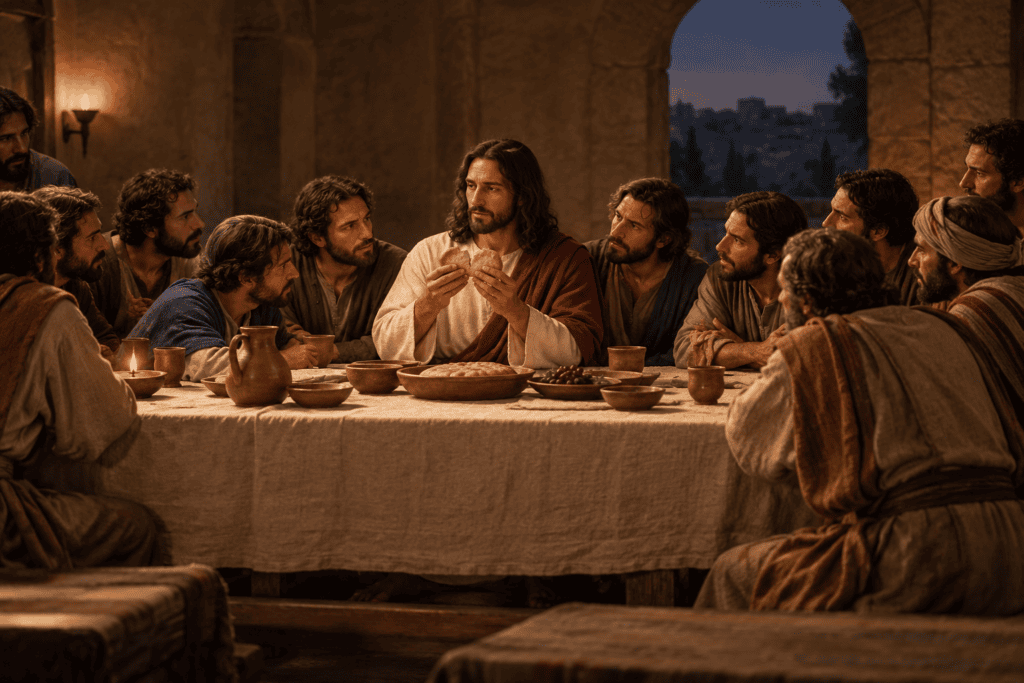
The Lord’s Supper Around the Table
The original Lord’s Supper took place around a table, where Jesus and his disciples shared a Passover meal marked by fellowship and celebration. The table offers a picture of Communion rooted in family, community, and the original setting of the meal.
- The Lord’s Supper began in the setting of a shared Passover meal.
- The table evokes familiar experiences of family, friendship, conversation, and celebration.
- Alexander Campbell advocated the simple table as a meaningful symbol for the church’s practice of the Lord’s Supper.
 By William Baker
The Lord’s Supper at the Table
The original Supper of the Lord took place at a table (Luke 22:21, 30; John 13:28; 1 Corinthians 10:21). Friends gathered together in a large second-story banquet room to share a meal. But they did more than eat; they talked and sang and celebrated.
This was a Passover meal, a festival meal reliving God’s rescue of the Jewish people from slavery and infant genocide. They ate greens and bitter herbs dipped in a spicy sauce, along with flat, unleavened bread. They drank wine, sharing sips out of at least three passed cups. They ate meat, one of the few occasions in all the year—a roasted lamb.
What the Table Represents
All this happened around a table. When we visualize a table, what picture comes into focus? What memories? For most of us, whether young or old, imprinted on our mind is our kitchen table. On the table are favorite, everyday family meals: the tuna fish casserole, the ham and rice, the spaghetti. Around the table is our immediate family, all in their familiar spots. Across the table, stories of the day are told, questions are asked, love and joy are shared.
The other table that might come to mind is a dining room table. Here we think of large gatherings of extended family—grandmas, grandpas, aunts, uncles, and cousins. They have come for a birthday or Christmas or Easter. Perhaps we think of friends or guests who have come for an evening together. Plates are being passed, talking is loud, and excitement is in the air.
Alexander Campbell (who thought a great deal about how the church should do things back in the early 1800s of American frontier life) advocated that the truest symbol for the church’s practice of the Lord’s Supper is a table. No altar, not even a pulpit—just a simple table in the middle of the room with the people gathered around it for celebration. This, he believed, would help the church easily enter into the original setting and mood around the original table—with Jesus and his disciples.
Can we visualize ourselves gathered around a table together this morning?
William R. Baker is professor of New Testament at Hope International University, Fullerton, California, and editor of the Stone-Campbell Journal.