Parenting Predictable, Not Perfect
Perfect parenting isn't the goal. Discover why family stability, involved fathers, and supportive relationships matter more than flawless parenting—and how local churches can encourage parents and help children thrive.

Good Enough Parenting: Why Stability Matters More Than Perfection
Parents don’t have to be perfect to provide the love and stability children need. Drawing on a Beyond the Standard interview with Jack Holland and Becky Ahlberg, Mark A. Taylor explores the importance of involved fathers, predictable home environments, and supportive relationships. He also challenges local churches to help families and children facing instability.
- Children benefit from stable relationships and predictable daily routines, even when parents aren’t perfect.
- Fathers and positive male role models play an important role in children’s development.
- Local churches can support struggling families through encouragement, mentoring, and consistent relationships.
Which of these videos reminds you of an awkward moment at your house?
Did you ever lose a hamster?
Did you ever make yourself sick making your kids happy?
Did parenting ever take you out of your comfort zone?
Well, take heart. “You don’t have to be perfect to be a perfect parent.”
It’s a message as encouraging for biological parents as it is for those who would adopt. And it’s exactly what Jack Holland told us in our August 20 episode of Beyond the Standard. In fact, he says professional literature on successful families uses the phrase “good enough fathering.”
We’re pretty sure the kids depicted in these videos won’t grow up to be juvenile delinquents. We don’t expect to see them in jail or gangs. We don’t predict they’ll become addicts or unwed fathers or high school dropouts. Certainly not because their parents aren’t cool.
Why Family Stability Matters More Than Perfect Parenting
As it turns out, being cool isn’t required. And neither are most of the methods and approaches tried by 50 years of social strategies and spending. Better methods are not the solution to poverty, delinquency, and crime, Becky Ahlberg said in this August interview. “It’s relationships. It’s people connected to each other in stable environments. They don’t have to be perfect; they just have to be stable.”
The issue, as Ahlberg explained it, is whether a child can predict what his daily life will be like. When do we eat? When’s bedtime? Where will I sleep tonight—and tomorrow? When are my parents coming home? Kids in trouble today “don’t have a stable environment speaking back to them a context for the culture in which they live, and a context for making better choices.”
That August interview started with a discussion of the crucial role fathers play in the rearing of their children. “Almost every pathology you can name in our culture today, especially those that include young people under 18, have at least a 70 percent rate of a single-mother home,” Ahlberg said.
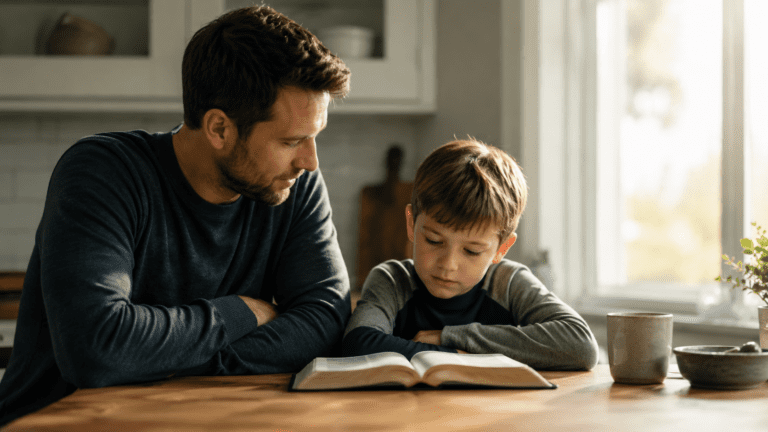
This doesn’t mean all kids in single-mother homes are doomed to dysfunction. But God created male and female for a reason. Holland said, “Kids need a strong male role model in their lives.” When Dad is absent (and far more single-parent households are led by moms than by dads), kids need someone else to fill that gap.
How Churches Can Support Parents and Children
All of which leads to questions for a local church:
What are your strategies for encouraging dads to stay involved in the lives of their kids?
How do your ministries encourage stability at home and challenge parents to consistent Christian living?
 How are you helping single-mother families to find male role models for their children?
What are you doing to mentor the children in your city who are living in chaos?
Perhaps, more than anything else, churches can encourage parents to keep at it, to keep praying, to keep finding ways to demonstrate an unswerving Christian example.
In the hubbub of everyday life, Christian parents and role models, learning from and leaning on the grace of Jesus, know “you don’t have to be perfect to be the perfect parent.”
Even when a hamster’s gone missing.
You can listen to this whole interview with Ahlberg and Holland.
Tune in September 17, 11 a.m. Eastern, for the next episode of Beyond the Standard, as we talk with Susan Lawrence and Melissa Sandel about how to recruit, keep, and show appreciation for volunteers.

Author: Mark A. Taylor
Mark A. Taylor, who served as Christian Standard editor from 2003 to 2017, retired in June 2017 after almost 41 years with Standard Publishing (Christian Standard Media).
Sponsored

For 160 years Christian Standard has served the churches of the Restoration Movement. Your gift keeps articles like this one free for every church leader.
Sponsored

Keep reading
More in Family & Relationships


From the archive
Christian Standard has covered this since 1866.