By BJ Krug
It was a time of war. A time of upheaval. A time of economic uncertainty, of political uncertainty. In 1816 the Napoleonic Wars had just ended, and the nations of Europe had crashed over and against each other until their borders were no longer recognizable, even to the people living in them. In many places, occupation forces were still present or were only recently withdrawn.
A young priest in Austria named Joseph Mohr wrote a poem channeling some of that uncertainty by recasting it in familiar terms of love, care, and affection—a challenge, you might say, to the people of Austria to care for each other, just as Mary cared for the Christ child, a human baby, on the night he was born.
Two years later, Father Mohr was serving as an assistant priest at the church in the little town of Oberndorf, Austria. Oberndorf had just been severed from much of its heritage and business interests by the divisions wrought by the Napoleonic Wars, and literally found itself in a different country than before.
On Christmas Eve 1818, Father Mohr went to the church organist and village schoolmaster to ask him to write guitar music for the poem he had written two years earlier. Franz Xaver Gruber returned with a lullaby for baby Jesus.
At mass that evening, Father Mohr played guitar and sang tenor, while Gruber sang bass. The choir joined in on the last two lines of each verse.
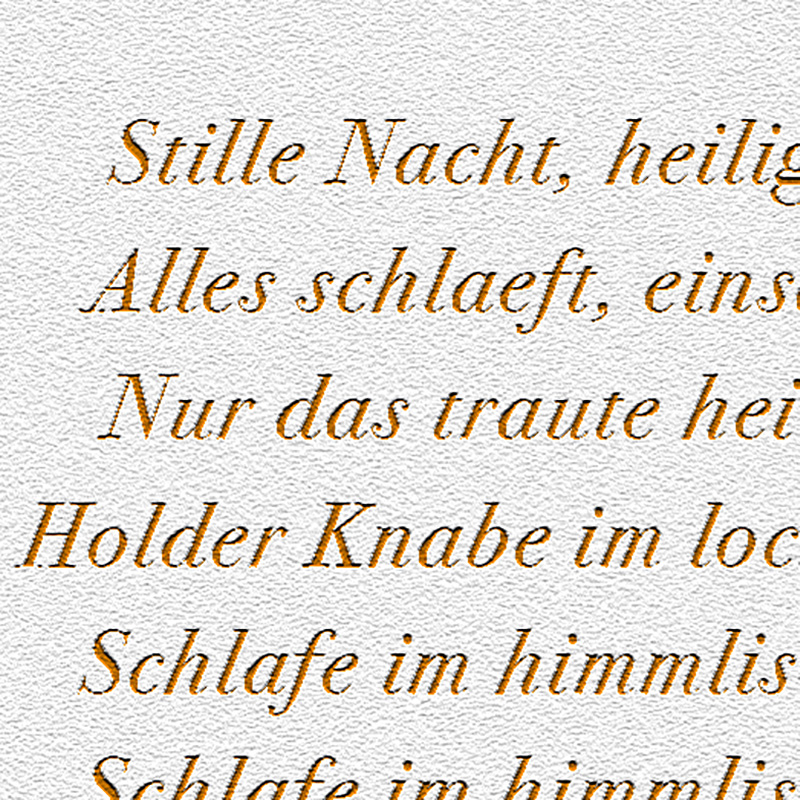
Stille Nacht, heilige Nacht,
Alles schlaeft, einsam wacht
Nur das traute heilige Paar
Holder Knabe im lockigen Haar
Schlafe im himmlischer Ruh!
Schlafe im himmlischer Ruh!
____
Silent night, holy night,
All are sleeping, only the
holy pair are awake
with the lovely boy with curly hair.
Sleep in heavenly peace,
Sleep in heavenly peace.
The song quickly became beloved throughout the German-speaking world. Within a few years it was performed in the courts of kings and emperors, and by 1839 it spread to America and became a beloved part of many Christians’ Christmas worship.
The Original Message
Here in America though, we sing only half of the verses, and even those don’t always catch the meaning of Mohr’s original poem. Take verse 2 for instance—our second verse usually includes “the shepherds quaking at the sight” of the angels, whereas Mohr took pains to point out that the shepherds—plain, ordinary people just like his congregation—were the first to be told of Jesus’ arrival.
Our third verse very seriously calls Jesus “God’s own son, love’s pure light,” omitting Mohr’s statement that the baby Jesus laughed, and that this laughter—the very joy of God—is God’s love and our mercy and salvation.
And then there are the verses that never made it into our hymnals, verses that proclaim all power of fatherly love was poured forth in Christ, and that Jesus lovingly embraced the peoples of the world like a brother. Or how God, from the beginning of the world, planned to free us from wrath—a promised salvation.
This is the message of “Silent Night,” the freedom from wrath, from war, from division—so long as we can place ourselves within the joy of a baby boy with curly hair.
Schlaf im himmlischer ruh.
Schlaf im himmlischer ruh.
A Message of Hope and Peace
Not quite 100 years later, in 1914, it was a time of war. A time of upheaval. A time of economic uncertainty, of political uncertainty. In 1914 the First World War broke out, and the nations of Europe crashed over and against each other until their borders were no longer recognizable, even to the people living in them.
World War I settled into trench warfare on the western front by mid-September of 1914, only a month or so after the beginning of the war. German soldiers lined up in their trenches facing French and British troops in their own trenches a short distance away, shooting at each other, leading pointless charges against each other, engaging in chemical warfare and seemingly constant artillery barrages.
It’s frankly hard for me to imagine any time or place that sounds more like Hell than the western front of World War I.
And yet, in the midst of that hatred, violence, and terror, Christmas still came. According to many soldiers on both sides of the war, on Christmas Eve 1914, the shooting stopped along many sections of the western front. German soldiers began to decorate Christmas trees within their trenches, and the candles lighting their trees shone across the battlefield, reminding soldiers on all sides of love. Of home. Of brotherhood.
A lone German voice broke out, singing “Stille Nacht, heilige Nacht,” and soldiers of both sides were reminded that it was. A silent night. A holy night. A night for brothers, even if they had not realized they were brothers before.
The English soldiers joined in the song in English, and more Germans joined, until a battlefield which had so recently rung with the sound of gunfire filled instead with that hundred-year-old lullaby to the baby Jesus. “Schlaf im Himmlischer Ruh.”
Sleep in heavenly peace.
Sleep in heavenly peace.
The Message for Us
And here we are. Roughly another hundred years later—202 years since Joseph Mohr wrote the lyrics to “Silent Night,” 200 years since Franz Gruber wrote the music and they first sang it. It’s been 104 years since the 1914 Christmas Truce. And once again it seems like a time of war. A time of upheaval. A time of economic uncertainty, of political uncertainty.
There are wars in the Middle East and threats of war elsewhere. Americans are full of anger and hate toward each other; we blame each other and we have a hard time finding joy, or love, or kindness.
And yet, things aren’t as bad as they were in Europe 100 or even 200 years ago. So I ask this of you: When you’re tempted to draw battle lines, sing “Silent Night” and reach across an aisle, or a trench, or your neighbor’s fence.
When your world’s falling down around you and you’re not sure if you can sing, think of Mary and Joseph lying awake that first night to hold a little miracle with curly hair.
And when you’re not sure what’s real or what’s true, and you can’t figure out what to do, remember that God makes songs out of the lives of plain people doing plain work for the kingdom of God. Give him the space to breathe his Spirit into your work.
BJ Krug is a storyteller and graduate student at Milligan College. He attends Hopwood Christian Church in Tennessee.

Author: Christian Standard
Contact us at **@********************ia.com