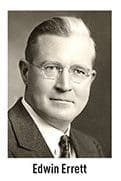
By Edwin R. Errett
Over the years, Christian Standard appears to have published remarkably little about demons and demonology. In the first 100 years of the magazine’s publication (1866-1966), there are only two entries in the Christian Standard Index for demons, demonology, or the occult. Moreover, the initial entry is a 1936 editorial written by Edwin R. Errett (1891-1944), the great nephew of Christian Standard’s founding editor, Isaac Errett (1820-1888), and himself the editor of Christian Standard from 1929 until his untimely death in 1944. Errett’s brief editorial related to demons (printed below) was prompted by the Sunday school curriculum’s mention of demons as an effort to explain them. The only other comment about demons in the Christian Standard for those years was a response to Errett’s editorial. So, below is Edwin R. Errett’s effort to define demons and demonology from the February 15, 1936, edition of Christian Standard.
DEMONOLOGY
The Bible-school lessons [which refer to demons] bring us to a rather difficult problem, the question, What were the demons to which the gospel writers and Jesus Himself refer? The difficulty arises from the fact that we seem to have no such phenomenon today.
Some teachers think they escape the problem by explaining that the superstition of that day attributed diseases and especially mental derangements to devilish spirits and that Jesus simply accepted the speech and attitudes of the times. But this only creates a greater problem. If this belief of the time was not true, how are we to account for Jesus’ acceptance of it? Was he ignorant on the matter? If He was not ignorant, what are we to say of the moral quality of His action in encouraging this false belief? For He not only allowed them to continue in the belief; He Himself encouraged it. In every other case, Jesus hastened to meet and destroy error and to release people from false beliefs. Of course, we who believe Jesus to have been divine can not accept the thought that He knew no better than did the people on this matter.
What, then, is the explanation?
It is clear (1) that Jesus treats these demons as personalities, (2) that they are of evil spirit and work and (3) that they are distinct from sickness itself (since both sick and demon-possessed are mentioned).
The most sensible way to come at the matter is that by which Alexander Campbell dealt with it. He looked for the meaning of the Greek word translated “demon”—its meaning at the time it was here used. He found that it meant the spirit of a man, that which could live on apart from his body. Therefore, he concluded that these beings are spirits of evil dead persons, who wander about under the evil direction of Satan and seek habitation. Where living persons have weakened themselves these beings obtain entrance and exert havoc.
Many students prefer to leave the matter merely with the statement that they are some sort of spiritual beings under Satanic influence.
Of course, many Christians shy away from this explanation because it seems to them to lend support to spiritualism. Not so, however. The existence of such beings is no justification for converse with them and the Bible expressly forbids having converse with “familiar spirits.” No good spirit would violate that injunction.
Some ask why we have not the phenomenon now. It is not certain that we do not. There are some cases of apparently dual personalities. Certainly it is not so common. And that may be because of the work of Jesus at that time.
We know very little of the spirit realm. Samuel, Moses and Elijah certainly appeared again to living men. The Scriptures speak clearly of Satan and of his angels. Why not accept this along with all the other imperfectly understood matters and be faithful to our duty?
Edwin R. Errett (1891-1944) served as editor of Christian Standard from 1929-1944.

Author: Christian Standard
Contact us at **@********************ia.com