Alien Life and Christianity: What C.S. Lewis Can Teach Us
The possibility of alien life does not need to frighten Christians. C.S. Lewis helps believers think with imagination, humility, biblical faithfulness, and confidence that all creation belongs to Christ.
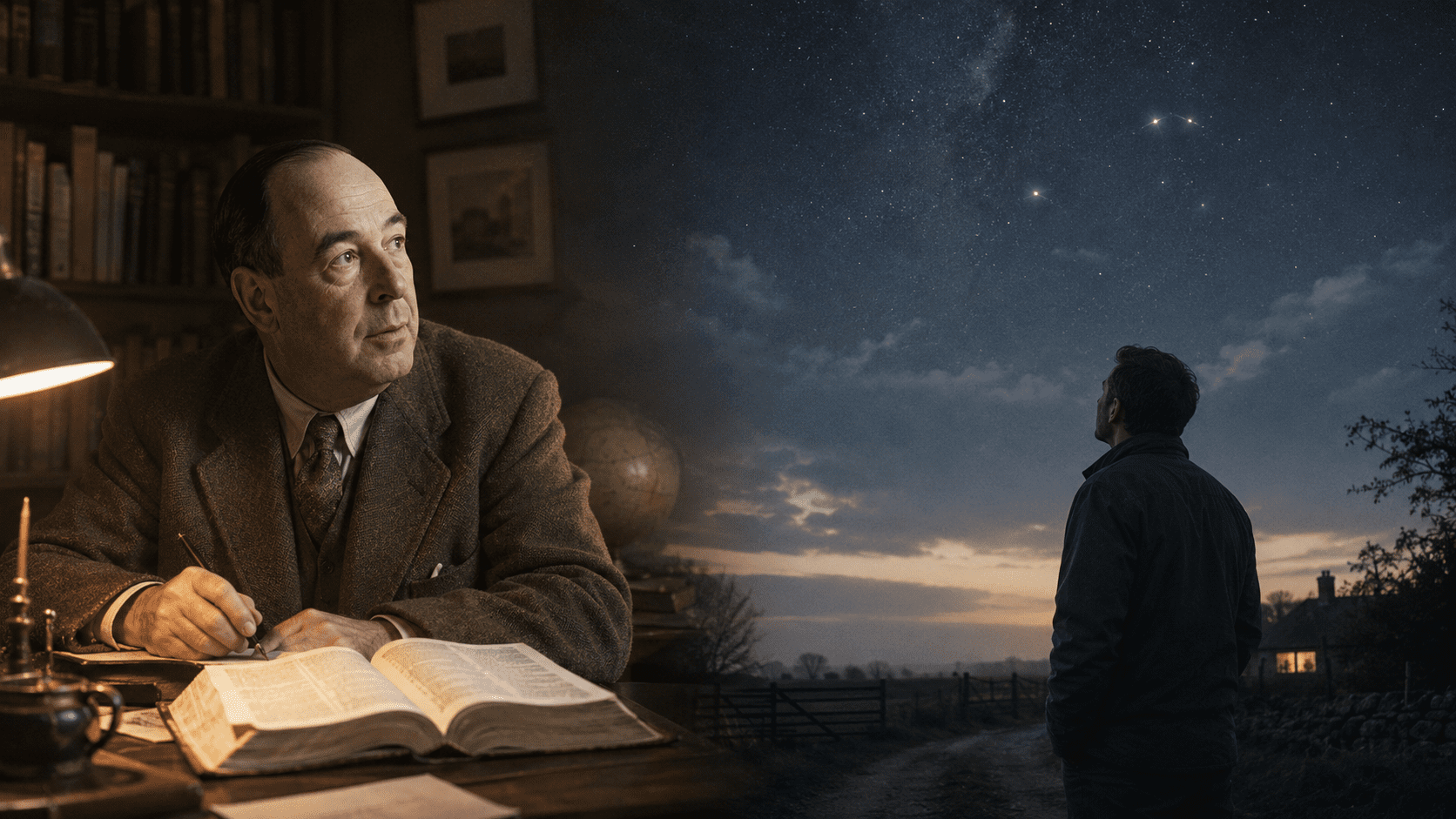
Alien Life and Christianity: What C.S. Lewis Can Teach Us
The possibility of alien life does not need to frighten Christians or weaken confidence in the gospel. C.S. Lewis helps believers approach the question with imagination, humility, biblical faithfulness, and a steady confidence that all creation belongs to Christ.
- The Bible does not require Christians to fear scientific discovery.
- C.S. Lewis treated alien life as a question for careful theological imagination, not panic.
- Pastors and church leaders can help believers think clearly before cultural anxiety takes over.
Every generation has its own version of the question, “What would this do to Christianity?” For some, it was the telescope. For others, it was geology, biology, psychology, or artificial intelligence. Today, one of the questions returning with fresh energy is old enough to have occupied philosophers, theologians, and science fiction writers for centuries: What if there is life beyond Earth?
The question is not merely scientific. It is spiritual, pastoral, and apologetic. Some believers wonder whether the discovery of alien life would shake the foundations of Christian faith. Some skeptics assume it would. Some Christians respond with fear, as if the gospel is fragile enough to be overturned by a telescope, a probe, or a future announcement from a space agency.
But Christians do not need to be afraid of the size of God’s creation. The heavens have always been larger than our comprehension. Scripture never presents that vastness as a threat to faith. It presents it as an invitation to worship and awe.
“The heavens declare the glory of God,” Psalm 19 says. They don’t declare his absence. They don’t declare that human beings are meaningless. They declare that creation doesn’t need to be fully explained or understood. It simply points to the glory of its Maker.
This is where C.S. Lewis remains a helpful guide. Lewis didn’t give Christians a complete theology of extraterrestrial life, nor should we pretend he did. But he did model something badly needed in our age of instant panic and shallow certainty. He showed how to think about strange questions with imagination, humility, and confidence in Christ.
Why the Question of Alien Life Has Returned
The modern search for life beyond Earth has moved far beyond pulp fiction. Scientists study Mars, ocean worlds such as Europa and Titan, and planets orbiting distant stars. NASA describes astrobiology as the search for unmistakable signs of life beyond Earth. The confirmed discovery of thousands of exoplanets has also widened public imagination about what may exist beyond our solar system.
Christians shouldn’t confuse scientific curiosity with unbelief or an argument against God. The desire to understand creation can be an act of wonder. Many great scientists have acknowledged a greater understanding of God through scientific discovery. Kepler, who mapped the planet’s elliptical orbits, called it “thinking God’s thoughts after him”. Newton wrote more about theology than physics and saw the universe’s order as proof of a divine lawgiver. Maxwell, who unified electricity and magnetism, was a devout Christian who believed his equations revealed God’s mathematical beauty. Francis Collins, who led the Human Genome Project, said decoding DNA felt like reading the language of God. The danger comes when science is turned into a rival religion, or when Christians assume every scientific question must be answered defensively before it has even been asked clearly.
There is an important distinction between asking, “Could God have created life elsewhere?” and claiming, “Life elsewhere would disprove Christianity.” The first question is legitimate. The second conclusion is much too large for the evidence.
Christian faith begins with God, not with human centrality. “In the beginning God created the heavens and the earth” is a larger sentence than we sometimes allow it to be. The Bible tells us what we need to know for life, salvation, worship, obedience, and mission. It does not tell us every detail about every creature God may or may not have made.
What C.S. Lewis Saw Clearly
C.S. Lewis addressed the subject most directly in an essay later known as “Religion and Rocketry.” He was responding to the concern that space exploration or the discovery of extraterrestrial life might undermine Christian belief. Lewis did not treat the issue as foolish. He took it seriously. But he also refused to grant the assumption that Christianity would collapse if life were found beyond Earth.
That position is worth a deeper look. Lewis didn’t rush to indulge speculation as truth. He didn’t build some elaborate certainty where God had not spoken. He simply asked better questions.
Would extraterrestrial life be merely microbial? Would it be rational and moral? Would it be fallen or unfallen? Would it need redemption? Would God have dealt with such creatures in ways unknown to us? Would the incarnation of Christ on Earth have implications beyond Earth? Lewis understood that the theological meaning of alien life would depend on what kind of life was discovered.
That is a crucial pastoral point. “Alien life” can mean many things. Bacteria beneath Martian soil would raise a different set of questions than intelligent moral beings capable of worship, rebellion, language, and love. Christians shouldn’t allow vague headlines to do our thinking or believing for us.
Lewis’s fiction also gave imaginative form to these questions. In his Space Trilogy, he imagined worlds where spiritual realities were not less real because they were cosmic. He didn’t portray the universe as empty machinery. His pen and imagination explored it as morally alive under God’s authority. Whether one agrees with every imaginative choice Lewis made is beside the point. He reminds us that Christian imagination should be larger, not smaller, than secular imagination.
The Bible Gives Us Confidence Without Answering Every Curiosity
Some Christians grow anxious because the Bible doesn’t directly answer every question about extraterrestrial life. But that absence shouldn’t trouble us. The Bible also doesn’t explain black holes, DNA, nuclear fusion, or the chemistry of distant planets. Scripture isn’t in some way deficient because it doesn’t answer questions it was not given to answer.
The Bible’s purpose isn’t to satisfy every curiosity. Its purpose is to reveal God, expose sin, proclaim redemption, form a people, and bear witness to Jesus Christ. It tells us who made the universe, why human beings matter, what has gone wrong with us, what God has done in Christ, and where history is headed.
Those truths aren’t diminished by the possibility that God’s creative work may be more expansive than we already know. If anything, the vastness of creation should enlarge our worship and awe.
Genesis 1 teaches that God is Creator. John 1 teaches that all things were made through the Word. Colossians 1 teaches that all things were created through Christ and for Christ, whether visible or invisible. Hebrews 1 teaches that God made the universe through the Son. Revelation 4 pictures the worship of God because he created all things and by his will they existed and were created.
That isn’t a small doctrine of creation. It’s not a tribal doctrine, as if God were merely the deity of one planet. The God of Scripture is Lord of heaven and earth and is not threatened by the size of his own handiwork.
What If Alien Life Were Discovered?
If some form of life beyond Earth were discovered, Christians should begin with calm as any form of alarm or defensiveness is rarely a fruit of biblical wisdom. The first response should be careful attention to what has actually been found.
There is a long distance between a possible chemical signature, a microbial organism, an animal-like creature, and a rational moral being. Each would raise different questions. The church should resist the pressure to comment beyond the facts. In a world that rewards instant reaction, Christian leaders should model patient discernment in response.
If microbial life were discovered, it would not constitute a challenge of the gospel. It would show that God’s creation includes life in places we did not previously know. That would be scientifically significant, but it would not overturn the doctrine of creation, the fall, the incarnation, the cross, or the resurrection.
If intelligent life were discovered, the questions would become more complex. But complexity is not contradiction. It wouldn’t change the truth about moral agency, sin, revelation, and redemption. We would need to avoid two opposite errors: trying to get the Bible to say more than it says, or assuming that Biblical silence on a specific discovery means it would somehow discredit spiritual truth.
Lewis was especially useful here because he saw that the question is not, “Can Christianity survive aliens?” The better question is, “What would God’s truth require us to believe if such creatures existed?” That’s a different way of thinking. It begins with the lordship of Christ and works outward with humility.
Christ Is Lord of All Creation
The center of Christian confidence isn’t Earth. The center is Christ.
That statement matters. Christians believe God became man in Jesus of Nazareth. We believe the Son took on human flesh, lived without sin, died for our sins, rose bodily from the dead, ascended to the Father, and will come again. The incarnation is particular. It happened in a place, at a time, among a people, in a real human body.
But particular does not mean small. God often works through the particular to bless the many. He called Abraham, one man, and promised blessing for all nations. He chose Israel, one people, to bear witness to the world. Christ was born in Bethlehem, crucified outside Jerusalem, and raised on the third day in history. The gospel is local in its occurrence and cosmic in its significance.
Colossians 1 does not present Jesus as merely a local savior for a local religious community. It presents him as the one in whom all things hold together. The cross is not a footnote in the universe. It is the decisive act of God’s reconciling work.
That does not mean we know every possible implication of Christ’s work for every possible creature. It does mean Christians have no reason to imagine any part of creation as independent from him.
Humility Is Not Weakness
It would be foolish to think a believer’s confidence requires having an immediate answer to every possible discovery scenario. Christian confidence is not the same as pretending we know and understand everything. We can say, “We do not know,” without saying, “We do not believe.”
Humility is especially important when dealing with speculative questions. Christians should be careful not to build dogmatic systems around imagined beings. We should not make alien life a test of orthodoxy when God has not revealed such life to exist. Nor should we use the possibility of alien life to smuggle in strange doctrines or spiritual distractions.
The church has enough revealed truth to obey without turning speculation into obsession.
At the same time, humility should not be confused with embarrassment. Christians need not speak as though the faith is always one discovery away from collapse. The resurrection of Jesus Christ is not made less true by a larger universe. The authority of Scripture is not reduced because there are questions Scripture does not directly address. The gospel is not fragile.
Pastors Should Prepare People to Think, Not Panic
This issue matters for church leaders because many believers encounter these questions through headlines, documentaries, podcasts, social media clips, and conversations with skeptical friends. Often the question beneath the question is not really about aliens. It is about whether Christianity can withstand possible discoveries.
Pastors, elders, youth ministers, and Christian educators can help by giving people faithful guardrails before they are needed.
Teach the doctrine of creation as larger than culture-war talking points. Teach Christ’s lordship over all things. Teach the difference between Scripture’s authority and our curiosity. Teach believers to distinguish evidence from speculation. Teach them that mystery is not the enemy of faith.
Young Christians especially need to see that biblical faith is not afraid of hard questions. If they are taught only to fear inquiry, they may assume faith is weakness. But if they are taught to seek truth under the lordship of Christ, they can grow in both conviction and wonder.
Churches should also avoid sensationalism. Not every headline deserves a sermon. Not every viral claim deserves a church statement. But when people are asking genuine questions, shepherds should be ready to speak with clarity, patience, and confidence.
Wonder Is a Christian Response
The question of alien life can easily become an argument. But it can also become an invitation to wonder.
Christians believe the universe is not an accident. It is God’s creation. The stars are not divine, but they do declare divine glory. The vastness of space should not make us feel small or abandoned. It should remind us that the God who knows the stars by name also knows his people by name.
Psalm 8 holds together the two truths we often separate. The psalmist looks at the heavens, the moon, and the stars, and asks, “What is mankind that you are mindful of them?” That question does not lead him to despair. It leads him to wonder, awe, and worship. Human beings are small, but priceless to God. The universe is vast, but completely under God’s authority.
That is a needed truth in this conversation. The possibility of life elsewhere does not erase the dignity God has given humanity. Nor does human dignity require that Earth be the only place where God has created life. Our worth comes from God’s heart, not from our ability to prove we are the only creatures in the cosmos.
The Gospel Is Not Threatened by the Size of Creation
C.S. Lewis helps us here because he refused to let fear set the terms. He could imagine other worlds without surrendering this one. He could ask speculative questions without loosening his grip on the gospel. He could acknowledge mystery without treating mystery as unbelief.
That’s the path Christians should take.
If no life is ever found beyond Earth, the heavens still declare the glory of God. If microbial life is found, the heavens still declare the glory of God. If intelligent life were ever found, Christians would need to think carefully and biblically, but the heavens would still declare the glory of God.
The Christian faith does not rest on the claim that creation is small. It rests on the living God who made heaven and earth, on the incarnate Son who conquered sin and death, and on the Spirit who bears witness to the truth.
We do not need to be frightened by the possibility that God’s creation is more populated, more mysterious, or more wonderful than we once imagined. We need to be faithful with what God has revealed, humble about what he has not, and confident that all creation belongs to Christ.
The stars are not a threat to the gospel. They are part of the theater in which the glory of God is displayed.

Author: Jerry Harris
Jerry Harris is publisher of Christian Standard and former teaching pastor at The Crossing, a large, multisite church located in three states across the Midwest.
Sponsored

Jerry Harris
Jerry Harris is publisher of Christian Standard and former teaching pastor at The Crossing, a large, multisite church located in three states across the Midwest.
More from Jerry Harris →For 160 years Christian Standard has served the churches of the Restoration Movement. Your gift keeps articles like this one free for every church leader.
Sponsored

Keep reading
More in Apologetics & Worldview


From the archive
Christian Standard has covered this since 1866.