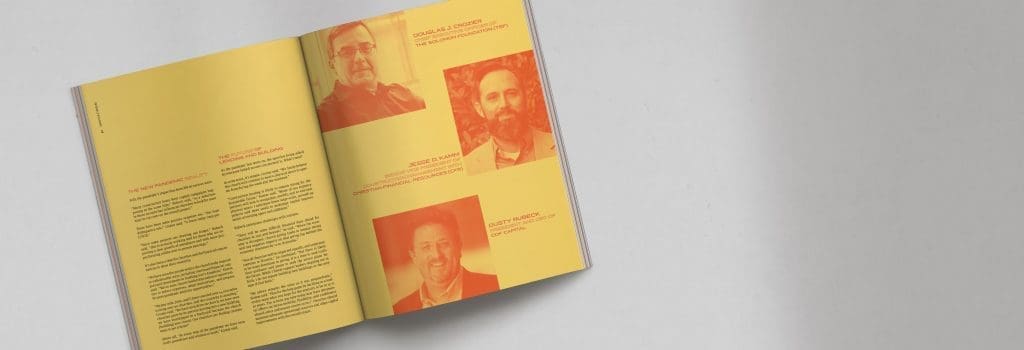
Three Leaders of Church-Lending Organizations Discuss How They Are Building on a Strong Foundation in Uncertain Times
Early in 2020, as the global pandemic unfolded, the uncertainty and economic losses seemed to spell disaster both for churches looking to build or expand their facilities and for the financial institutions that provide loans to these ministries. How can churches expect to build when they can’t even safely meet in person? How can giving and lending hold steady when the economy is flailing and so many people are out of work?
Now, mere months later—albeit long months—the worst fears did not happen. Churches are proceeding with construction projects and lending remains stable.
Leaders from three major Restoration Movement-affiliated, church-lending organizations—Douglas J. Crozier, chief executive officer of The Solomon Foundation (TSF); Jesse D. Kamm, senior vice president of construction management with Christian Financial Resources (CFR); and Dusty Rubeck, president and CEO of CDF Capital—agreed to share what they’ve seen and experienced during these trying times.
Each organization adopted a calm, reasoned, faithful approach—aiming to move forward prudently, soothe the fears of their ministry partners, and rely on God.
The men say all that has happened—the growth and stability of ministries and overcoming the dire predictions—is a testament to God’s faithfulness, the creativity of churches and believers across the country, and the diligence and wisdom of the supporting financial organizations.
Initial Uncertainty
Along with virtually everyone else, TSF, CFR, and CDF faced a time of uncertainty as spring arrived and the shock of the pandemic took hold.
Each organization adopted a calm, reasoned, faithful approach—aiming to move forward prudently, soothe the fears of their ministry partners, and rely on God.
“Very early in the pandemic,” Kamm said, “CFR met with each project leadership team to assess their situation and strategize the best course of action to fit their ministry needs. The aim was to balance the uncertainty and fluidity of the pandemic” along with the needs of each stakeholder, including “contractors, vendors, ministry leadership, and congregation.”
But once the landscape became clearer, the impact wasn’t as bad as some feared—in fact, all three organizations were able to continue their projects.
“Overall, it was a far smaller impact than we first anticipated,” Rubeck said. “Some projects were put on hold for a couple of months before commencing, some projects had unanticipated delays due to the shutdowns, and some felt almost no impact whatsoever.”
Kamm concurred. After an initial pause to gather data, CFR was able to move forward with every project.
And Crozier noted, “TSF has not stopped funding any current projects, and we have continued to approve new loans.”
Through it all, churches showed faithful resilience.
“Even in the best of times, construction projects are subject to various delays,” Rubeck said, “so most churches were prepared to deal with these obstacles already.”
The New Pandemic Reality
Still, the pandemic’s impact has been felt in various ways.
“Many construction loans have capital campaigns happening at the same time,” Rubeck said, “so a reduction in those receipts has influenced churches to look for more ways to cut costs on the overall project.”
There have been some positive surprises too. “Our loan delinquency rate,” Crozier said, “is lower today than pre-COVID.”
“Since some projects are drawing out longer,” Rubeck said, “this is actually working well for those who are expecting a slow growth of attendance and with more people favoring online over in-person meetings.”
It’s also been a time for churches and the financial organizations to show their creativity.
“We have seen the people within the church body respond in unbelievable ways, including continued financial support and investments in building God’s kingdom,” Kamm said. “We’ve seen church leadership embrace opportunities to reduce expenses, adopt innovations, and prepare for post-pandemic ministry opportunities.”
“We [my wife, Julie, and I] have traveled over 14,000 miles visiting over 90 churches, and the creativity is amazing,” Crozier said. “We have seen drive-in church, we have seen churches grow by 80 percent moving into a new building, we have worshipped in a backyard because the church [building] was closed. Our churches are finding creative ways to get it done!”
Above all, “At every step of the pandemic we have seen God’s providence and wisdom at work,” Kamm said.
The Future of Lending and Building
As the pandemic has worn on, the question being asked by everyone (which no one can answer) is, What’s next?
In some ways, it’s simple. Crozier said, “We firmly believe the church will continue to need a physical space to operate from during the week and the weekend.”
“Construction lending is likely to remain strong for the foreseeable future,” Kamm said. “Many of our ministry partners will look to reorganize, modify, and re-envision physical space. I anticipate fewer large-scale, ground-up projects and more small to midrange capital improvements of existing space and additions.”
Rubeck anticipates challenges will continue.
“There will be some difficult financial days ahead for churches in 2021 and beyond,” he said. “When the economy is disrupted, church giving tends to remain strong and any negative impacts on that giving lag behind the economic downturn by 12 to 18 months.”
“Not all churches will be impacted equally, and some may continue to flourish,” he continued. “But there is likely to be some downturn in giving. It is a time to seek God’s clear guidance and pause to seek the wisest plans for the future. While I firmly support leaders stepping out in faith, I do not equate building new buildings as the only sign of that faith.”
“My advice remains the same as it was prepandemic,” Kamm said. “Plan for the long game by deciding as a leadership team what you hope for the ministry to be in 15 to 20 years. The actions you take today may have detrimental effects on future mobility, flexibility, and nimbleness should other unforeseen events occur.” Churches should maintain adequate operational reserves and align capital improvements with the overall vision.
The Advancing of God’s Kingdom
But it’s never been just about money. In the months and years ahead, the church will continue to be comprised of followers of Christ who aren’t confined to a particular building. While Rubeck, Kamm, and Crozier are optimistic in the realm of church lending, they’re even more optimistic about the advance of God’s kingdom.
“When this pandemic is over, the church will come out stronger because of the creativity and commitment they have made to expand the kingdom,” Crozier said.
The creativity churches have exhibited during this time will continue. Churches are learning to adapt to changing environments, and those skills will impact the kingdom in the years ahead.
“It is expected that, for many new guests,” Kamm said, “the online virtual experience will become the new front door—the first place new guests will ‘sample’ your ministry and decide if they should step foot into the physical gathering.”
While Rubeck, Kamm, and Crozier are optimistic in the realm of church lending, they’re even more optimistic about the advance of God’s kingdom.
While these times are undeniably difficult, they’re a chance to grow and re-envision what it means to be the body of Christ: How and where do we gather? How do we connect to each other and to God? What do we do with our resources?
“The advances in the last months have been related to churches using a variety of methods to reengage their people and to focus on what matters most,” Rubeck said. “I don’t think God has much concern about the facilities we want to build, or even our mastery of the digital universe. From the beginning, God has been concerned about relationships with his creation. So, my hope is to see church leaders double and triple their investments into the spiritual pathways that create these connections, and that facilities begin to take a back seat to greater concerns.”
“Imagine what it would look like,” Rubeck continued, “if we could unleash these great waves of generosity and [if] all of the funds were used to reach the lost, here and around the world,” rather than build bigger, better buildings.
In uncertain times—in all times—God’s people can trust him. While so many in the world today put their trust in financial security, throughout this pandemic God has shown his faithfulness to the believers, churches, and financial institutions who rely on him.

Author: Melissa Wuske
Melissa Wuske is a freelance editor and writer. She and her husband, Shawn, and their son, Caleb, live and minister in Cincinnati. Find her work online at melissaannewuske.com.




Have churches been forced to look at ways to “reuse” their facilities during the weekdays as a way of helping small businesses to “carry on,” if the small businesses don’t have the funds for renting their own space?
Maybe that would be one method of reaching out to the community.