
Why Christians Care About Voting
How should Christians think about voting rights, redistricting, and political gerrymandering? This reflection traces America’s voting history and the varied Christian responses to public participation.
How should Christians think about voting rights, redistricting, and political gerrymandering? This reflection traces America’s voting history and the varied Christian responses to public participation.
March 1, 2024
Exploring the pivotal issues that gave rise to two major divisions (and a number of smaller ones) . . .
February 2, 2019
(Part two in a three-part series) By Steve Carr In our digital society, postage stamps seem archaic. But in Alexander Campbell’s day, they symbolized wealth. And as postmaster at Buffaloe, Virginia, he was able to wield this wealth to benefit the Restoration Movement. During the colonial era, postal service was sketchy. It was so costly and inconsistent that the United States made it an official government institution after the Revolutionary War. As the country expanded westward, mail became essential in providing access to critical information, thoughts, and ideas. As a result, postmasters became among America’s most important citizens. Campbell
November 23, 2011
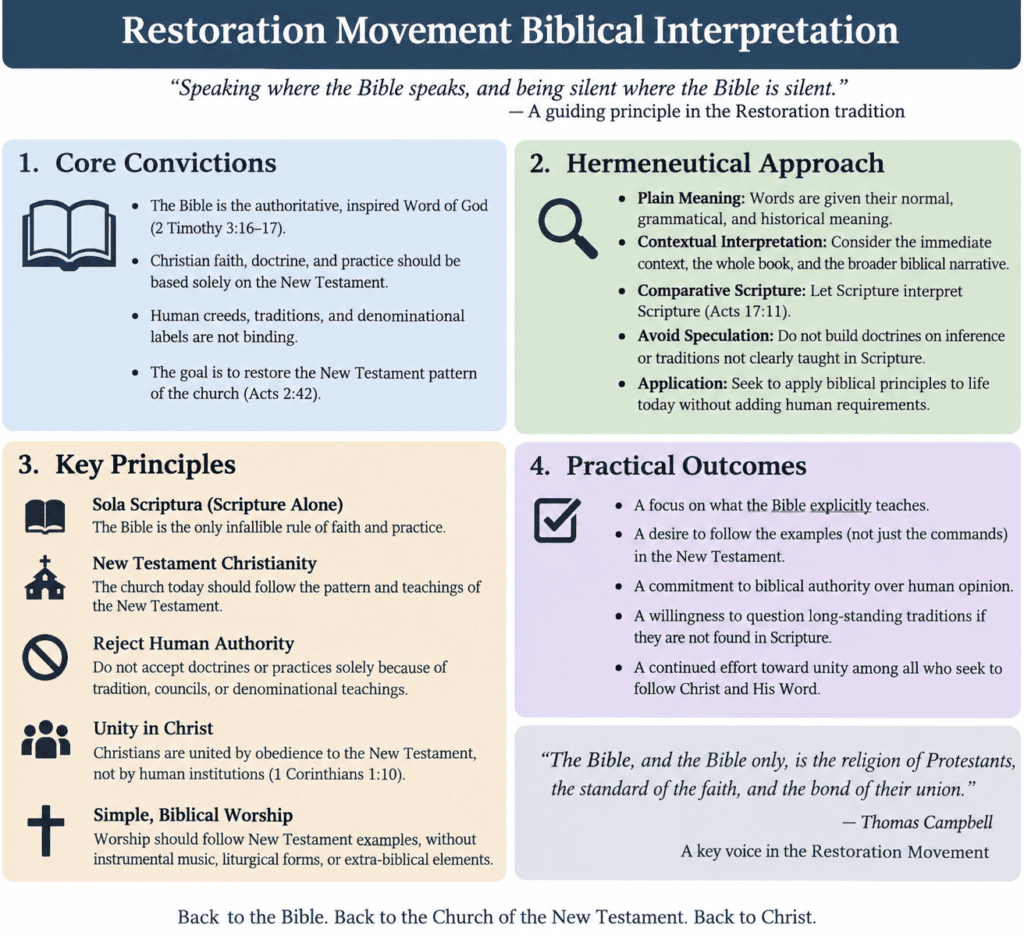
Mark Weedman traces three pivotal moments in Restoration Movement biblical interpretation, from Thomas Campbell’s plea for unity through debates involving Isaac Errett, David Lipscomb, Modernism, and Fundamentalism.
November 18, 2011

What helps new ministers flourish in their first year? Mark W. Hamilton explores what churches should provide—and what congregations should reasonably expect from young ministers in return.
August 8, 2010

John Mark Hicks reflects on children, baptism, and the kingdom of God, questioning assumptions about the age of accountability and presenting baptism as a mature act of owned discipleship.
July 4, 2010

James B. North traces how people connected to the Restoration Movement have served in public office, from presidents and senators to judges, representatives, governors, and state legislators.
November 5, 2006

Jason Bembry shares the questions that reshaped his assumptions about Christian participation in war, engaging Jesus’ teaching, early church practice, Restoration voices, and Romans 13.

A closer look at the people and correspondence behind the 1906 Census of Religious Bodies—and how its published data became a lasting symbol of the Churches of Christ and Disciples of Christ division.
Sponsored

Sponsored

Sponsored


Learn how to turn the sermons you’re already preaching into searchable, shareable content that helps people discover and connect with your local church. Access Be Seen, Be Heard on demand with Wes Woodell and Trey Sheneman. A two hour course for preachers, church media and website teams, and anyone who wants to help their church reach more people online.

September 17, 2026
Quentin Davis

September 15, 2026
David Faust

September 15, 2026
James Thompson