Articles for tag: Higher Criticism

Studying Scripture with Alexander Campbell (Part 2)

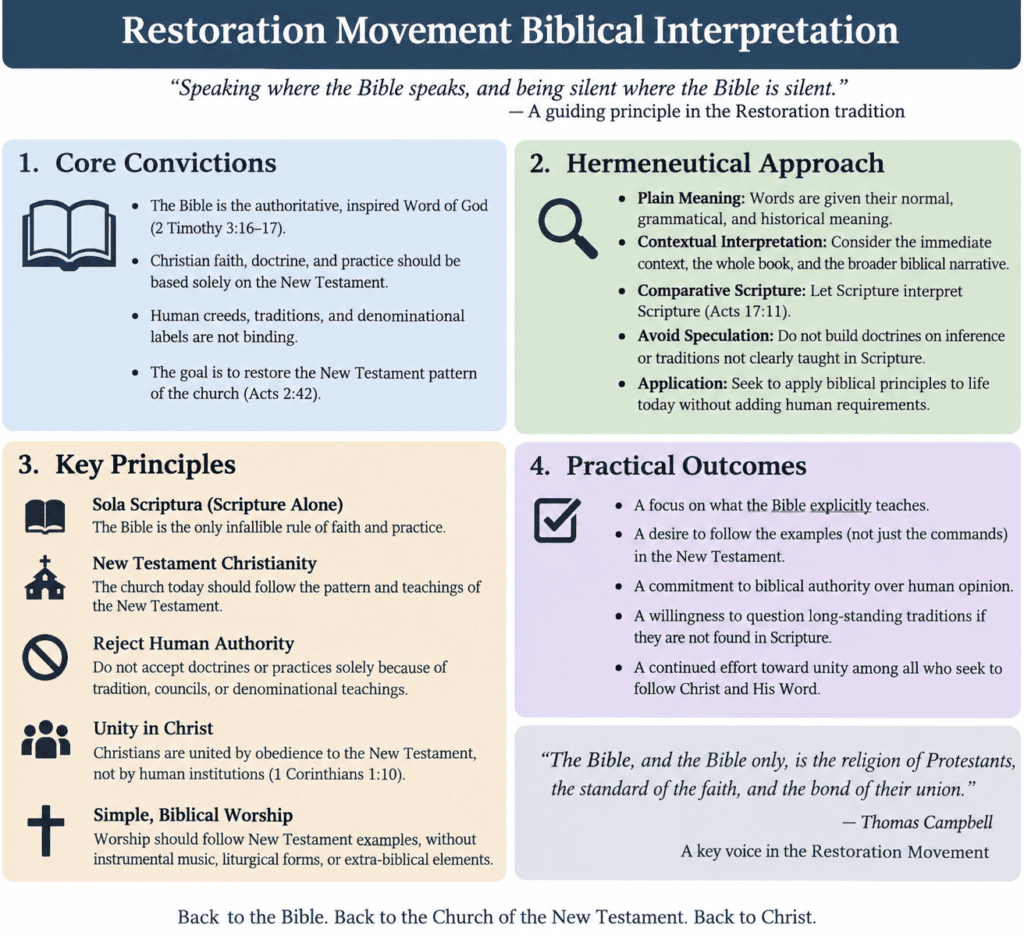
Today we conclude this two-part article from 1940 explaining the “four aspects” of Alexander Campbell’s Bible study. Today’s article covers aspects three and four. _ _ _ Alexander Campbell’s Contribution to Bible Study (Part 2) By Howard Elmo Short, B.D. (Hartford);Minister, Church of Christ, Cuyahoga Falls, O.;February 10, 1940; p. 5 . . . There is no finer contribution that Mr. Campbell has made to Bible study than this insistence upon original thinking. How often we read, leafing through, just to find the “pet” verses which prove the point we are arguing at the moment! The admonition of Mr. Campbell

A New Critical Juncture in the Restoration Movement

By Jerry Harris The Restoration Movement has faced critical junctures at least twice in its history. The first time was after the Civil War. Deep wounds remained as the nation endeavored to reconstruct itself. Death had silenced the great leaders of our movement: Barton Stone in 1844, Thomas Campbell in 1854, John T. Johnson in 1856, Walter Scott in 1861, Alexander Campbell in 1866, and “Raccoon” John Smith in 1868. Division came from many voices that tore at the fabric of the simple principles of unity based in the restoration of the church of the New Testament. It was into

Biblical Interpretation in the Restoration Movement

By Mark Weedman The history of the Restoration Movement is diverse and complex, and summarizing it is necessarily difficult. But some general patterns do emerge, and we can use those patterns to gain an overview of how followers of the Restoration Movement have approached biblical interpretation. Three moments in that history stand out as especially important in shaping how Thomas and Alexander Campbell and their followers would interpret the Bible. The first was the appearance of Thomas Campbell”s Declaration and Address, a seminal document that established the movement”s governing plea. The second moment was a debate between Isaac Errett and

Scholarship in the Stone-Campbell Movement

By Douglas A. Foster So-called scholars trained in prestigious schools are blinded in their judgment by the speculations of academicians.” “Common sense is more valuable than all the accumulated knowledge of the learned.” “A theological seminary is a theological cemetery.” Sound familiar? Such ideas were a powerful part of the intellectual landscape in the early 1800s at the beginning of the Stone-Campbell Movement. Many believed that not only was scholarship useless, but that it prevented people from seeing simple truths evident to “unschooled” people. Richard Hofstadter in Anti-intellectualism in American Life shows how the new American sense of freedom and

Help Keep Christian Standard Free & Accessible with a Tax Deductible Donation

We can do more together!

Every gift makes a difference!

No, thank you.
100% secure transactions - receipts provided.
Does Your Church Want to Support Christian Standard?

Would your church consider including support for Christian Standard in its annual missions budget? Your support would help us not only continue the 160-year legacy of this unifying ministry, but also expand the free resources, cooperative opportunities, and practical guidance we provide to strengthen churches in the U.S. and around the world.

We can do more together!

Every gift makes a difference!

No, thank you.
100% secure transactions - receipts provided.
Secret Link