Articles for tag: Restoration History

THROWBACK THURSDAY: ‘Barton W. Stone—Champion of the Word’ (1962)

Sam Stone wrote in 1962, "If the early leaders of the Restoration movement are like men engaged in a race, it might be said that Barton Warren Stone took an early lead, but was later passed by Alexander Campbell." Sam Stone contended that Barton Stone was deserving of greater appreciation . . . and he did so by presenting this "survey of his life." . . .

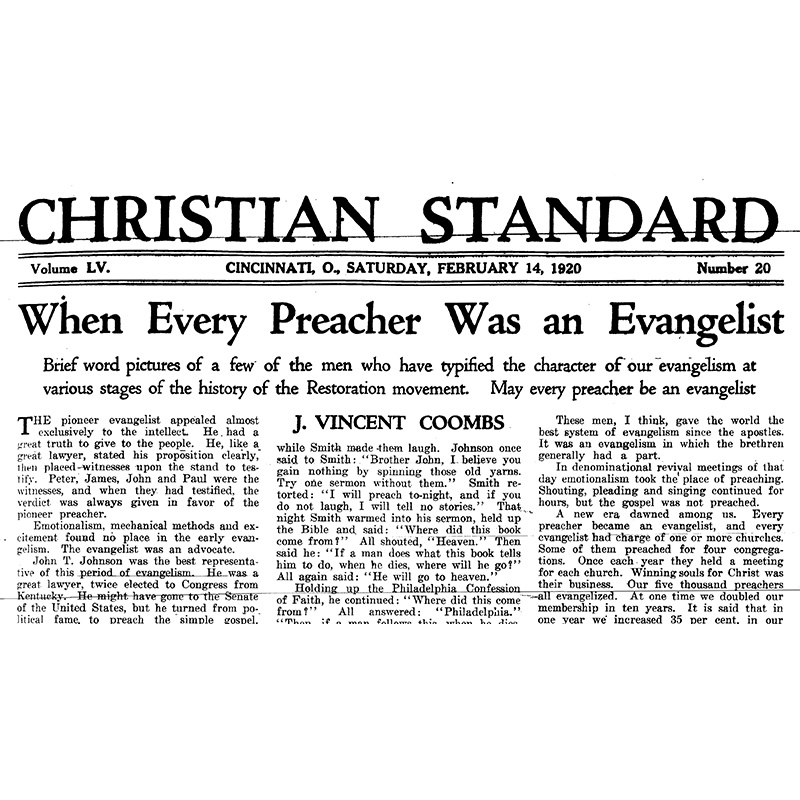
THROWBACK THURSDAY: ‘The Birth of the Restoration’ (Part 1; 1924)

"The nineteenth century dawned on an America that was far from Christian. Unbelief was prevalent and popular," Ira M. Boswell wrote in 1924. "The Bible was considered a dead book and the gospel powerless to save. Speaking to sinners concerning personal salvation was objectionable to pious believers, and looked upon as a personal interference with the plans of God." . . .

A Bright Future Across the Pond: Restoration Churches in the U.K.

By Martin Robinson and Mont Mitchell  Some have claimed that Christian Churches and Churches of Christ are the first group of churches to grow up in America—as if they’re an entirely American creation. Well, there’s more to the story.   Shared Understanding  Churches with a broadly “Restorationist” ideal had arisen in various parts of Britain in the late 18th century. Though they varied in ideas and went by different names—Scotch Baptists, Haldane churches, Sandemanian churches—they shared a commitment to congregational autonomy, governance by elders and deacons, weekly Communion, and believers’ baptism. Some congregations could trace their origins to somewhere around the

Politics in Print

A Review of Christian Standard’s Coverage of U.S. Presidents Since 1866 By Jim Nieman Has Christian Standard’s coverage of politics been slanted during its 154-year history? Undoubtedly. The readership of a Christian journal would demand nothing less. The better question might be: Has Christian Standard’s coverage of politics been fair? We certainly hope so . . . but when you root through more than 7,500 issues of a magazine, you’re bound to find at least a few items that give you pause. When asked to examine the magazine’s treatment of politics since 1866, I decided for expediency’s sake to focus

Sex, Religion, & Politics

Learning from Our Restoration History—and the Civil War—How to Fight Well By Steve Carr An adage suggests there are three subjects one should not bring up in public conversation: sex, religion, and politics. In this article, I throw caution to the wind and bring up all three, while pursuing how political issues have impacted the Restoration Movement. One of the mottoes of our movement is, “In essentials, unity; in nonessentials, liberty; in all things, love.” In the traditional understanding of this proverb, nonessentials refers to those extra-biblical topics not specifically mentioned in Scripture. While politics would seem to fit in

Ozark Profs Share the Bible ‘On Demand’ Via NextLevel

By Jim Nieman In 2016, Ozark Christian College began producing free online teaching videos featuring professors such as Chad Ragsdale, Michael DeFazio, Shane Wood, and Mark Scott. Since that time, the project—known as NextLevel Online—has grown to include 25 different biblical teaching series and 198 free online videos that have been viewed more than 100,000 times by church classes, small groups, student ministries, and individuals in all 50 states and 35 countries. Ozark’s mission is to “train men and women for Christian service,” said Jim Dalrymple, Ozark’s vice president of advancement. “We do this in the classroom every day, and

Marshall Keeble and What He Taught Me

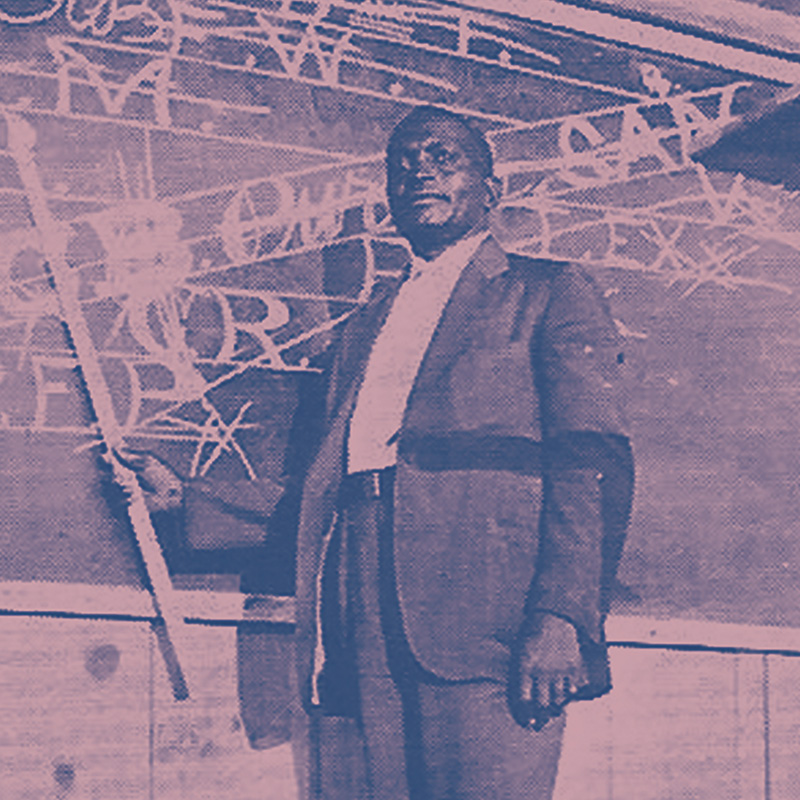
By Jerry Harris I, like so many independent Christian church preachers, had the opportunity to study the history of the Restoration Movement in Bible college. My experience was a droning professor in a 7 a.m. class. My goal then was simply to survive it, achieve the best grade possible, and then move on to more interesting things. Biographical sketches of our movement’s pioneers held little interest for me at the time, and for the most part, it stayed that way for many years. It wasn’t until our church launched a multisite location in Hannibal, Missouri, that an interest in our

Your Story Is Not About You Alone

By Mark A. Taylor Like every great novel or memorable movie, your story has a cast of compelling characters. And no matter how much you may hear about telling or improving your story, it will never be about you alone. These other characters in your story set its plot even before you were born. Your parents and theirs, your siblings and your childhood have all colored and directed your story, probably in ways you don”t realize. This is why your counselor pokes and prods to know more about your family and your growing-up years. Your story is not about you

New Signs of Hope in Eastern Canada

By Jim Tune Eastern Canada (Ontario and the Maritime provinces) was the seedbed for what finally became known as the Restoration Movement in Canada. Long before the thoughts of Barton Stone were circulated north of the 49th parallel, and several decades before Alexander Campbell visited the Canadian churches, a simple movement””similar, but not identical to that in the United States””took root in Canada. It was an appeal to model the church according to the simple doctrine and polity of the New Testament, to pursue unity, and to discard denominational labels and creeds. Scottish “restorationists” arrived upon the shores of New

Rediscovering the Sacred Stones

A church”s new multisite campus. A town steeped in history. The grave of a Restoration Movement pioneer”s wife. A reflection on what this frontier preacher stood for, and the message we still proclaim today.  By Jerry Harris There she was. Her stone lying on its back, broken and weathered among scores of neglected reminders of lives long since past. The inscription was hard to read because of a combination of age, moss, and dirt, but careful examination gave witness to the precious soul long forgotten to so many.   Celia W. Wife of Elder B.W. Stone Died Apr. 23, 1857

The Passion of Barton Stone

By Jim Tune Barton Warren Stone was one of the foremost leaders for religious freedom on the western frontier during the first half of the 19th century. He led a movement with goals many—including me—are still pursuing today. Barton Stone was born in Maryland in 1772 and as a boy decided to become a preacher. At age 19 he was ordained a minister in the Presbyterian church. In 1801, Stone moved to Cane Ridge, Kentucky. As he took up his preaching ministry, he discovered that some of the things he read in his Bible seemed inconsistent with the strong Calvinist

Biblical Interpretation in the Restoration Movement

By Mark Weedman The history of the Restoration Movement is diverse and complex, and summarizing it is necessarily difficult. But some general patterns do emerge, and we can use those patterns to gain an overview of how followers of the Restoration Movement have approached biblical interpretation. Three moments in that history stand out as especially important in shaping how Thomas and Alexander Campbell and their followers would interpret the Bible. The first was the appearance of Thomas Campbell”s Declaration and Address, a seminal document that established the movement”s governing plea. The second moment was a debate between Isaac Errett and

Remembering J.W. McGarvey

By Andrew Paris This coming Thursday, October 6, marks the centennial anniversary of the death of John William “J.W.” McGarvey, a great Christian preacher, teacher, author, educator, and Scripture scholar who deserves to be remembered. McGarvey was a man of only one book””the Bible. He was firmly convinced it was the inerrant Word of God, and so he devoted his life to loving it, teaching it, defending it, and living it. In his day, McGarvey held the respect of all groups emerging from the Restoration Movement, and was recognized as the movement”s greatest scholar and writer. He has been a

The Brush Run Church

By Calvin Warpula In 1809 when Thomas Campbell wrote the Declaration and Address of the Christian Association of Washington [Pennsylvania], he had no plan to start a separate church. He strongly opposed sectarianism and all human creeds and promoted unity among all believers in Christ on the basis of the Scriptures only. His son, Alexander, who arrived from Ireland later that year, agreed with and supported his father”s views. On Saturday, May 4, 1811, at its semiannual meeting, the Christian Association decided to transform itself into a local church because its calls for unity based on Scripture had been rejected

Secret Link