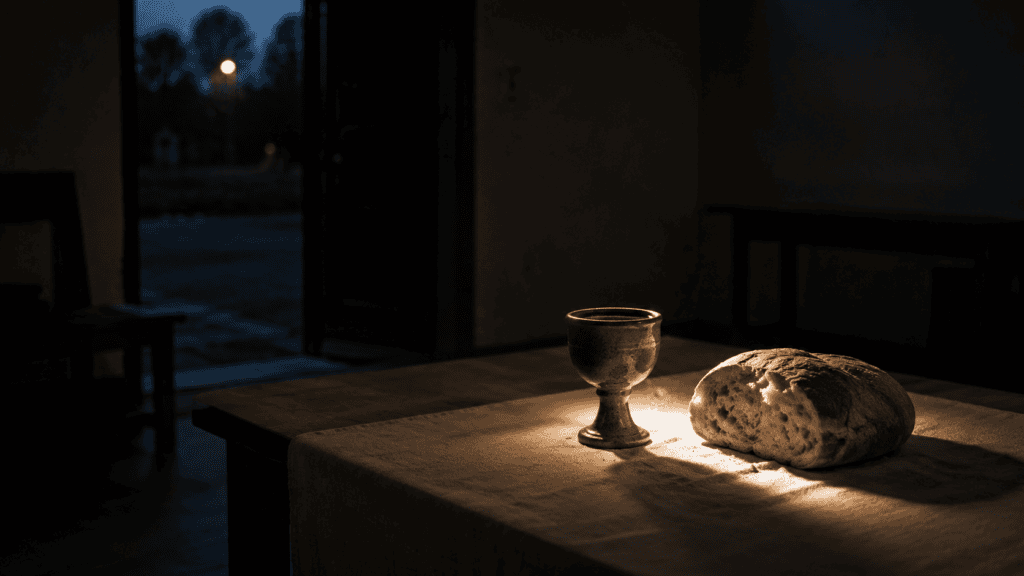

Communion Self-Examination and the Heart Before God
Communion self-examination is a time for honest cross-examination before God. Charles Gerber urges believers to examine their hearts, especially for bitterness and unforgiveness, before taking the Lord’s Supper.
- Communion invites believers to examine themselves from the cross’s point of view.
- Self-examination should include looking honestly for bitterness and unforgiveness.
- Communion is not a time for self-condemnation, but for opening the heart before God.
By Charles Gerber
Examine is a word often used in court proceedings. Examination can be defined as “putting yourself under evaluation, as with a microscope.” This type of examination is for our own good, like when we visit a doctor. Some examinations are done with great care and precision.
The word examine is found only twice in the New Testament, in 1 Corinthians 11:28 and 2 Corinthians 13:5. The word examine is from the Greek word dokimazo, meaning to test (literally or figuratively); by implication, to approve.
A Time for Cross-Examination
Cross-examine is another term used in court proceedings. A witness is cross-examined by a lawyer. The word picture of cross-examination is wonderful for a Communion illustration—Communion is a time for cross-examination, a time to look at ourselves from the cross’s point of view.
During Communion, we should examine our hearts and discern which emotions found there should be removed. One of the worst to find and first to remove is bitterness of heart, which is unforgiveness. Proverbs 14:10 says, “Each heart knows its own bitterness, and no one else can share its joy.” We need to examine our hearts to see if there is unforgiveness for any person in our lives. Before we take Communion, we need to make sure we have forgiven the people who have hurt us.
First Chronicles 29:17 states, “I know, my God, that you test the heart and are pleased with integrity.”
Jeremiah 11:20 says, “But, O Lord Almighty, you who judge righteously and test the heart and mind, let me see your vengeance upon them, for to you I have committed my cause.”
Questions for Communion
To examine yourself does not mean to beat yourself up. Examine can be defined as “putting yourself under God’s microscope.” First Corinthians 11:27 says people can take Communion in an unworthy manner. This can occur when people take Communion without self-examination, an action with dangerous implications (vv. 29, 30).
To examine yourself, ask these questions: Is there someone you need to forgive? What is preventing you from forgiving him? Is there someone from whom you should seek forgiveness? Why haven’t you sought his or her forgiveness?
Communion is the perfect time for cross-examination. As we cross-examine ourselves, we also open our hearts for God to cross-examine us.
Charles Gerber is founder of Christian Counseling Services in Muncie, Indiana, and has served in this ministry more than 25 years. The counselor and author also serves as an elder with University Christian Church and as an adjunct professor with Central Christian College of the Bible, Moberly, Missouri.