
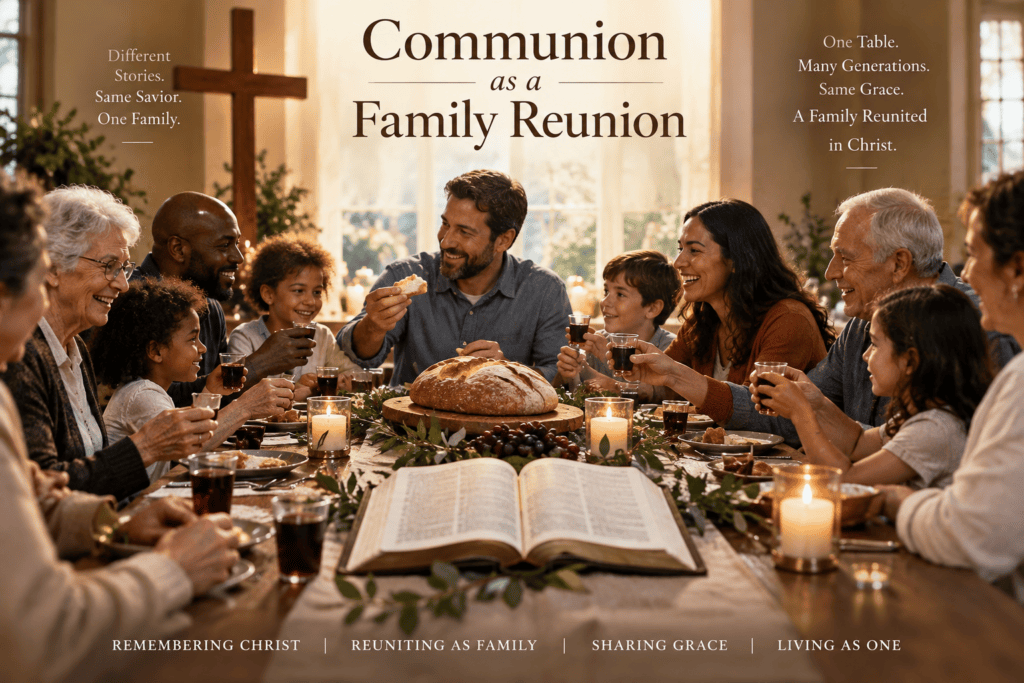
Communion as a Family Reunion
Communion as a family reunion points believers toward the day when Christ’s disciples from every nation and every century will gather with him in his Father’s kingdom. The Lord’s table reminds believers that they belong to one family through Christ and look forward to that eternal celebration.
- The original Lord’s Supper took place during Jesus’ final Passover meal with his disciples.
- Communion anticipates a future gathering of Christ’s followers from every tribe, tongue, nation, and century.
- At the Lord’s table, believers celebrate their shared family relationship through the blood of Christ.
By William Baker
The original Supper of the Lord took place at a table (Luke 22:21, 30). It was a Passover meal. It was Jesus’ last supper with his devoted disciples. In a matter of hours he would be arrested, beaten, and crucified. He treasured these last moments with them because they offered a foretaste of the greatest family festival reunion of all time.
They would be back together again like this—at another table, at another time. Next time, gathered around the table would not just be this handful of solemn believers. Next time, every tribe, tongue, and nation would be there rejoicing. Next time, the throngs of disciples from every century, from every corner of the earth, would be together to celebrate his victory over death that gave each one life. Next time, no clock would end the celebration. Next time, the party would go on forever.
Communion as a Family Reunion
Family reunions are amazing events. Sometimes, hundreds gather at campgrounds or state parks. The more, the merrier. Food, fun, stories, singing, and laughter culminate in the big family photo of everyone there. Long-lost cousins are introduced. Grandmas comment on just how much so-and-so’s child looks like Mother. The truth is, of course, that everyone looks kind of the same, or at least related. They are all family. The older they get, the more they treasure each and every reunion, and each and every person there.
Looking Forward to the Father’s Kingdom
At the table of the Lord, we anticipate Jesus’ words, “I will not drink from this fruit of the vine from now on until that day when I drink it new with you in my Father’s kingdom” (Matthew 26:29). When he says “you,” he refers not only to his first disciples, but to all his disciples, even to us gathered today. We are part of a great family related each to the other through the blood of Christ. Let us rejoice in that day when we will all be together like this forever with him.
William R. Baker is professor of New Testament at Hope International University, Fullerton, California, and editor of the Stone-Campbell Journal.