Christian Community at Easter: What the Resurrection Gives Us
Christian community at Easter reflects the support, encouragement, friendship, and shared hope believers find in the risen Christ. While secular alternatives may imitate aspects of religious community, the article argues that they cannot reproduce the life Christians celebrate in the resurrection.
- Church community offers ongoing support, encouragement, and friendship.
- Secular attempts to reproduce religious community may imitate its forms without sharing its foundation.
- The resurrection of Christ is presented as the source of the life Christians experience together.
By Mark A. Taylor
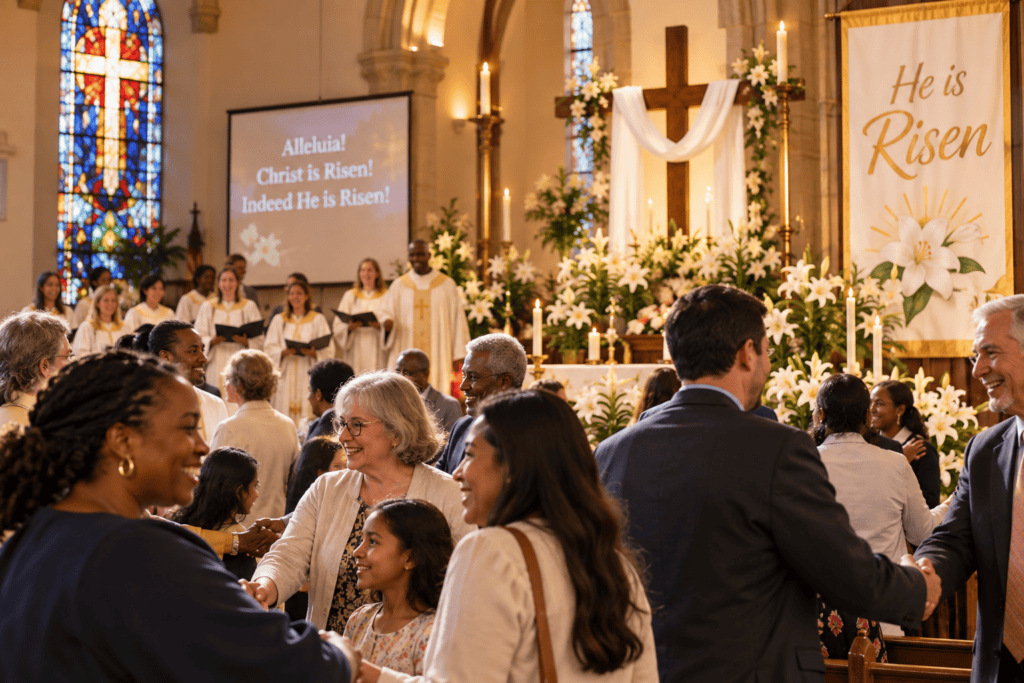
Regular churchgoers sometimes resent the come-on-Easter crowd, suspecting shallow motives among those who don’t make it to worship more often.
But this Easter, as I think about seeing folks I don’t know or haven’t seen at church in months, I’m more inclined to feel sad than mad. Think of all they’re missing by not joining us week after week! We need each other, and how do people find support and encouragement and friendship without the church to lean on?
Can Secular Community Replace the Church?
Earlier this year, The Wall Street Journal featured one man’s answer to that question. Alain de Botton wrote Religion for Atheists: a Non-Believer’s Guide to the Uses of Religion, and the newspaper featured an excerpt in their Saturday “Review” section, February 18.
The writer has observed the decline of religion in the West and, along with it, diminished opportunities for nonchurchgoers to find community. He describes a “ruthless anonymity” in contemporary life and proposes secular solutions.
Among them: an Agape Restaurant. “By simple virtue of being in the space, guests would be signaling—as in a church—their allegiance to a spirit of community and friendship.”
For the troubled, a “psychotherapeutic travel agency” could match mental disorders with destinations most likely to lessen them.
And universities, according to the article, could create relationships departments to teach about such problems as the tensions in married life.
Although de Botton has knowledge of religion, he shows no evidence of experiencing faith. His premise is “to balance a rejection of religious faith with a selective reverence for religious rituals and concepts.” He got his restaurant idea from the agape feasts celebrated by early Christians, but one wonders if he has ever received agape love himself.
He has observed how religious communities help their members to cope with everyday life, and he assumes a sociological or psychological cause for the benefits. But he has missed the meaning that draws crowds to Easter worship. I doubt that de Botton’s readers will succeed in creating secular shells to nurture as Christian groups help their members, because anything manmade will lack the essence of what we celebrate at Easter.
The Life We Celebrate at Easter
Christ is alive! Not in some mystical or symbolic sense, but actually alive! And his resurrection gives us hope and keeps us returning to the church and relating to other Christians and forgiving their faults and confessing our sins to them. Only in that life can we find peace and purpose. I’m sorry that Alain de Botton seems not to have discovered it. I’m hoping that the irregular attendees crowding our services this weekend will catch a taste of the life that comes only from Christ and want to return to see more of it.

Author: Mark A. Taylor
Mark A. Taylor, who served as Christian Standard editor from 2003 to 2017, retired in June 2017 after almost 41 years with Standard Publishing (Christian Standard Media).