Why Christians Should Care About Bioethics
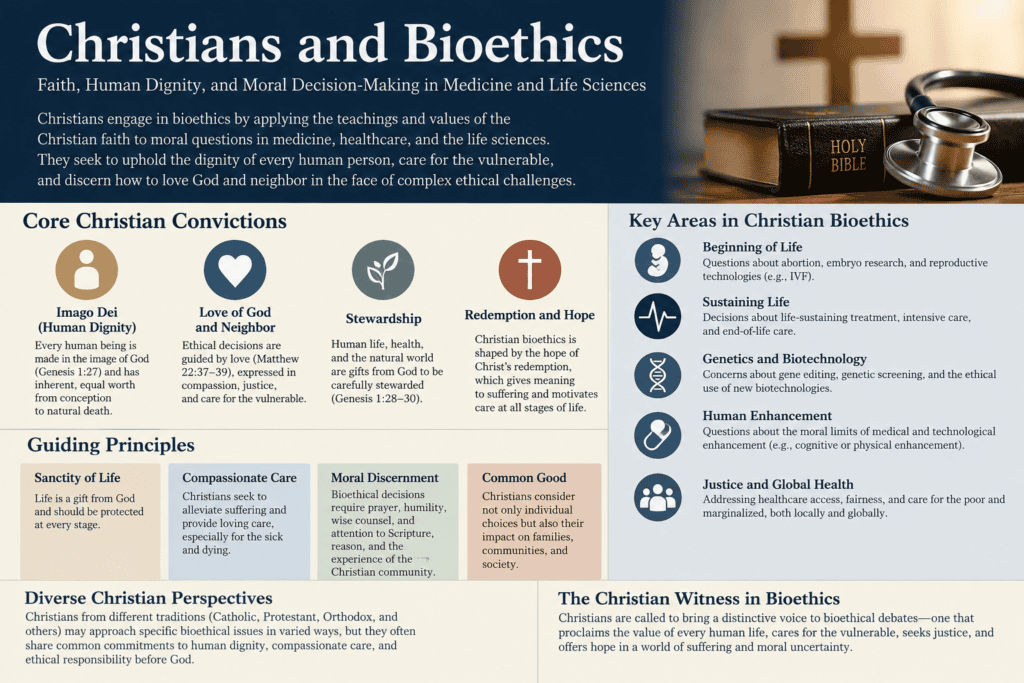
Bioethics brings questions of life, health, suffering, medical technology, and death into the context of Christian discipleship. Robert C. Kurka and Nathan Babcock explain why Christians should approach these complex decisions through stewardship, human dignity, faithful decision-making, and the lordship of Jesus Christ.
- Bioethical decisions involve Christian stewardship of human life and the created order.
- Advances in biotechnology raise important questions about human dignity, suffering, healing, and what it means to be human.
- The church has an important role in helping Christians evaluate medicine and technology through a Christian worldview.
By Robert C. Kurka and Nathan Babcock
 Christians are concerned about life, health, and death. Christians are called to understand and experience life, health, and death in the context of the lordship of Jesus Christ and their discipleship to him. That’s why Christians should care about bioethics.
Dean Leuking once described a scene of congregational worship, variations of which are played out every Sunday in every Christian congregation:
It is the Sabbath. People are gathering for worship. A family files into the sanctuary. They are much at home there, but this time it is different. The mother is absent. She is in a nearby hospital, awaiting surgery on the day following. . . . Across the aisle sits a man who can walk into the building and sit down without limping or wincing with pain. . . . A year ago he underwent surgery for rebuilding of a hip badly deteriorated by degenerative arthritis. . . . Halfway back sits a middle-aged woman about to stifle a yawn. She came to worship straight from her shift as a nurse in the intensive care unit of the hospital where she works. This time she stayed two hours past her regular shift, helping with a critical case. . . . Under the balcony near the exit, at his regular place, sits a doctor. His beeper is quiet at the moment.1
This scene captures a reality that is also conveyed by the average prayer list in every Christian congregation: that life, health, disease, suffering, and death are of concern to every Christian in every congregation.
Christians, like everyone else, aspire to live long, healthy, and productive lives. Also, Christians, like everyone else, struggle to cope with, overcome, and understand the meaning of disease, suffering, and death. Christians, however, unlike everyone else, seek to understand and experience life, health, disease, suffering, and death in the light of who Jesus Christ is and what he has done, and in the light of their personal commitment to follow Jesus and the teachings of Scripture and the church.
Christians are concerned about life, health, and death. Christians are called to understand and experience life, health, and death in the context of the lordship of Jesus Christ and their discipleship to him. That’s why Christians should care about bioethics.
What Is Bioethics?
The word bioethics may be unfamiliar to many, but the broad concerns of bioethics are alien to no one. Noted Evangelical bioethicists John F. Kilner and C. Ben Mitchell have succinctly defined bioethics as a process of “distinguishing between what we should pursue and what we shouldn’t pursue in matters of life and health.”2 Thus bioethics is concerned with moral questions created by, and in relationship to, health care, biotechnology, and biomedical research, as well as viewpoints, practices, and pursuits related to life, health, disease, suffering, and death.
Most Christians have some acquaintance with several of the more high-profile bioethical issues: abortion, stem cell research, in vitro fertilization (IVF) and other reproductive technologies, euthanasia and physician assisted suicide, and organ donation and transplantation. Since the 1960s, several high-profile medical and legal cases have brought these kinds of issues into the public consciousness, such as the 1973 landmark Roe v. Wade decision (abortion), the birth of Louise Brown (“test-tube baby”), and the life-support cases of Karen Ann Quinlan and Terry Schiavo.
Critical and Complex
Our conviction is that bioethics is, and will be, one of the most critically important and ethically/theologically complex discipleship issues of the 21st century. Therefore, we believe it is imperative for all Christians not only to care about bioethics, but also to become accurately informed about bioethics and theologically equipped for bioethical thinking and decision-making. What follows is a broad overview of six reasons Christians should take bioethics seriously as a matter of importance for their discipleship to Jesus Christ.
Bioethics Is About God’s Creation and Our Stewardship of It
The bio in biotechnology and bioethics denotes life. Biotechnology exploits the materials and processes of life for industrial and medical purposes3, and bioethics deals with the moral questions in the life-health-disease-suffering-death complex created by biotechnology. Christians should care about bioethics because the stuff of life which biotechnology exploits, and over which bioethical debates rage—DNA, genes, embryos, stem cells, organs, molecules, reproduction, human dignity, and the ending of life in death—all belong to our creator God (Psalm 24:1, 2; Romans 11:33-36).
Humans are not masters of the created order, and Christians have a responsibility to remember that truth as crucial to our own discipleship, and to bear witness about that truth to an unbelieving world. Instead of being masters, humans are stewards of the created order on earth (Genesis 1:26-28). As stewards, our dominion over biological life and processes takes shape not as an absolute right to rule, but as a responsibility to the will of the creator. This means we are accountable to the creator for what we do with his creation, especially human life.
Christians therefore, as those who have been reconciled to their creator through Christ, must realize that decisions concerning life and health—individually, for one’s family, for society—cannot be merely personal decisions made with only private objectives in mind. Instead, as Christians, our decisions about life, health, and death must be grounded in our commitment to our creator’s will, and in our understanding of our caretaker’s calling.
Bioethics Is About Faithful Christian Decision-Making and Living
When faced with an inability to conceive children on their own, should Christian couples make use of assisted reproductive technologies (IVF, etc.)?
When confronted with the dilemma of a loved one needing the support of a ventilator to survive, are Christians under an obligation to prolong life at all costs?
Do Christians have a duty to set forth, in advance, their wishes for health care in a circumstance where they cease to be able to communicate or make decisions for themselves?
Should the Christian parents of an 8-year-old child with a terminal diagnosis and prognosis make known to the child the nature of the disease and the expectation of death in the interests of truth telling, or should they withhold that information out of concern for the child’s emotional well-being in his or her final days?
If, in the future, viable therapies are developed from human embryonic stem cell research, should Christians avail themselves of those therapies?
These are only a few of the difficult bioethical situations Christians may encounter. Without the necessary theological training and pastoral guidance for how to think about bioethical issues in terms of the Christian worldview, many, if not most, Christians will be at a loss for how to faithfully navigate such challenging and complex situations.
Biotechnology Is About the Paths of Present and Future Technology
This is where the bioethics discussion can begin to sound like science fiction, but readers need to understand that science is increasingly moving out of fiction and into reality. Research is underway and the development of the technologies is ongoing. From parents designing babies to suit their tastes4 to augmenting human capabilities with machines5 to connecting human brains to the Internet6 to rewriting the human genome7 and to “enhancing” morality through drugs and other techniques8, changing and “improving” humanity is on the biotechnological agenda. As biotechnology develops in this direction, its presence in our lives will become more pervasive (it will no longer be limited to the hospital), and the ethical dilemmas it creates will become more complex.
A children’s book entitled How the Incredible Human Body Works is a well-written introduction to the human body, with many creative illustrations of the body’s various systems. The book is innocuous enough until the final two pages, which are about “the superbody.” These pages explore, for kids, some of the projected and developing technologies for enhancing the human body, such as changing genes, nanobots, faster reactions, smart skin, and tooth phones.9 You may not be reading about human enhancement, but your children probably already are, or soon will be.
Bioethics Is About What It Fundamentally Means to Be Human
At the heart of bioethical debate are the timeless questions about what it means to be human. To borrow Leon Kass’s chilling metaphor, “Human nature itself lies on the operating table” in the world of biotechnology and biomedicine.10
Christian theology has always had a “high view” of human nature, for Christians believe humans are created in the image of God, humans are loved sacrificially by God, and the divine work in creation and redemption confers upon humans an inestimable dignity and worth. It is obvious, however, that this is not the prevailing view of human nature in the contemporary Western world. Instead, in a society that is captured by the sentiments and habits of materialism, humans are generally understood to be the accidental results of a blind, random, and naturalistic evolutionary process. This way of viewing humanity leads quite easily to the conclusion humans have no essential “nature” (especially not one divinely given), and that since we have evolved to be self-conscious creatures, we have the right, and even the responsibility, to take control of our own evolution, and re-engineer ourselves.
Humanity Plus, a group actively promoting the use of biotechnology to leave our current version of humanity behind, has stated it bluntly: “Transhumanists view human nature as a work-in-progress, a half-baked beginning that we can learn to remold in desirable ways.”11
Bioethics Is About Salvation from the Broken Human Condition
The fifth reason Christians should care about bioethics is well illustrated by the title of the February 21, 2011, Time magazine cover story: “2045: The Year Man Becomes Immortal.”12 For nearly 2,000 years Christians have been preaching the good news of Jesus’ life, death, and resurrection. We have been proclaiming that Jesus alone can grant salvation from sin, death, and disease, and reward us with eternal life in God’s presence. Biotechnology and biomedicine are beginning to move in on this traditionally Christian territory.
The Time article, by reporter Lev Grossman, profiled the Singularity Movement and several of its highest profile advocates, including technologist and futurist Ray Kurzweil, science fiction novelist Vernor Vinge, and biologist Aubrey de Grey. “Singularity” refers to “the moment when technological change becomes so rapid and profound, it represents a rupture in the fabric of human history”13; and this moment will lead to a technologically re-engineered humanity capable of transcending all current limitations imposed by embodiment, frailty, disease, and death. Based on mathematical calculations, Kurzweil predicts “singularity” will occur in 2045 (33 years from now!) and he envisions a future in which technologically engineered posthumans will be godlike and immortal.14
It may be tempting for our readers to dismiss such ideas with a scoff, but we would point out that this vision that looks to biotechnology (rather than to the gracious actions of God in Christ) for salvation from the broken human condition is one that will have tremendous intellectual and social currency and attractive power in our materialistic, technology-saturated, technology-worshipping culture.
Indeed, we would argue that the church-at-large in America, which has done precious little theological evaluation of technology, and which has generally adopted no higher ethical principle in relationship to technology than pragmatism (“If it works, we’ll use it!”), will be vulnerable to biotechnological visions of salvation.
Bioethics Is About the Church
The preceding points about human enhancement, the meaning of human nature, and biotechnological salvation lead to our final reason for Christians to care about this subject: bioethics is about the church. In fact, more pointedly, bioethics needs the church. Stanley Hauerwas wrote, “Medicine needs the church . . . as a resource of the habits and practices necessary to sustain the care of those in pain over the long haul.”15 Hauerwas’s emphasis on “the care of those in pain” reminds us of the humanity of medicine and clarifies the danger of biotechnology and bioethics without the church, which is the objectification of human nature into something to be “conquered” and “improved” by means of our own contrivance. This can only lead to the situation predicted by C.S. Lewis in 1944: that a man who can make of himself what he pleases will also have the power to make of other men what he pleases.16
The current trajectory of biotechnology seems to be heading in this direction, and because of this, our comments above have the tone of warning. This is precisely why bioethics needs the church.
However, our warnings here should not be taken to indicate we have an overly negative view of biotechnology or are recommending such to others. Instead, we believe our human ability to explore and understand the created order, and to develop medicines and technologies as tools for treatment and healing, are rooted in our identity as divine image bearers who are caretakers of creation. Christianity, following the example of Jesus’ healing ministry as set forth in the Gospels, has a long history of caring for and seeking to bring healing to the sick and the poor.17 In addition, a strong argument can be made that modern science was made possible by the convictions about God and creation deeply embedded in the Christian worldview, and that it could not have been born apart from those convictions.18
So then, medicine and science are very much at home within the Christian worldview, and there is a tremendous amount of good, in terms of the eradication of diseases, the alleviation of human suffering, the elongation of human life, and the betterment of living conditions for the handicapped, that is a direct result of developments in biomedicine and biotechnology.
The larger project for Christian bioethics, then, is to pursue and advocate for the further development of biotechnology and biomedicine that is consistent with our creator’s will and our caretaker’s calling, and that serves a truly human future and the common good of all humans.
This is the perspective on biotechnology we commend—a perspective (1) grateful to God for his blessings in the persons of doctors and scientists, and in the forms of medical technology; (2) earnest to further the development of biotechnology that promotes human healing and well-being, and that respects human dignity; (3) realistic about humanity’s sinful condition, our propensity to violate human dignity in pursuit of some lofty or noble goal, and our limitations as finite creatures that we cannot re-engineer ourselves to transcend; and (4) diligent in evaluating all of our technological tools by the values and norms of the kingdom of God.
Notes and Sources
1F. Dean Leuking, “The Congregation: Place of Healing and Sending” in Martin E. Marty and Kenneth L. Vaux, eds. Health/Medicine and the Faith Traditions: An Inquiry into Religion and Medicine (Philadelphia: Fortress Press, 1982), 273, 274.
2John F. Kilner and C. Ben Mitchell, Does God Need Our Help? Cloning, Assisted Suicide, & Other Challenges in Bioethics (Wheaton: Tyndale House, 2003), xii.
3This definition of biotechnology is adapted from the definition given at www.askoxford.com (accessed 8 September 2011).
4Marcy Darnovsky, “One Step Closer to Designer Babies: New Noninvasive Prenatal Genetic Testing Could Change Human Pregnancy Forever,” Science Progress, www.scienceprogress.org/2011/04/one-step-closer-to-designer-babies/ (accessed 6 July 2011).
5See, for example, Jacob Aron, “Hand-hacking lets you pluck strings like a musical pro,” in The New Scientist, 23 June 2011.
6See, for example, the speculations of Michael Corost in his book, World Wide Mind: The Coming Integration of Humanity, Machines, and the Internet (New York: Free Press, 2011).
7Jo Marchant, “Evolution Machine: Genetic Engineering on Fast Forward,” The New Scientist, 27 June 2011.
8See, for example, Amelia Hill, “Manipulating Morals: Scientists Target Drugs that Improve Behavior” in The Guardian, 4 April 2011, www.guardian.co.uk/science/2011/apr/04/morality-drugs-improve-ethical-behaviour (accessed 6 July 2011).
9Richard Walker, How the Incredible Human Body Works (New York: DK Publishing, 2007), 56, 57.
10Leon R. Kass, Life, Liberty, and the Defense of Dignity: The Challenge for Bioethics (San Francisco: Encounter Books, 2002), 4.
11Humanity Plus, http://humanityplus.org/learn/philosophy/transhumanist-values (accessed 8 February 2010).
12Lev Grossman, “2045: The Year Man Becomes Immortal,” Time, 21 February 2011, 42-49.
13Ibid., 43.
14Ibid., 46, 49.
15Stanley Hauerwas, Suffering Presence: Theological Reflections on Medicine, the Mentally Handicapped, and the Church (South Bend: University of Notre Dame Press, 1986), 81.
16See C.S. Lewis, The Abolition of Man in The Complete C.S. Lewis Signature Classics (New York: HarperOne, 2002), 720, 721.
17See Darrel W. Amundsen and Gary B. Ferngren, “Medicine and Religion: Early Christianity through the Middle Ages”; and Ronald L. Numbers and Ronald C. Sawyer, “Medicine and Christianity in the Modern World” in Martin E. Marty and Kenneth L. Vaux, eds. Health/Medicine and the Faith Traditions: An Inquiry into Religion and Medicine (Philadelphia: Fortress Press, 1982), 93-160. Also, Ronald L. Numbers and Darrel W. Amundsen, eds. Caring and Curing: Health and Medicine in the Western Religious Traditions (Baltimore: Johns Hopkins University Press, 1986).
18See Stanley L. Jaki, The Road of Science and the Ways to God (Chicago: The University of Chicago Press, 1978); as well as Alfred North Whitehead, Science and the Modern World (New York: The Free Press, 1967).
Robert C. Kurka, is professor of theology and church in culture at Lincoln (Illinois) Christian University Seminary. Nathan Babcock is assistant to Kurka for LCU bioethics and pastor of Bismarck (Illinois) First Church of Christ.
Where to Learn More About Christians and Bioethics
The Hargrove School of Adult and Graduate Studies at Lincoln (Illinois) Christian University has launched a new

Master of Arts in Bioethics program, under the direction of Robert Kurka, to equip Christian leaders in bioethics. For more information, visit www.lincolnchristian.edu/Hargrove/AcademicPrograms.asp.
Human Dignity in the Biotech Century: A Christian Vision for Public Policy, edited by Charles W. Colson and Nigel M. de S. Cameron (Downers Grove: Intervarsity Press, 2004).
Biotechnology and the Human Good, by C. Ben Mitchell, Edmund D. Pellegrino, Jean Bethke Elshtain, John F. Kilner, and Scott B. Rae (Washington, D.C.: Georgetown University Press, 2007).
Bioethics: A Primer for Christians, by Gilbert Meilaender (Grand Rapids: Eerdmans, 2005).
The Abolition of Man, by C.S. Lewis, in The Complete C.S. Lewis Signature Classics (New York: HarperOne, 2002).
The BioBasics Series from The Center for Bioethics and Human Dignity and Kregel Publications is a series of booklets addressing questions on a wide range of bioethical issues. These are available at www.kregel.com and www.amazon.com (also, four of the booklets are available in digital format through Logos Bible Software).
The website of The Center for Bioethics and Human Dignity (located at Trinity International University in Chicago) is replete with bioethics resources, as well as links to many other valuable websites; go to www.cbhd.org.
The website www.bioethics.com is a tremendous resource for up-to-date news from the worlds of biotechnology and biomedicine.








Just finished “Why Should Christians Care About Bioethics”. It was excellent. The writers gave a very good overview of the subject. We are on the cusp of a very pointed subject concerning bioethics and biotechnology. Perhaps another article could be written that brings it down to where the average person would understand it more fully. Not that this article was all that technical.
The question I asked myself was this. Is there another event recorded in God’s Word that would help set the stage for understanding our present dilemma? Are there contrasts and comparisons to be made? The record of the tower of Babel comes to mind. Why did they build it? (The record indicates that it was for pride and selfish reasons.) It was not to glorify God. The event does show how much greater God is over all of our knowledge.
The Bible is seemingly silent on opposition to building the tower but there may have been some who questioned the motive behind the building of it. I suggest this only as a means and sounding board for the readers to more easily connect and understand the situation we are facing with bioethics and biotechnology.
With your network of resources maybe an article to this effect could be published.
Thank you and congratulations on the fine articles in the Christian Standard.
Richard Throckmorton, Retired minister