Communion Meditations Sponsored by …

Communion . . . and Humility

Communion and Humility: Remembering Jesus’ Example
Communion and humility belong together in David Timms’ reflection on Jesus washing his disciples’ feet. The simple bread and cup remind believers not only of Jesus’ sacrifice but also of his example of humble service. Timms challenges Christians to approach Communion with a renewed willingness to serve others rather than seek recognition.
- Jesus’ washing of his disciples’ feet demonstrates the humility he expects his followers to practice.
- The simplicity of Communion’s bread and cup reminds believers that following Christ is not about status or privilege.
- Remembering Jesus at the Communion table should inspire practical acts of humble service.

Jesus said, “Do this in remembrance of me.”
Remember summer camp or church camp? Those late nights raiding other tents or dorms? Those camp meals that looked increasingly familiar as the week went on? The mosquitoes, bugs, and sunburn that made for some uncomfortable moments? But most of all . . . cleanup duties at the end. Remember the scramble not to be assigned the shower and toilet block? Remember the hair, the soap residue, and the scum? It was nasty, and nobody in their right mind would volunteer for that job. We were made for a higher calling!
Jesus’ Example of Humble Service
As the early disciples remembered that last night with Jesus, front-and-center among their thoughts stood “the foot-washing.” Jesus had volunteered for the equivalent of cleaning the shower and toilet block. More than that, he told his disciples to do the same thing.
“So if I, the Master and Teacher, washed your feet, you must now wash each other’s feet. I’ve laid down a pattern for you” (John 13:14, 15, The Message).
Of course, the point is not that we all take off our shoes and socks and line up for a dip. This statement addresses our attitude as much as action. Will we show the same humility as Jesus? Or do we have a higher calling, in our own minds?
Communion and Humility: The Bread, Cup, Basin, and Towel
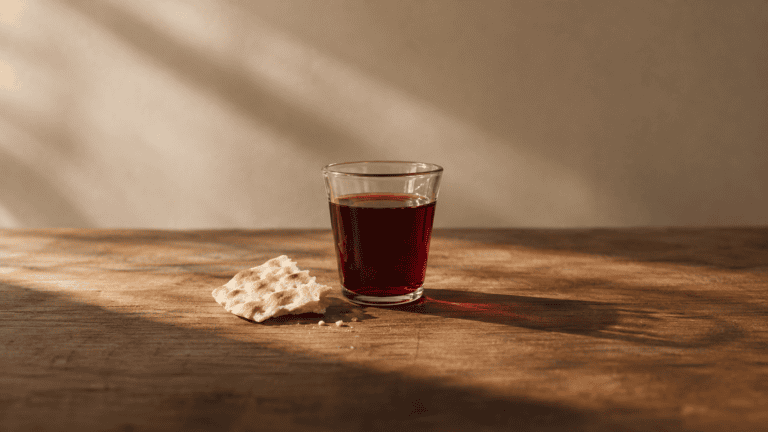
It’s significant we celebrate Communion with simple bread and juice. If the elements were tenderloin steak and exotic wine it might suggest a certain exclusiveness. But we have unleavened bread (and not much of it) and a taste of juice—something even the poorest of the poor can relate to.
The Communion table calls us, therefore, to humility and simplicity. We remember the example of Jesus with the basin and towel, and every time we eat the bread and drink the cup we should resolve to take up the basin and towel ourselves.
Andrew Murray, a South African theologian and pastor who lived a century ago, described humility as the bedrock of our discipleship. In a culture that glories in achievement, success, fame, and power, humility sounds like weakness. But in God’s kingdom, Christ honors those willing to wash feet and clean toilet blocks.
That adds another layer of significance to this simple experience we call Communion. Its simplicity calls us back to humility, again and again. As we eat and drink, we remember Jesus with the basin and towel—and we resolve afresh to be less proud and more humble. The bread and the cup and the basin and the towel must not be separated.
David Timms serves as professor of New Testament and theology at Hope International University in Fullerton, California.

Author: David Timms
Sponsored
For 160 years Christian Standard has served the churches of the Restoration Movement. Your gift keeps articles like this one free for every church leader.
Keep reading
More in Theology & Bible


From the archive
Christian Standard has covered this since 1866.





