Communion Meditations Sponsored by …

The Summer of ’66
The violence of 1966 reminds us that humanity's struggle with sin is nothing new. Victor Knowles reflects on the cross, Communion, and God's extraordinary love for sinners in a world marked by violence.

The Summer of 1966: Violence, Communion, and God’s Love
Reflecting on the violence of the summer of 1966, Victor Knowles considers humanity’s long history of sin and suffering. From the tragedies of that summer to the crucifixion of Christ, he reminds readers that Communion points to God’s extraordinary love for sinners.
- The summer of 1966 brought shocking acts of violence that challenged any romantic view of the past.
- Scripture reveals that human violence and rejection of God have existed since the earliest generations.
- The bread and cup of Communion remind believers of Christ’s sacrifice and God’s love for sinners.
It was the summer of 1966, and I was set to enter my junior year in Bible college in August. Three shocking events transpired that sultry summer 50 years ago.
 On June 6, civil rights activist James Meredith was shot while traveling in Mississippi. Fortunately, he survived.
A few days later, on July 14, the city of Chicago became the scene of a horrific mass murder when Richard Speck killed eight student nurses.
And just when I thought things couldn’t get worse, on August 1 an ex-Marine, Charles Whitman, barricaded himself atop the University of Texas Tower in Austin. Before that now distant day was done, the sniper had shot and killed 14 people and wounded 32 more.
Violence and the Human Condition
Sometimes we think “the good old days” were not so bad. Not so. Mankind had barely begun to breathe when Cain killed his brother, Abel.
The Bible says the heart of God was “deeply troubled” (Genesis 6:6) at the “wickedness of the human race” (6:5), and that “the earth is filled with violence because of them” (6:13).
Centuries later, in the parable of the tenants, Jesus spoke of a landowner (God) who sent his servants (the prophets) to collect the fruit from the tenants. Every one of the servants was beaten, stoned or killed. “Last of all, he sent his son to them. ‘They will respect my son,’ he said” (Matthew 21:37). But they didn’t. They killed his son too.
God so loved but the world so hated.
Jesus came into a first-century world filled with death and violence. His love and compassion was met head-on with nails and thorns.
In “Indifference,” poet George Studdart-Kennedy wrote of Jesus’ crucifixion:
They crowned Him with a crown of thorns, red were His wounds and deep,
For those were crude and cruel days, and human flesh was cheap.
The Miracle of Calvary and Communion
And herein lies the miracle of Calvary and Communion.
“You see, at just the right time, when we were still powerless, Christ died for the ungodly. Very rarely will anyone die for a righteous person, though for a good person someone might possibly dare to die. But God demonstrates his own love for us in this: While we were still sinners, Christ died for us” (Romans 5:6-8).
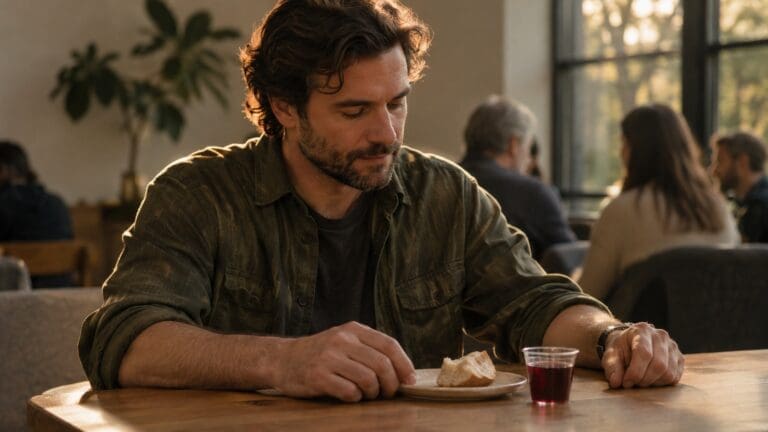
The broken bread and crimson cup remind us of our sin—and God’s amazing love for sinners.
Victor Knowles is founder and president of POEM (Peace on Earth Ministries), Joplin, Missouri.

Author: Victor Knowles
Victor Knowles is president of Peace On Earth Ministries, Joplin, Mo. This article is adapted from an address given to the Advanced Preaching class of St. Louis Christian College, Florissant, Mo., on Sept. 13, 2019, and to the Wabash Valley Christian Institute at New Hope Christian Church, Bridgeport, Ill., on Nov. 7, 2020.
Sponsored
For 160 years Christian Standard has served the churches of the Restoration Movement. Your gift keeps articles like this one free for every church leader.
Keep reading
More in Theology & Bible


From the archive
Christian Standard has covered this since 1866.





