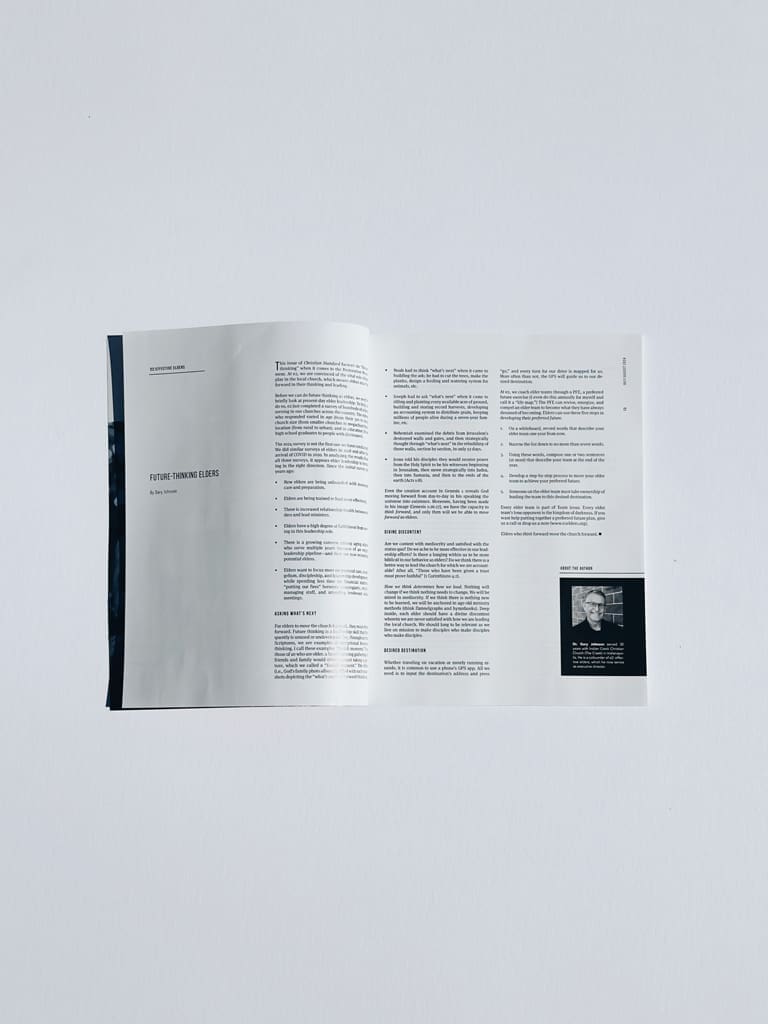
By Gary L. Johnson
This issue of Christian Standard focuses on “future thinking” when it comes to the Restoration Movement. At e2, we are convinced of the vital role elders play in the local church, which means elders must be forward in their thinking and leading.
Before we can do future thinking as elders, we need to briefly look at present-day elder leadership. To help us do so, e2 just completed a survey of hundreds of elders serving in our churches across the country. The elders who responded varied in age (from their 30s to 80s), church size (from smaller churches to megachurches), location (from rural to urban), and in education (from high school graduates to people with doctorates).
The 2024 survey is not the first one we have conducted. We did similar surveys of elders in 2018 and after the arrival of COVID in 2020. In analyzing the results from all three surveys, it appears elder leadership is trending in the right direction. Since the initial survey six years ago:
- New elders are being onboarded with increased care and preparation.
- Elders are being trained to lead more effectively.
- There is increased relationship health between elders and lead ministers.
- Elders have a high degree of fulfillment from serving in this leadership role.
- There is a growing concern among aging elders who serve multiple years because of an empty leadership pipeline—and they are now recruiting potential elders.
- Elders want to focus more on pastoral care, evangelism, discipleship, and leadership development, while spending less time on financial matters, “putting out fires” between congregants, micromanaging staff, and attending irrelevant elder meetings.
Asking What’s Next
For elders to move the church forward, they must think forward. Future thinking is a leadership skill that frequently is unused or undeveloped. Yet, throughout the Scriptures, we see examples of exceptional forward thinking. I call these examples “Kodak moments.” For those of us who are older, a heartwarming gathering of friends and family would often warrant taking a picture, which we called a “Kodak moment.” The Bible (i.e., God’s family photo album) is filled with such snapshots depicting the “what’s next” of forward thinking.
• Noah had to think “what’s next” when it came to building the ark; he had to cut the trees, make the planks, design a feeding and watering system for animals, etc.
• Joseph had to ask “what’s next” when it came to tilling and planting every available acre of ground, building and storing record harvests, developing an accounting system to distribute grain, keeping millions of people alive during a seven-year famine, etc.
• Nehemiah examined the debris from Jerusalem’s destroyed walls and gates, and then strategically thought through “what’s next” in the rebuilding of those walls, section by section, in only 52 days.
• Jesus told his disciples they would receive power from the Holy Spirit to be his witnesses beginning in Jerusalem, then move strategically into Judea, then into Samaria, and then to the ends of the earth (Acts 1:8).
Even the creation account in Genesis 1 reveals God moving forward from day-to-day in his speaking the universe into existence. Moreover, having been made in his image (Genesis 1:26-27), we have the capacity to think forward, and only then will we be able to move forward as elders.
Divine Discontent
Are we content with mediocrity and satisfied with the status quo? Do we ache to be more effective in our leadership efforts? Is there a longing within us to be more biblical in our behavior as elders? Do we think there is a better way to lead the church for which we are accountable? After all, “Those who have been given a trust must prove faithful” (1 Corinthians 4:2).
How we think determines how we lead. Nothing will change if we think nothing needs to change. We will be mired in mediocrity. If we think there is nothing new to be learned, we will be anchored in age-old ministry methods (think flannelgraphs and hymnbooks). Deep inside, each elder should have a divine discontent wherein we are never satisfied with how we are leading the local church. We should long to be relevant as we live on mission to make disciples who make disciples who make disciples.
Desired Destination
Whether traveling on vacation or merely running errands, it is common to use a phone’s GPS app. All we need is to input the destination’s address and press “go,” and every turn for our drive is mapped for us. More often than not, the GPS will guide us to our desired destination.
At e2, we coach elder teams through a PFE, a preferred future exercise (I even do this annually for myself and call it a “life map.”) The PFE can revive, energize, and compel an elder team to become what they have always dreamed of becoming. Elders can use these five steps in developing their preferred future.
1. On a whiteboard, record words that describe your elder team one year from now.
2. Narrow the list down to no more than seven words.
3. Using these words, compose one or two sentences (at most) that describe your team at the end of the year.
4. Develop a step-by-step process to move your elder team to achieve your preferred future.
5. Someone on the elder team must take ownership of leading the team to this desired destination.
Every elder team is part of Team Jesus. Every elder team’s lone opponent is the kingdom of darkness. If you want help putting together a preferred future plan, give us a call or drop us a note (www.e2elders.org).
Elders who think forward move the church forward.

Author: Christian Standard
Contact us at **@********************ia.com





Gary Johnson’s article, “Future Thinking Elders” should be read and discussed by every eldership in every one of our churches! What this article speaks to hits at major issues in the life of many of our churches. Seeing our churches grow in numbers and improve in health is what we have been directed to do as leaders.