By Rick Cherok

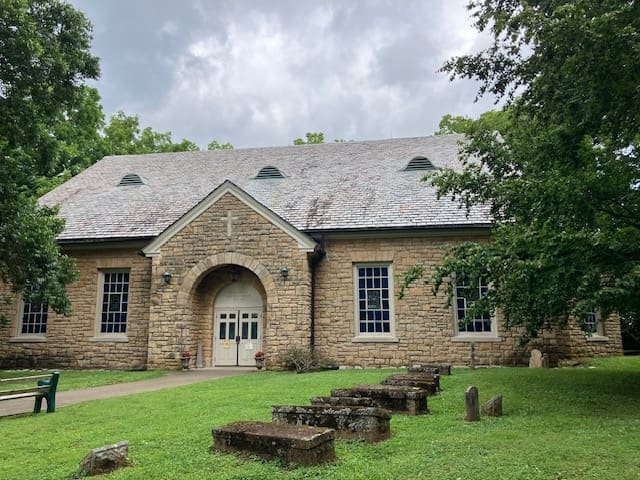
Amid the rolling green hills of central Kentucky’s horse farms lies an historic location of interest to both American history and Christian history, but specifically to the history of the Stone-Campbell Movement. On nearly five acres of land along Route 537, which winds slightly north and to the east of Paris, Kentucky, are three buildings constructed of a distinctive golden-colored limestone (native only to this area) beside an ancient graveyard. One building is the home of James H. Trader, who has served as curator of the site for nearly twenty years. Another building is the Barton Warren Stone Museum (built in 1975) that displays artifacts and information related to the site and to the Stone-Campbell Restoration Movement. And the final building (built from 1954-1957), the largest structure on the site, covers the crown jewel of this historic location: the Cane Ridge Meeting House.
The Cane Ridge congregation began in 1790, when frontiersman Daniel Boone (1734-1820) led a group of Presbyterian settlers to the region and identified the cane-covered ridge as a site for a potential church building. The following year, in 1791, the settlers constructed a fifty-by-thirty-foot, log-cabin church from insect-resistant blue ash timber. The Cane Ridge Church included a pulpit with a floor-level seating area and a balcony that was regularly used as a place for slaves in the area to participate in the worship services.
In 1796, at the tender age of twenty-four, Barton W. Stone (1772-1844) accepted the ministry position for both the Cane Ridge and Concord Presbyterian Churches, a position he held between 1796 and 1812. At his ordination by the Transylvania Presbytery in 1798, Stone verbalized an early Restoration Movement concept when he was asked if he would accept the Westminster Confession of Faith as the system of doctrine taught in the Bible. Stone replied, “I do, so far as I see it consistent with the Word of God.” From its beginning, the Restoration Movement has focused on the Word of God over man-made creeds and doctrines.
While ministering at Cane Ridge, Stone attended a sacramental gathering in Logan County, Kentucky, that unexpectedly sparked a wave of religious fervor in June 1800. Stone planned a similar meeting for August 1801 at Cane Ridge that ultimately became known as the Great Revival and resulted in one of the pivotal religious events of the Second Great Awakening (a period of intense Christian revival in the early 1800s that influenced every aspect of life and faith in America). Crowds estimated in the range of 20,000 people, gathered in the vicinity of the Cane Ridge Church to participate in the sacramental service and the emerging revival excitement. This period of passionate revival at Cane Ridge lasted for several days and soon gained national attention. It has been described by some as the “Pentecost” of America’s Second Great Awakening.
The Presbyterian Synod of Kentucky, frowning upon the “enthusiasm” of the revival movement, called Stone and a group of others to account for their support of the revivals. In response, the revivalist Presbyterians withdrew from the Synod of Kentucky and formed their own governing group: The Springfield Presbytery (centered in what is now Springdale, Ohio). After slightly more than nine months of existence, the revivalist ministers gathered at the Cane Ridge Church on June 28, 1804, and voted to dissolve their fledgling presbytery. The intervening months of study and prayer since their withdrawal from the Kentucky Synod led them to desire an abandonment of human denominations, a return to the beliefs and practices of the New Testament, and to refrain from adding yet another division to the larger movement of Christendom. And so, they composed and issued a document known as The Last Will and Testament of the Springfield Presbytery and decided to drop their denominational affiliations and become “Christians Only.” In The Last Will and Testament of the Springfield Presbytery they wrote, “We will, that this body die, be dissolved, and sink into union with the Body of Christ at large.” This document set the Stone-Campbell Movement in motion and established Stone’s congregation at Cane Ridge as the first church of the Stone-Campbell Restoration Movement.
The church at Cane Ridge would continue serving as place of worship until 1921, when the congregation finally disbanded (after 130 years). Because of the historic significance of the site, however, it was decided to restore the building to its original form in 1932. In addition, the log-cabin church was enclosed inside a beautiful sandstone structure (with historically unique stained-glass windows depicting scenes associated with Stone’s life and ministry) to preserve and protect the building from the elements. Also, after Barton W. Stone’s death in 1844, his earthly remains were removed (in 1847) from his original burial location in Jacksonville, Illinois, to their current resting place in the Cane Ridge graveyard. Upon learning of Stone’s death, Alexander Campbell (1788-1866) noted that he was “the honored instrument of bringing many out of the ranks of human tradition and putting into their hands the Book of Books as their only confession of faith and rule of life.”
There is no admission fee for visiting the Cane Ridge Meeting House, but donations for upkeep and administration of the site are appreciated. The Meeting House welcomes over 10,000 visitors annually and is open daily from 9:00 a.m. to 5:00 p.m. (Sundays 1:00 p.m. to 5:00 p.m.) between April and October. For additional information about the site, visit their official website.
Rick Cherok serves as Managing Editor of Christian Standard, Executive Director of Celtic Christian Mission, and Director of Men’s Services at Kentucky Christian University.

Author: Christian Standard
Contact us at **@********************ia.com







Excellent read!
So helpful. Thank you.
I’m a multi-generation daughter of The Restoration Movement. ‘Been to Cane Ridge as church-small-group activity and recommend visiting. ‘Never knew Daniel Boone history or Stone burial in Jacksonville IL (25 miles from Detroit Christian Church where my father and grandfather served after my great grandfather moved from the Hillsboro Christian Church in OH). My father weekend-ministered to three small KY churches and the old Metamora (IN) Christian Church which to this day has a plaque commemorating A. Campbell’s service there. Dad also taught Bob Russell at CCU who led the Southeast megachurch now showcasing the legacy of Cane Ridge in KY. It’s fun to experience sites of our movement’s origin and spread across the Midwest. I’ve been 77 years in Restoration churches and love what we stand for though it’s great to see other churches getting back to the Bible now. May God bless this country with another revival such as occurred at Cane Ridge!
Being Central Kentucky born and bred, I’ve been blessed to make numerous visits to Cane Ridge to ponder its historic events and significance to Christ’s Church and to America. And it was a great privilege to preach from that historic pulpit, a truly humbling moment in view of those who stood behind it in the congregation’s beginning! It strikes me that, if we could move back closer to the simplicity and forthrightness of those days, today’s Church would be far better off!