How Church Leadership and Alignment Work Together
Church leaders regularly face difficult questions about how closely volunteers and leaders need to align with a congregation’s beliefs, mission, and methods. This framework considers both the level of leadership a person holds and the degree of alignment required, while also accounting for trust, giftedness, and character.
- Greater leadership authority, influence, and public representation generally call for greater alignment.
- Alignment can be evaluated across core Christian essentials, church-defining convictions, important interpretations, and matters of preference and wisdom.
- Leadership decisions should also consider trust, giftedness, and character alongside theological, missional, and methodological alignment.
By Tyler McKenzie
Church leaders, we’ve all been there. You’re scrolling on social media. You see one of your staff or volunteers post something shocking, divisive, scandalous, or theologically wonky. Then all the sudden you are left with a decision, “Can they still serve in the role we have them in?” Or maybe it’s not something you see on social media. Maybe it’s a self-admission of sin. Maybe it’s a rumor that makes its way to your office. Maybe it’s an area of disagreement that emerges after a sermon. What are you supposed to do? Do you have a process for thinking through the dynamic relationship between levels of leadership and alignment? You should. It won’t make the hard conversations any easier to have, but at least you and your church will be clear.
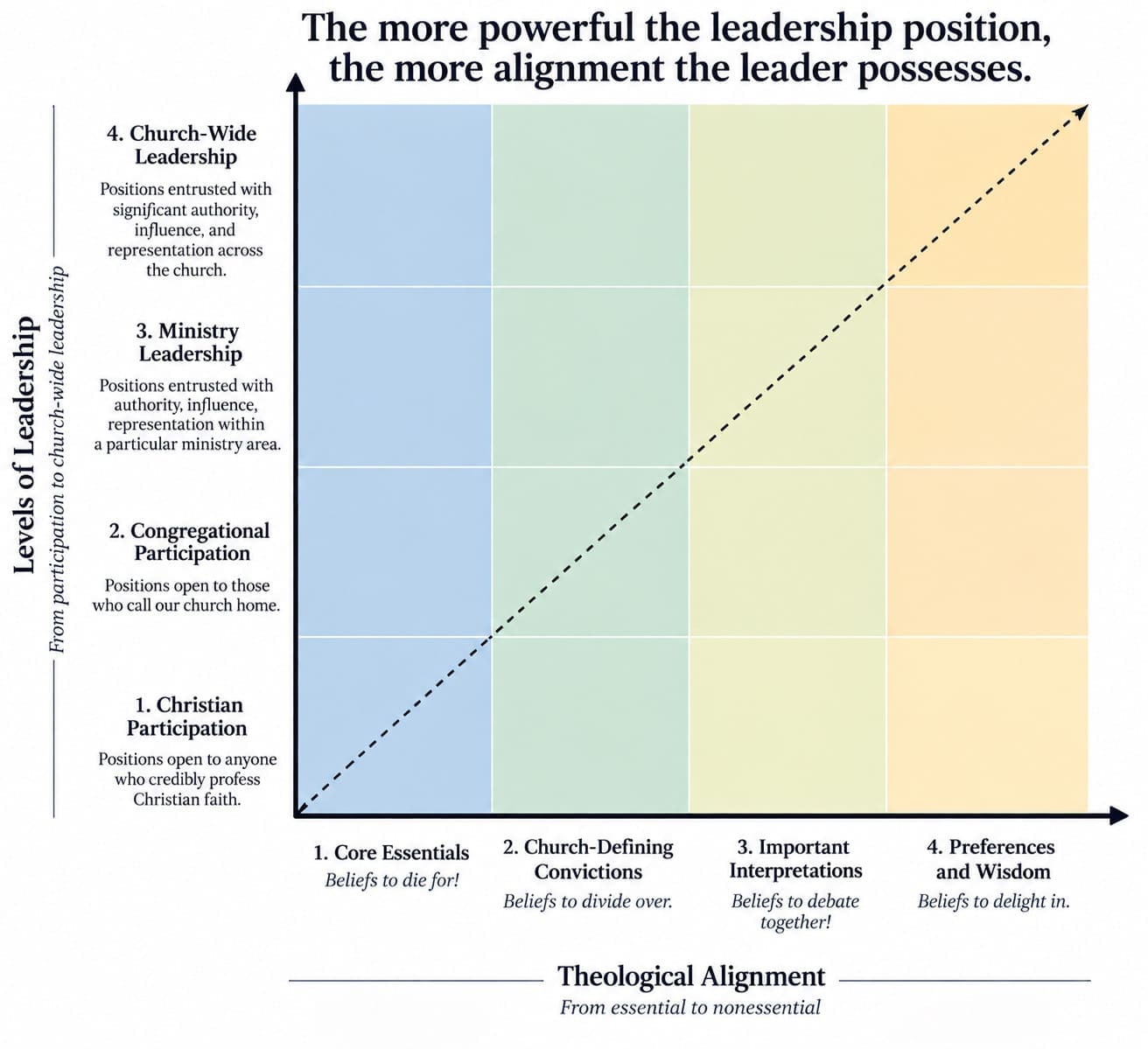
The diagram below represents a good faith effort to answer this: “How much do I need to agree with a person to allow them to serve in our church?” The answer to that question is rarely black and white, and it usually depends on which leadership position they are looking to serve in. If you don’t want to read my rationale, skip to the bottom and check out my sketch (turned into professional looking graphic by AI). If you care about how I came to my conclusions, I’ve tried to be thorough but concise in the following paragraphs.
The diagram will help you visualize how we think through the dynamic relationship between positional leadership and church alignment. The basic rule of thumb you are going to see from me throughout is, the more powerful the leadership position, the more alignment the leader possesses.
The X-Axis: Alignment
The x-axis represents Alignment. When you are plotting a person on this axis, the more alignment they have, the further right they go. I measure alignment in four tiers, starting with the most essential points of unity on the far left and moving toward peripheral issues on the far right. The tiers are listed left-to-right as follows:
- Core Essentials of the Faith—Beliefs to die for!
These are the foundational beliefs that make someone a Christian. For us, these include beliefs like the triune nature of God, the deity and humanity of Christ, his atoning death and bodily resurrection, Scripture as inspired and authoritative, etc.
- Church-Defining Convictions—Beliefs to divide over.
These are denominational distinctives (or in our nondenominational context, local church distinctives) that are core beliefs we see as clearly attested to by Scripture, but other denominations have split over. We don’t think these beliefs are necessary to consider you a Christian, but they are consequential enough to our church that we feel like we should take a hard stance. For us, these include beliefs like baptism, elder governance, the missiological necessity of evangelism and justice work, the biblical-historical view of marriage and sexuality, etc.
- Important Interpretations—Beliefs to debate together.
These are beliefs that are ambiguous and debated enough to passionately wrestle with without breaking fellowship. For us, these include beliefs like gender and church leadership, predestination and the extent of human freedom, continuationism v. cessationism, politics and public theology, etc.
- Preferences and Wisdom—Beliefs to delight in.
These are beliefs that we might enjoy studying and debating but should not divide us. For us, these include beliefs like interpreting the creation story, end times beliefs, worship style, church programming, etc.
To be clear, I kept my lists of specific examples in each tier short on purpose. I believe it is the role of the elders in every local church to prayerfully consider where different beliefs ought to fall. You may put certain things in Tier Two that I have in Tier Three. I may put certain things in Tier Three that you have in Tier Four. Fine. But my greatest encouragement is around Tier One. We must be careful we don’t throw too much into the essentials box.
Another thing worth noting about plotting the x-axis … Theological alignment is not the only type of alignment that matters when deciding if/where someone serves. Missional alignment (the mission, vision, values of the church) and methodological alignment (the ways you chose to do ministry) matter as well. That said, theological alignment is the most important. It’s one thing to disagree on worship style or small group models. It’s an entirely different thing to disagree on the authority of Scripture.
Last thing on the x-axis. When it comes to determining the weight of a specific conviction, there are four considerations that help me place those beliefs that I’m on the fence about.
- Biblical Clarity—How clear is the Bible on this?
- Theological Centrality—How much weight does Scripture place on this?
- Historical Agreement—How united has the historic “big-C” Church been on this?
- Institutional Consequence—How great is the practical impact of this belief here in my local context?
The Y-Axis: Leadership Levels
The y-axis (vertical) represents Leadership Levels. As you look on the y-axis, you will notice that I have identified four levels.
- Christian Participation—Positions open to anyone who credibly professes Christian faith.
- Congregational Participation—Positions open to those who call our church their home.
- Ministry Leadership—Positions entrusted with authority, influence, and/or representation within a particular ministry area.
- Church-Wide Leadership—Positions entrusted with significant authority, influence, and/or representation across the church.
When it comes to determining the weight of a specific leadership position in the church, I grade them based on three measurements:
- Hierarchical Authority—How much formal authority does this position exercise?
The formal authority a position has to govern the church. High levels of hierarchical authority in my church would be roles like elders, executive ministers, ministry leaders, etc.
- Formational Influence—How much does this position shape what people believe/become?
This is a position’s ability to shape the beliefs, values, practices, and spiritual development of others, whether or not that position possesses formal authority over others. Positions that have a lot of formational influence in my context would be teachers, small group leaders, curriculum developers, etc.
- Public Representation—How prominently is this position perceived as representing us?
This is the degree to which a position is recognized as speaking or acting on behalf of the church to the broader community. Positions that have a lot of public representation in my context would include front-stage worship leaders, our social media director, and anyone who teaches in our large gatherings on Sundays.
It’s important to lay out all three of these measurements because it is possible for a position to score high on one but not the other two. Take for example a volunteer song leader. They are regularly front stage leading the congregation in song and prayer. They are a face people associate with your church. But they don’t hold a lot of formational influence in that they are singing pre-scripted songs. They also don’t have any hierarchical authority. Nonetheless, with that level of public representation, you may choose (like we do) to have a high bar of alignment for front-stage leaders because of how visible they are in the community.
A Few Things Not Considered
There are three things the x and y axes do not consider. Anyone of these could dramatically impact whether or not you place a specific individual into a role that they may be qualified for on paper.
- Trust – Does our leadership trust them? Have they been in the community and at the church long enough? Do we really know them? Do they have a social media presence that is concerning?
- Giftedness – Has the Spriit of God gifted them for this? Does it seem evident that they could actually lead in this position well? Do they have a sense of passion and calling for it?
- Character – Does their “above-reproachedness” meet their leadership position? Are they a person of integrity, Christlikeness, love, and holiness?
Okay, enough explaining. Think this through, y’all. Maybe even play around with the diagram. The dotted diagonal line is meant to be a reference for where you might place certain positions. Perhaps the elder or lead minister would be in the top right. Perhaps a volunteer at a local nonprofit feeding the hungry would be in the bottom left. I would love your gentle feedback on what you might do differently or on how this might be made better. My big hope is that it will help you have important conversations about leadership and alignment that will bring clarity to your church.

Author: Tyler McKenzie
Tyler McKenzie serves as lead pastor at Northeast Christian Church in Louisville, Kentucky. He also produces a fun Bible podcast for parents and their kids called “the Preacher and the Piano man.”