Are People Really returning to Church in the United States?
Public signs of renewed Christian interest are showing up in popular culture, campus revivals, and research trends. This article highlights data points pointing to a possible reversal in church attendance and Bible engagement, especially among younger adults. It also offers practical steps churches can take to prepare for first-time or returning guests.
- Research and reporting point to rising church attendance and Bible engagement, led in part by younger generations.
- Campus revivals and public faith stories are contributing to a broader “spiritual vibe shift.”
- Churches can prepare by improving the guest experience before, during, and after a visit.
Did you see the video clip of Hulk Hogan (August 23, 2023), or Kid Rock (January 27, 2024) sharing their faith in Jesus on The Joe Rogan Experience podcast (the top podcast in the world)? Whether it is singer Justin Bieber, comedian Russell Brand, or actor Chris Pratt, there’s been a resurgence of Christianity in popular culture. The New York Times is calling it a “spiritual vibe shift” as many famous people turn to faith and publicly proclaim their newfound belief.
Couple that with the revivals taking place across college campuses. It began at Asbury College in February 2023 and continued to spread: Auburn University in September 2023, Florida State University in March 2024, Ohio State University in August 2024, Purdue University in March 2025, and University of Cincinnati in November 2025, just to name just a few.
Even credentialed intellectuals are becoming Christians. Tom Holland, the author from Cambridge and Oxford, considered himself an atheist. But in 2016, he wrote an article titled, “Why I Was Wrong About Christianity.” In 2019 he authored the influential book, Dominion: How the Christian Revolution Remade the World ,that has helped many people come (or return) to faith. Also, consider Ayaan Hirsi Ali, who left Islamic extremism and rose to prominence as a leader in the New Atheist Movement. In November 2023, she shocked the world in an article for the online news outlet Unherd, titled, “Why I Am Now a Christian.” She eventually found atheism to be lacking and realized that secular humanism led to a bleak place.
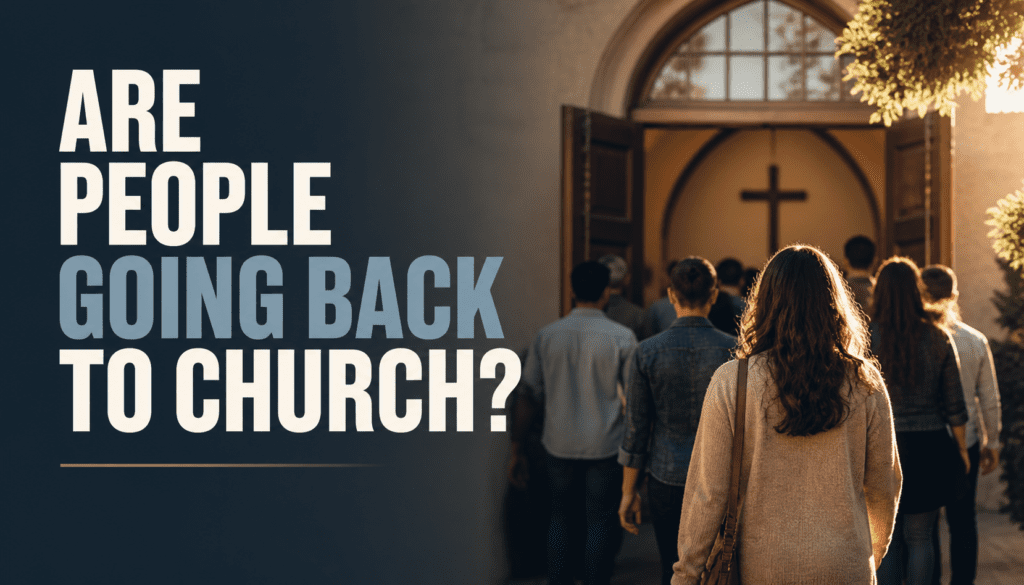
Are people really going back to church?
For several decades, people observed the decline of Christianity in America. However, there’s been a shift, and recent research confirms we are now experiencing a reversal of the previous trends. Take these three data points as an example:
Resurgence in Church Attendance
Church attendance was declining, but new research from Barna Group is seeing “a historic reversal.” And it is younger generations—particularly young men—are leading the way.
Increased Bible Sales and Reading
The Wall Street Journal reported at the end of 2024 that Bible sales rose by 22 percent in the U.S. At the end of 2025, the L.A. Times reported that Bible sales were up another 11 percent over the previous year. Barna Group showed that Bible reading spiked in 2025, and once again it was young adults—specifically young men—leading the way.
The New “Quiet Revival”
In the United Kingdom, this growth in Christianity has been dubbed “The Quiet Revival.” The Bible Society found church attendance has grown by over 2 million people in six years, which represents a 50 percent increase. Again, this is being led by young adults, especially young men.
Preparing for Their Return
Imagine your next-door neighbor decides to visit your church. What would they experience? Our hope is they would experience what Paul wrote about in 1 Corinthians 14:24-25. It is important to emphasize that God causes growth (1 Corinthians 3:6). Renewal and revival are the work of the Holy Spirit and prayer. At the same time, God calls us to the work of ministry as faithful stewards of his grace (1 Peter 4:10).
What can we do to prepare for those coming back to church? Are there barriers we need to remove to make it possible for them to experience God? Is there anything before, during, or after their visit that we need to improve?
Before: Does your website clearly show the times of your services and where you are located? Are the images welcoming? Is the content clear? Could someone new see themselves visiting your church? Does the signage explain where to park, check in kids, or find a restroom?
During: Are your members encouraged to be friendly and welcoming? Is your worship service designed to incorporate guests every single week? Does someone explain how your church observes Communion? Do you explain terminology and avoid insider language (i.e., ministry-specific terminology such as come to “Fusion” or join us at “Ignite”)?
After: Do you offer clear next steps for new people? Is there a follow-up process thanking them for their visit and inviting them back? What information do you collect from them and what will you invite them back to (i.e., events, another worship service, a new-person class)?
Don’t get overwhelmed or try to do everything all at once. Choose one category—before, during, after—or one item in each category to work on. Spend dedicated time each week updating your guest experience and over the course of a month you will have made progress. It may also be helpful to invite others into the process or to empower a gifted team to create a rough draft for approval. The goal is thinking through a visitor’s perspective and preparing to welcome, engage, and follow up with them. After all, people are coming back to church!

Author: Seth Bryant
Seth Bryant is Lead Pastor of New Hope Christian Church, Roanoke, Virginia. A graduate of Johnson University and Cincinnati Bible Seminary, Seth also serves on the board of e2: Effective Elders. He and his wife have two children and a dog, and they enjoy spending time outdoors in the Blue Ridge Mountains.