What’s the Right Sort of Institution for an Anti-Institutional Bunch Like Us?
Nondenominational churches are growing, but can they build lasting influence without becoming denominations? Explore the Restoration Movement’s legacy, the institutional strength of Reformed evangelicalism, and lessons from the North American Christian Convention.

Why Nondenominational Church Growth Needs Strong Institutions
Nondenominational churches have experienced remarkable growth, but their influence has not always matched their numbers. Comparing the institutional strength of Reformed evangelicalism with the Restoration Movement, this article explores how Christian institutions can extend a movement’s influence without sacrificing local church independence. The North American Christian Convention offers a historical model of what that balance can look like.
- Reformed evangelical institutions demonstrate how seminaries, publishing networks, and leadership organizations can reinforce one another and extend their influence.
- Nondenominational growth reflects principles historically associated with the Restoration Movement, including congregational autonomy and biblical authority.
- The North American Christian Convention illustrates how shared institutions can strengthen independent churches without becoming a denomination.
From 2021 to 2024, I was in an educational cohort with about 15 other leaders from larger churches. The cohort was broadly evangelical. We had representation from the Anglicans, Assemblies of God, Presbyterians, Southern Baptists, and even a couple Stone-Campbellites! One of the guys I grew close to is in leadership at The Gospel Coalition. His theological leanings are strongly reformed, as were many of the leaders in the cohort. I playfully called them the “Reformed bros” to affectionately annoy them.
Why the Reformed Bros Have More Influence
One day, my buddy and I were discussing some of the differences between the Restoration Movement and the Reformed traditions represented there, and he made a comment that stuck with me. I can’t remember precisely how he said it, but this catches the essence of it: “When it comes to church growth, you guys (nondenominational Christians) are blowing us out of the water. But when it comes to institutions, we are further along. That’s why we have more influence.”
He’s not wrong! I would argue that the Reformed theological camp has the most powerful and most prestigious institutional infrastructure of any Protestant tradition in the United States. Reformed evangelicalism has not just united around their theology, they have built an ecosystem capable of disseminating it broadly, deeply, and generationally.
They have a network of strong seminaries with accomplished scholars doing a lot of important publishing and teaching (Reformed Theological Seminary, Westminster TS, Covenant TS, Southern TS, Calvin TS . . . to name a few). They have built The Gospel Coalition, which has become the dominant theological voice of the Google era. Search almost any religious question, controversy, or cultural issue, and chances are high that a TGC article will pop. And TGC does much more than online articles. They put on conferences, host podcasts, network pastors, and publish media, educational resources, and books. There are also institutions like Desiring God, Ligonier Ministries, 9Marks, Crossway, and Acts 29. They have united to build publishing houses, church networks, websites, leadership pipelines, and more.
The important point here is that these institutions reinforce one another in a way that multiplies and magnifies their influence. Someone encounters John Piper online, then reads a Crossway book, then begins listening to a Gospel Coalition podcast, then attends CROSS CON, then enrolls at Southern, then absorbs 9Marks ecclesiology, then eventually pastors or plants a church that introduces another generation to the same ecosystem. And, as an interesting sidebar, this ecosystem has been especially good at building and promoting its celebrities—Piper, Keller, Sproul, DeYoung, Chandler, Driscoll, etc. (the list is long).
For what it’s worth, we have great churches, gifted leaders, brilliant scholars, formidable seminaries, and dynamic parachurch ministries too! But it’s my argument that my buddy is right. Their institutional infrastructure has been stronger than ours historically. This is why they have an outsized influence comparatively.
45 Million Nondenominational Christians?
The institutional excellence wasn’t the only thing my Reformed bro was right about. When it comes to church growth, the non-denoms are blowing everyone away. The numbers are there to prove it. Because of our anti-institutional nature, we are hard to count. But according to the 2020 Religion Census, there are over 21 million nondenominational Christians in the U.S. Ryan Burge, leading American religion statistician, points out that this could be way low, given that 14% of all Americans say they are nondenominational. If you extrapolate that out to the country’s entire population, that is up to 45 million people (https://www.graphsaboutreligion.com/p/the-future-of-american-christianity).
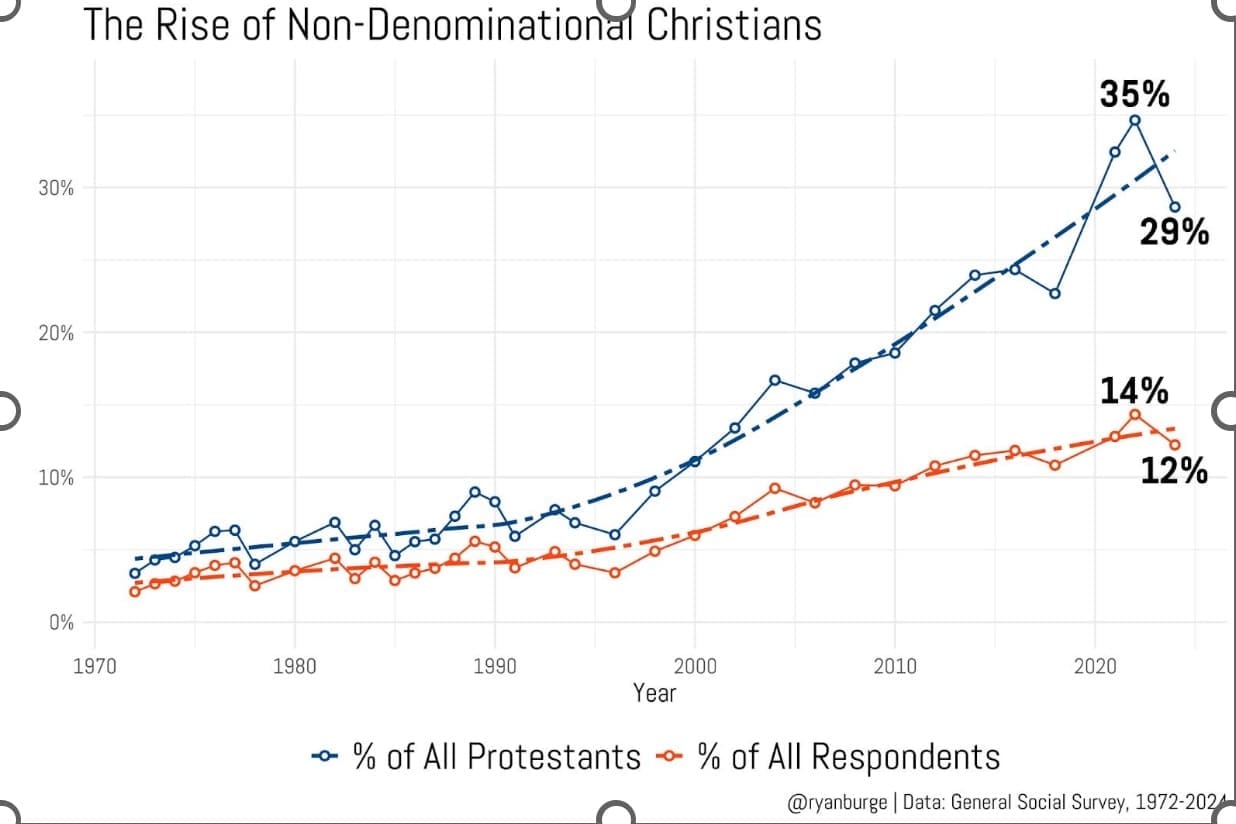
Burge reports that since 1972, non-denoms have risen from a 5 percent market share of Protestants to a whopping 30 percent! Just 1 in 20 Protestant Christians identified as nondenominational in the 1970s. Today, that number is now 1 in 3. He goes on to say that the future looks bright for non-denoms because our overall age profile is significantly younger than the largest protestant denominations, and we are also excelling in racial diversity. This is all happening while the growth trends of other denominations are heading in the opposite direction.
Nondenominational Christians Aren’t All Stone-Campbellites . . . or Are They?
That said, there is one very important caveat I need to state clearly. Many churches considered as “Nondenominational Christian Churches” in the data would not identify as Stone-Campbell churches with a heritage rooted in the Restoration Movement. They are not united perfectly in theology, ecclesiology, or praxis. What unites these nondenominational churches are their:
- shared rejection of denominational affiliation
- desire for local church autonomy
- minimal creedal commitments in lieu of a high view of biblical authority.
Ok. Let’s just say it out loud! These nondenominational churches may not claim a RM heritage, but that profile sure does sound very-very-very RM! This is where things get interesting.
I cannot attribute the growth of nondenominational Christian churches directly to Stone-Campbell Christianity. That would be presuming on the data something we can’t clearly prove.
But historically, the Stone-Campbell Movement was one of the great and unusually early adopters of all this! We deserve at least a little credit, right!?
I have heard much concern from Restoration Movement leaders that we are experiencing a loss of historical memory. They are right. Many of our churches have little to no knowledge of our roots. But, that said, while our history may not be popular, our ways are! While the names Stone and Campbell are known by fewer and fewer, key aspects of their vision are embraced by more and more. I’m not a movement historian, but I wonder, wouldn’t our founding fathers be happy about this?
In the 1804 Last Will and Testament of the Springfield Presbytery, Barton Stone and his colleagues wrote, “We will, that our name of distinction . . . be forgotten.” The ultimate hope of our movement is that any distinctive denominational identity would be absorbed and forgotten in the larger body of Christ. They willed that success would not be that everyone become Stone-Campbell Christians, but rather, that everyone stopped identifying around these markers all together and authority be returned to Scripture and local congregations.
I wonder . . . If we were able to go back to 1808 and tell them that over 200 years from now their vision would be the defining reality of American Christianity, that 1 in 3 Protestants summing up to potentially 45 million Christians will have rejected denominational affiliation, favored local church autonomy, and chosen the Bible as the ultimate authority for theology and practice . . . I think they might at least crack a smile.
Institutions the Anti-Institutional Can Support
Bringing the article full circle, in this moment of growth and favor, establishing the right sort of institutions can help us maximize our influence. We can create and support great institutions while still remaining fiercely anti-institutional. What we need is the right sort of institutions . . . like the North American Christian Convention. Today, we remember the NACC 100 years after its first gathering. While this institution may be no more, it served a great purpose for its time. At its irreducible minimums, there were three things that made the North American work as an institution (in our anti-institutional movement):
- Power: There was a revolving presidency rather than entrenched leadership.
- Community: It was focused on gathering people rather than controlling them. It reminded our churches that, while we may be operating independently, independence does not mean isolation.
- Word: It was centered around Bible preaching rather than church polity. No delegates. No voting. No legislating. No electing. Just great preaching and teaching that informed and inspired.
I would not be writing for Christian Standard or preaching at one of our churches (Northeast Christian Church in Louisville) if it wasn’t for the example of my dad, a preacher. And my dad received his call to preach listening to Wayne Smith at the North American Christian Convention in the 1970s. “Preach the Word, brother! Preach it! Put it high where men can teach it; put it low where men can reach it. But preach the Word, brother! Preach it!” What made the NACC the right sort of institution is that it gave our nondenominational churches the strength of a denomination without making us one. That’s the sort of institution I can get behind.

Author: Tyler McKenzie
Tyler McKenzie serves as lead pastor at Northeast Christian Church in Louisville, Kentucky. He also produces a fun Bible podcast for parents and their kids called “the Preacher and the Piano man.”
Sponsored

For 160 years Christian Standard has served the churches of the Restoration Movement. Your gift keeps articles like this one free for every church leader.
Sponsored

Keep reading
More in Restoration Movement History

The NACC: A Story of Separation, Independence, and Faithfulness

A Century Ago: The Conflict and Controversy That Created the North American Christian Convention

Victor Glover: Faith, Influence, and a Legacy Beyond the Horizon
From the archive
Christian Standard has covered this since 1866.