Articles for tag: Denominationalism

A Movement Away from Denominationalism: What’s It Mean for Us?

By Ben Cachiaras  When asked about the key to his success, Dick Clark, of American Bandstand fame, replied, “I don’t set trends. I just find out what they are and exploit them.” Worrying about trends can get you into trouble. So can ignoring them. At the least, it seems wise for church leaders to strive to be like the men of Issachar “who understood the times and knew what Israel should do” (1 Chronicles 12:32). In this spirit, I was asked to consider how we might understand and respond to the rising trends noted in “A ‘Postdenominational’ Era: Inside the

If You Lead Alone, You're Doing It Wrong

A Cutting-Edge Way to Find New Ministry Partners Online . . . and in Person By Mark Kitts I’m still smarting from the recent closing of my alma mater, once known as “the Flagship College” of the independent Christian churches (ICC). Our schools, publications, and national gatherings have historically been unifying bastions of the Restoration Movement. But these institutions have been losing influence as people have voted with their feet and their wallets. Is it because Restoration ideals have lost their relevance? I don’t think so. I see these ideals being adopted as never before. Denominationalism is declining at an

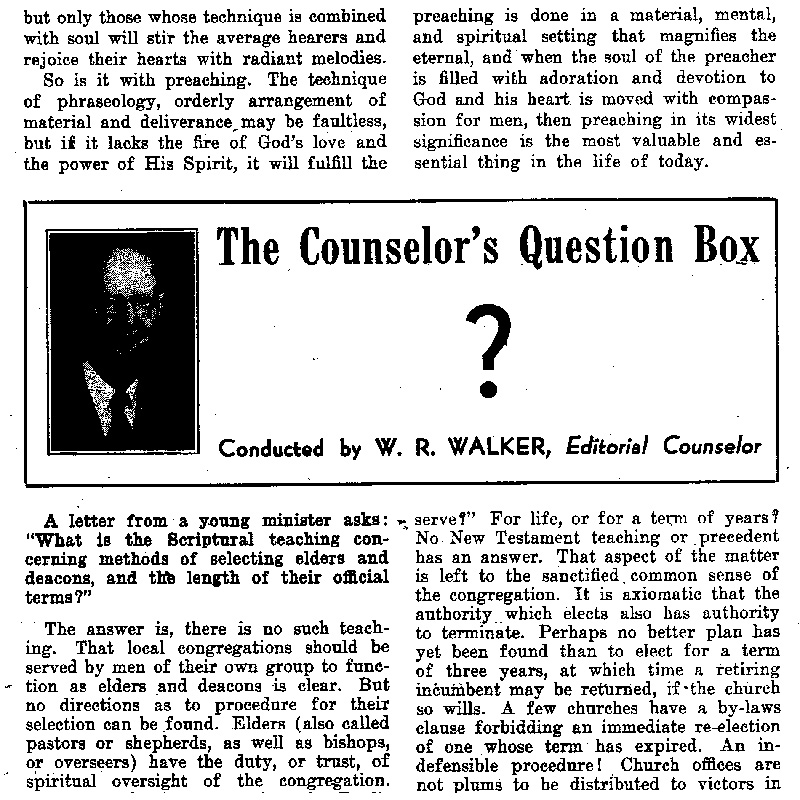
W. R. Walker: “The Counselor’s Question Box”

In last week’s column we acquainted readers with W. R. Walker by sharing a 1963 article about him published a few weeks after his death. Walker preached for almost two decades in churches in northeast Ohio and, later, for 28 years (1920-48) at Indianola Church of Christ in Columbus, Ohio. In between, from approximately 1914 to 1920, he taught at Christian colleges. Walker also was part of Standard Publishing for about 40 years. In addition to serving as president from the 1920s until 1955, Walker was listed as “editorial counselor” within the pages of Christian Standard from 1945 until his

A New Critical Juncture in the Restoration Movement

By Jerry Harris The Restoration Movement has faced critical junctures at least twice in its history. The first time was after the Civil War. Deep wounds remained as the nation endeavored to reconstruct itself. Death had silenced the great leaders of our movement: Barton Stone in 1844, Thomas Campbell in 1854, John T. Johnson in 1856, Walter Scott in 1861, Alexander Campbell in 1866, and “Raccoon” John Smith in 1868. Division came from many voices that tore at the fabric of the simple principles of unity based in the restoration of the church of the New Testament. It was into

Now More Than Ever: Embracing the DNA that Created a Movement

By Rubel Shelly Did you ever agree to something””only to regret it later? As I begin writing this piece, that feeling hovers over me. I will not characterize the Stone-Campbell Movement as others would. (Some have already been offended that I call it the Stone-Campbell Movement rather than the Restoration Movement; it is a movement of ideas and ideals, not particular historical characters, they say. Others were offended that I dared call it a “movement” at all; it is theological rediscovery and return, not a human program.) See? I told you I didn”t feel good about this. I”m in trouble

Staying Connected”“It”s to Our Benefit!

By Mark A. Taylor The following column first appeared at this site in 2008, but it strikes me, with a couple of tweaks,  as remarkably current still today. So while I’m on vacation this week, let me offer it for your consideration. I’m guessing many readers have forgotten it or missed it when it first appeared! Christ followers outside our movement are often intrigued when they get to know us better. They”re impressed first with the accomplishments of Christian churches and churches of Christ: “¢ Dynamic missions work “¢ World-class church planting initiatives “¢ Creative leadership of new approaches like

Considering the Question of “˜Them” and “˜Us” and “˜Ours”

By Mark A. Taylor The spirit of the day was one of inclusiveness. “Denominationalism is dead.” “Sectarianism is to be shunned.” “People today are more interested in Jesus than any human hierarchy or divisions.” Hear, hear for the plea to be “Christians only.” But this discussion was not just about whom to treat as Christians, but also about whom to include in one of “our” meetings. And here opinions were not as uniform. If the meeting is by and for “us,” some wondered, shouldn”t those credentialed by the meeting planners be from among “us”? Their question of “them” and “us”

I Have a Family

By Jim Tune My father died just a few months ago. It hasn”t been easy, and I feel the loss keenly. His death has prompted a desire to know more about my dad, his extended family, and his heritage. As a godly father and a devoted worker for Christ, he has also marked me with a legacy””one I intend to celebrate, embrace, and pass on. No one would expect any less.   The Family I Chose From a faith perspective, I also have a family. I didn”t join it as the result of a father”s will or by accident. I

Our Decision, Our Opportunity

By Mark A. Taylor Some in Christian churches and churches of Christ are worried about the future of our movement. Others aren”t thinking about our movement much at all””its past or its future. But regardless of whether we”re fretting or forgetting about our future, it is still before us, and we ignore it at our peril. “The future doesn”t care if you believe in it,” says marketing guru and entrepreneur Seth Godin. Godin tells his audiences they can invent their own future. Part of that process involves looking carefully at what”s happening now. Some trends to consider: Denominationalism is dead.

Remembering, Renewal, and Celebration

By Mark A. Taylor Once in awhile an article actually brings us to tears while we”re preparing it for print. Not often, mind you. But it does happen. It happened this week as one of our staff was formatting Ethan Magness”s articles about the Lord”s Supper. His insights are among several powerful pieces in this issue to help readers think afresh about Communion. He challenges us to lift our weekly observance above thoughtless routine. “The danger posed by meaningless ritual is no reason to stop the ritual,” he says. And he suggests how to keep our Communion celebrations alive. Another

Preview/Order “What Kind of Church Is This?”

                What Kind of Church Is This? This 8-page brochure for visitors and new members has sold hundreds of thousands of copies! Updated now with current information and a fresh, new look, it is the perfect addition to welcome packets, new member folders, or other outreach products. Explains history and philosophy of Restoration Movement churches in a winsome, colorful way. CLICK HERE TO ORDER PRINTED COPIES (sold in lots of 100; $30 per 100) CLICK HERE TO ORDER A DOWNLOADABLE PDF (post on your Web site; print unlimited copies for $9.99) READ LEROY

The Emerging Church and the Stone-Campbell Movement: Some Striking Similarities (Part 1)

By William R. Baker See the Sidebar: “The Emerging Church: A Brief History and Helpful Resources”     "Emerging churches are communities that practice the way of Jesus within postmodern cultures," say Eddie Gibbs and Ryan Bolger.1 We might wonder, From what are these churches emerging? Simply stated, they are emerging from a modern world to a postmodern world.2    Yet, thinkers about the emerging church also want to place this mantra of “emerging” on the church generally in the past, present, and future.3 Thus, in the New Testament writings of Paul, we see the Greco-Roman church “emerge” from the

Restoration Movement Q&A 1

Answers from Gene Carter, Becky Ahlberg, and Eric Ahlberg Does the Restoration Movement Matter? Answers from Gene Carter, Becky Ahlberg, and Eric Ahlberg Gene Carter is retired in Playa del Rey, California, after 55 years of ministry, 25 in the Midwest and 30 in Southern California. Becky Ahlberg is worship and neighborhood engagement minister at Anaheim (California) First Christian Church and a CHRISTIAN STANDARD contributing editor. Eric Ahlberg is a member of Anaheim First Christian and a forensic structural engineer at Exponent Corporation in Irvine, California. Do you feel as strongly about being a part of the Restoration Movement today

This Is What”s “˜Actually Happening”

By Mark A. Taylor If you read only one article in this special NACC Preview Issue, be sure you see the interview with convention president Cam Huxford. Here”s a dialogue with a contemporary church builder who knows about evangelism, preaching, and servanthood. Here”s a preacher who speaks with humility about great leaders in our fellowship while ignoring the fact that he has become one of them. Here”s a fellow with his eyes focused on the future, but he shows no enthusiasm for throwing out the past. He”s young enough to appeal to emerging leaders and old enough to speak with

Why I Came Back to the Christian Church

By Jeffrey A. Metzger Actually, I never left the Christian church. But I did spend almost five years of my life preaching for two denominational churches and working to export my biblical and Restoration principles and understandings. It is also true that eight years ago I left a large denominational church (one of the largest in the denomination) near New York City to start River Hills Christian Church (www.riverhillscc.com) in suburban Cincinnati. My goals for crossing lines were simple: to make Christ known and to preach and teach the Bible. People everywhere need Jesus. People everywhere deserve to know and

Secret Link