Articles for tag: Hermeneutics

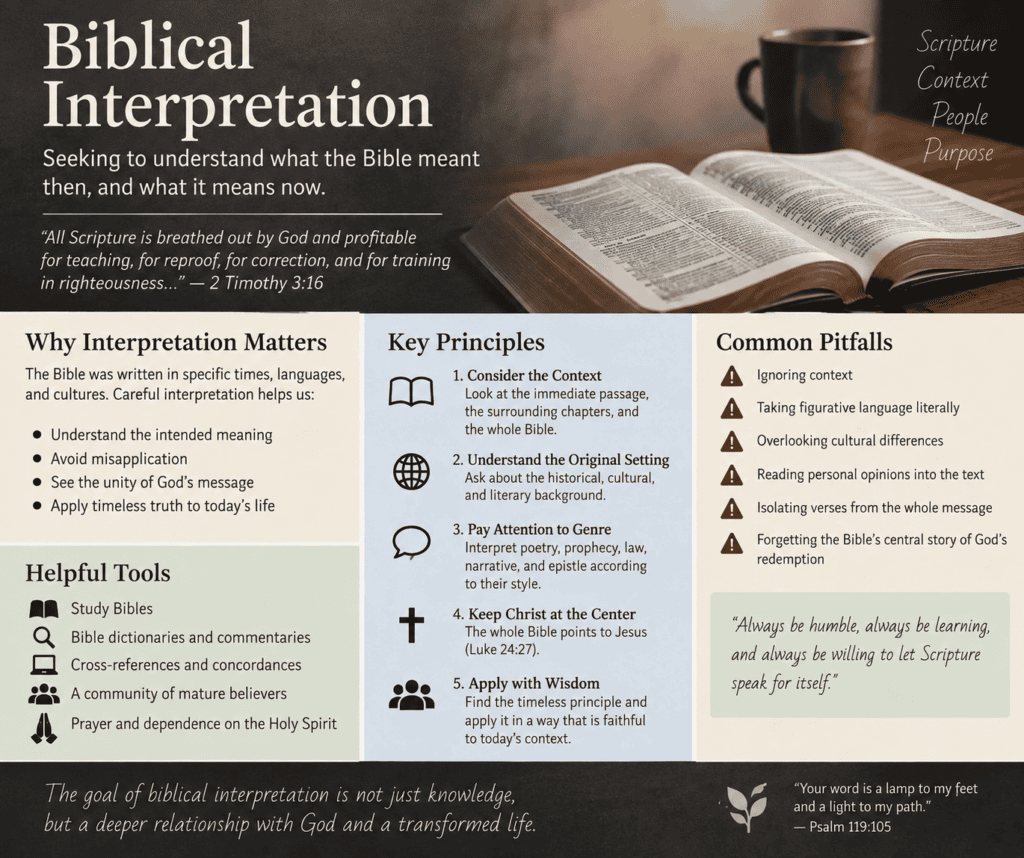
Lesson for December 9, 2018: Whole Truth (Luke 1:14; 24:17-27)

Dr. Mark Scott wrote this treatment of the International Sunday School Lesson. Scott teaches preaching and New Testament at Ozark Christian College, Joplin, Missouri. This lesson treatment is published in issue no. 13 (weeks 49–53; December 9–30, 2018) of The Lookout magazine, and is also available online at www.lookoutmag.com. Image: This painting, Der Gang nach Emmaus (1837), by Austrian painter Joseph von Fuhrich, Is a depiction of Cleopas and another disciple encountering Jesus on the Road to Emmaus. Courtesy of Wikimedia Commons. ______ Lesson Aim: Look in the whole of Scripture for what God reveals about Jesus.. ______ By Mark Scott  The basis for discerning the

Lost in Translation

By Jim Tune I wrote my message quickly and fired it off. Just seconds after clicking Send, it dawned on me with mortifying clarity that I had sent the text message to the wrong recipient. My message fortunately was not overly sensitive, rude, or confidential. Still, it left room for both misunderstanding and embarrassment. I”m guessing this experience is not unique to me. We”ve all been in a situation where someone reads a message intended for someone else that potentially could lead to misunderstanding and conflict. I was relieved when the unintended recipient responded graciously and with minimal offense. It

Finding the Right Answers

By Matt Johnson Everyday Theology, as its subtitle promises, tells us How to Read Cultural Texts and Interpret Trends.  How does your faith speak to human rights, pop music, or designer funerals? Is there any benefit to buying a ticket for the latest Hollywood blockbuster? When should we embrace the hurry of modern American culture, and when should we slow down? What does the proliferation of the blogosphere mean to our culture and the church? Complicated questions have complicated answers, and anyone who tells you otherwise is selling you something less than the gospel. So I appreciated Everyday Theology (Grand Rapids:

Books for Bible Students: Reading the Bible for All Its Worth

By Mark Matson If I had to choose just one Bible handbook to accompany solid Bible study, it would be How to Read the Bible for All Its Worth (Zondervan) by Gordon Fee and Douglas Stuart, both well-known and respected biblical scholars. This book, now in its third edition, has proven itself over three decades. The first edition, which came out in 1981, is still valuable, and the latest edition is a real treat. I use this book for college and seminary classes, and I also recommend it to my church. Fee and Stuart”s book is not a handbook, as

Should Women Preach? (The Story of One Bible College Faculty’s Quest for an Answer)

By Matt Proctor In the book Children’s Letters to God, one young girl wrote: “Dear God, are boys better than girls? I know you are one, but try to be fair.” It’s an age-old question: what does God think about women and, specifically, women’s roles in the church? It’s also a controversial question. The April 2013 article “Women Preaching” generated more comments on CHRISTIAN STANDARD’s website than any other article last year. The article mentioned that Ozark Christian College offers a preaching class for women, and some readers wondered about the biblical rationale for such a class. (By the way,

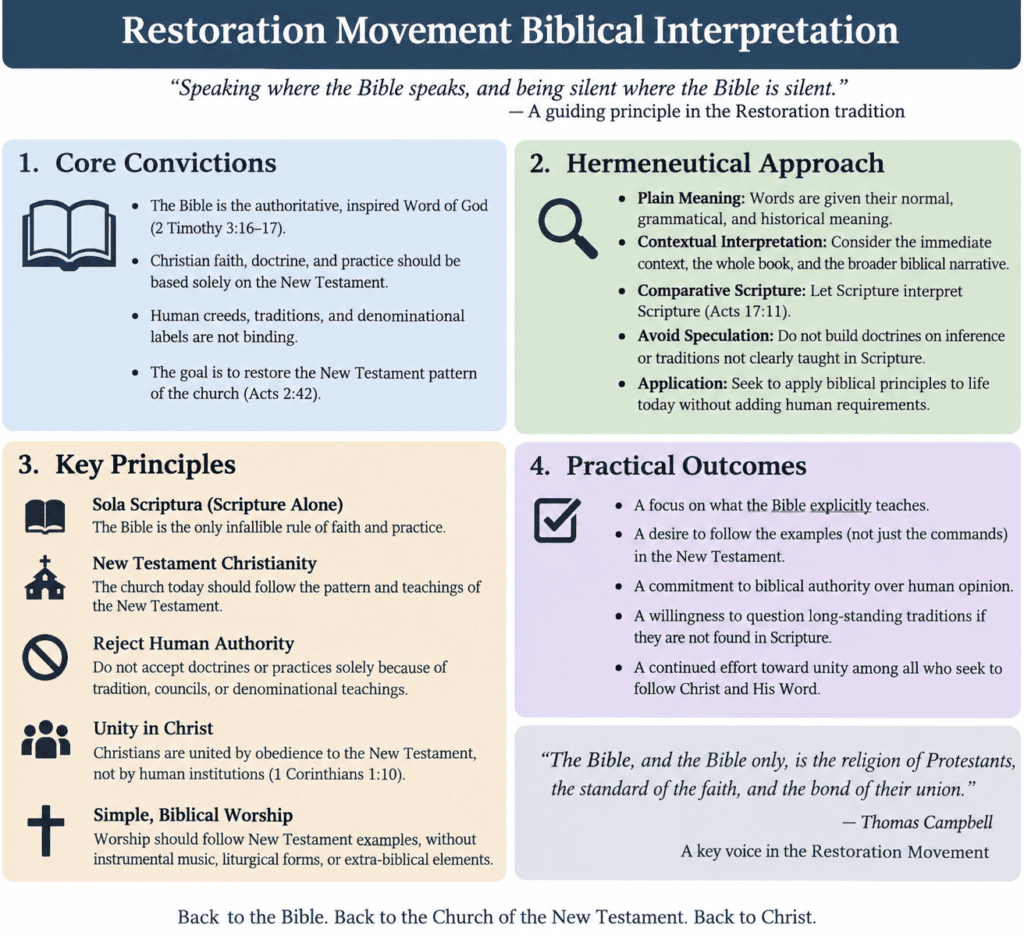
Biblical Interpretation in the Restoration Movement

By Mark Weedman The history of the Restoration Movement is diverse and complex, and summarizing it is necessarily difficult. But some general patterns do emerge, and we can use those patterns to gain an overview of how followers of the Restoration Movement have approached biblical interpretation. Three moments in that history stand out as especially important in shaping how Thomas and Alexander Campbell and their followers would interpret the Bible. The first was the appearance of Thomas Campbell”s Declaration and Address, a seminal document that established the movement”s governing plea. The second moment was a debate between Isaac Errett and

Reading the Text on Its Own Terms

By Mark Scott “Good Bible interpretation is letting the text have its own voice.” “True interpretation is what the author intended to say.” “Always strive for the AIM (author”s intended meaning).” “A text cannot mean what it never meant.” “Meaning is singular; significance is plural.”   I heard and/or read all of the above statements in my Bible college days. Each one made sense to me. I trusted their sources. I embraced them. They served me well. I was good to go on interpreting the Scriptures. But something happened along the way. The supposed plain talk of interpreting the Bible

Application Without Heresy

By Daniel Overdorf I hiked a trail in the Smoky Mountains with some friends last spring. I was refreshed by the crisp air, mountain peaks, and conversation. All the fresh mountain air I”d inhaled came out in a single gasp, however, when we approached a 20-foot bridge that crosses a ravine. The term bridge may overstate the reality””a park ranger, with a devilish grin in place, positioned what looked like a long railroad tie across the canyon, strung a couple of wires to function as handrails, and invited weekend hikers to test their mettle. I prefer to leave my mettle

Getting the Most from the Epistles (Part Two)

By Matt Proctor   We have seen that the New Testament Epistles are published apostolic sermons intended to be read publicly to the recipient churches””with rich theological content, skillful rhetorical crafting, and deeply personal emotion. Now let me suggest five questions that can help you understand these sometimes-difficult books.   Have I Read the Entire Letter? Gordon Fee and Douglas Stuart give this challenge: “You need to develop the habit of reading the whole letter through in one sitting. You will need to block out an hour or so to do this, but nothing can ever substitute for this exercise. It is the

The Tyranny of the Paradigm (Part 2)

Read “The Tyranny of the Paradigm (Part 1)” Read “The Tyranny of the Paradigm (Part 3)” _________________ By Jack W. Cottrell Previously I noted that Michael Denton speaks of how modern science regards Darwinian evolution as the determinative paradigm or controlling interpretive principle to which all scientific data must be made to conform””even when the data are in conflict with the paradigm. He calls this faulty methodology the “priority of the paradigm” (à la Thomas Kuhn). In that earlier essay I applied this concept to certain faulty theological systems, which likewise are distorted by the tyranny of their respective paradigms.

FROM MY BOOKSHELF: For Presiders, Preachers, Prayers, and Other Leaders

By LeRoy Lawson Clinton J. Holloway, Lest We Forget: Meditations at the Meal of Remembrance (Cold Tree Press, 2008). August 2008 featured selections in Christian Standard from this collection by Clinton Holloway of meditations on the Lord”s Supper. This helpful book responds to a need many a presider feels when trying to offer a fresh thought before the worshipers partake. Some of Holloway”s offerings are refreshingly original, others more predictable, and yet others will spark your own imagination. Each focuses our attention on the reason for our worship. And, to one who has sat through””and even been guilty of presenting””sometimes

Interview with Perry Stepp

By Brad Dupray From an early age, Perry Stepp was captivated by the complexity of Scripture. “As a kid I would listen to my dad preach and I was fascinated with doctrine and how different parts of the Bible connected with each other.” He followed that path to a lifelong study of the Word culminating in the recent release of Reading Paul”s Letters to Individuals, a commentary on Philemon, 1 and 2 Timothy, and Titus (cowritten with Hulitt Gloer; Smyth & Helwys Publishing). Perry is an alumnus of Dallas (Texas) Christian College and holds a master”s degree from Lubbock (Texas)

A Publication for Scholars: A Review of Stone-Campbell Journal

By Paul E. Boatman The gathering crowd had a distinctive appearance. Many were young (20-something) and “non-chic”; not slovenly, but lacking the affected “coolness” offered by the latest fashions. This group reminded me of high school meetings of the National Honor Society””often not the most popular kids on campus, but the ones we knew to watch through the coming years. Several of the older members of the crowd were people I knew through academic collegiality or through their writing. My first venture into a conference sponsored by the Stone-Campbell Journal (SCJ) both stimulated and defied stereotyping. In collective IQ, the

postmodernism

Five Books About Postmodernism

A curated reading list on worldview and postmodernism, featuring key evangelical resources that explain cultural shifts, challenges to absolute truth, and practical ministry engagement—from James Sire’s worldview primer to Leonard Sweet’s EPIC-culture approach.

Help Keep Christian Standard Free & Accessible with a Tax Deductible Donation

We can do more together!

Every gift makes a difference!

No, thank you.
100% secure transactions - receipts provided.
Does Your Church Want to Support Christian Standard?

Would your church consider including support for Christian Standard in its annual missions budget? Your support would help us not only continue the 160-year legacy of this unifying ministry, but also expand the free resources, cooperative opportunities, and practical guidance we provide to strengthen churches in the U.S. and around the world.

We can do more together!

Every gift makes a difference!

No, thank you.
100% secure transactions - receipts provided.
Secret Link