December 19, 2022
Traveling by Starlight
Ignatius wrote words about a birth on his way to his death . . .
December 19, 2022
Ignatius wrote words about a birth on his way to his death . . .
November 7, 2022
By Lee Magness Many of us call the meal “the Lord’s Supper” (1 Corinthians 11:20), but the Greek word translated “Lord’s” is not a possessive noun, but a descriptive adjective. Although the meal does belong to the Lord (Jesus inaugurated the meal, is present in the meal, presides at the meal, etc.), Paul was emphasizing that the meal is characterized by the Lord. It is the Lordly Supper. In every way it is focused on him—past, present, and future. The meal is a remembrance of Jesus past, not just a memorial of the meal he instituted, but a recollection of
December 25, 2018

(This Communion Meditation originally appeared online in December 2012.) By Lee Magness For God so loved the world that he gave his one and only Son, that whoever believes in him shall not perish but have eternal life. For God did not send his Son into the world to condemn the world, but to save the world through him (John 3:16, 17). About AD 110 in the ancient city of Antioch, a revered Christian leader named Ignatius wrote these words: A star shone forth in the heaven above all the stars; and its light was unutterable, and its strangeness caused
December 18, 2018

(This Communion Meditation originally appeared in our issue from December 26, 2004.) By Lee Magness But when the time had fully come, God sent his Son, born of a woman, born under law, to redeem those under law, that we might receive the full rights of sons (Galatians 4:4, 5). The scene is a sparse hill in ancient Judea, not far from Jerusalem. Nearby is a cave. Jesus wears one meager garment. Mary watches, wondering what it all means. A man stands by, not the father of Jesus, but the one who will care for her. Beneath Jesus are
December 11, 2018

(This Communion Meditation originally appeared online in December 2012.) By Lee Magness So Joseph also went up from the town of Nazareth in Galilee to Judea, to Bethlehem the town of David. . . . He went there to register with Mary, who was pledged to be married to him and was expecting a child (Luke 2:4, 5). As the time approached for him to be taken up, . . . Jesus resolutely set out for Jerusalem (Luke 9:51). They journeyed to Judea—Joseph closing his shop, Mary pregnant, too pregnant for such a taxing trip. To Bethlehem, with its
June 10, 2017

Where early Christians worshipped and why By Pat Magness and Lee Magness How have believers through the centuries used church buildings to express and extend the gospel? A simple survey can lend insight to those making church building decisions today. Where have believers worshipped God over the centuries? The Psalms picture ancient Israelites giving praise to God as individuals in a variety of settings. But the construction of the tabernacle, the building of the temple, and the development and spread of synagogues demonstrate that the use of buildings for corporate worship was also a high priority among God”s chosen people.
February 5, 2016
By Jennifer Johnson As a professor of Greek and New Testament at Milligan College in Tennessee, Lee Magness taught about the exegesis and theology of the parable of the prodigal son for decades. But a few years ago he taught a class on “Jesus and the Arts” with his wife, Patricia Magness, and began noticing the great works of art this parable has inspired through the years. “It sparked an idea””to teach a course that approached the parable from both an exegetical and artistic perspective,” he says. “I also added in some work on the sociological background of the story
December 4, 2015
By Lee Magness Luke tells us three things about the location of Jesus” birth: the town, the building, and the furniture. First, Luke emphasizes that Jesus was born in Bethlehem, mentioning the town four times (2:4, 6, 11, and 15). Bethlehem was a farming village, insignificant except for one thing””being the birthplace of King David. No, make that two things””Bethlehem means “house of bread.” Jesus, the “bread of life,” was born in the “house of bread.” Second, Luke tells us there was no guest room for Mary and Joseph when it was time for Jesus to be born (Luke 2:7).
We asked 35 Christian leaders, “Who is the influencer with the biggest impact on your life and ministry?” Most of these leaders listed several influential thinkers, writers, innovators, and leaders more of us should get to know. This response is from Laura Buffington, teaching pastor with SouthBrook Christian Church, Miamisburg, Ohio. ________ Wendell Berry: His poetry, stories, and essays on knowing our place and living in place reshape the world for me every time I read him. Christena Cleveland: Her work on loving through differences is truthful and painful in all the correct ways. Lee Magness: I”m indebted to many teachers
December 7, 2012
By Lee Magness It comes as a surprise in the painting of Jesus” birth by the great contemporary Chinese artist He Qi (pronounced “huh chi”). The baby bears an apple. Most of the features of the painting are to be expected, traditional if not biblical details common to many depictions of the nativity””Mary bending low, Joseph lifting his lantern, animals peering at the peculiar intruders, the manger with its golden straw, and the rosy-cheeked child staring straight into the onlookers” eyes. The painting doubles as an annunciation””an angel soars, shepherds gaze skyward, sheep frolic in the foreground. But there is
February 5, 2012
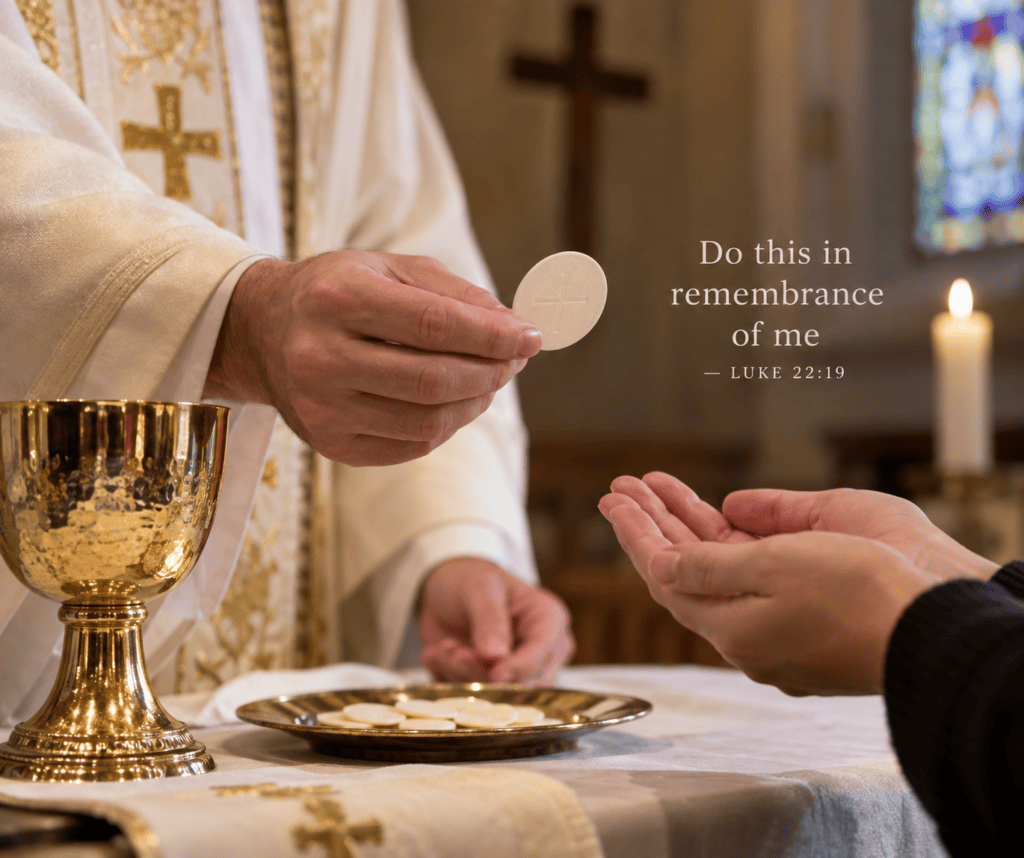
Lee Magness explores the Lord's Supper through four familiar names—Lord's Supper, Communion, Eucharist, and sacrament—and considers how each reveals the meal's significance and central place in Christian worship.
September 2, 2007

Lee Magness reflects on the cross of Christ, the irony of those who mocked Jesus, and the wonder of gathering at the Lord’s Table as sinners saved by his sacrifice.
June 10, 2007

Three Communion meditations from Lee Magness introduce two new books—In the Breaking of the Bread and The Longest Table—offering Scripture readings, reflections, and prayers that invite worshipers to the shared table of Christ.
Sponsored

Sponsored

Sponsored

Learn how to turn the sermons you’re already preaching into searchable, shareable content that helps people discover and connect with your local church. Access Be Seen, Be Heard on demand with Wes Woodell and Trey Sheneman. A two hour course for preachers, church media and website teams, and anyone who wants to help their church reach more people online.
October 6, 2026
Rick Cherok

October 6, 2026
Landon Shuman

October 6, 2026
Doug Redford