Emmanuel School of Religion Enters a New Season of Seminary Leadership
As Robert Wetzel retired after 15 years as president of Emmanuel School of Religion, incoming president Michael Sweeney reflected with him on the seminary’s mission, challenges, and future. Their conversation touched on community formation, financial pressures, theological depth, and the changing relationship between seminaries and churches.
- Robert Wetzel retired in May after a five-decade academic career, and Michael Sweeney became Emmanuel’s fifth president on June 1.
- Both leaders emphasized that seminary education must shape both the head and the heart.
- Emmanuel is seeking to serve churches more directly while addressing financial challenges and changing expectations for ministry training.
by S. J. Dahlman
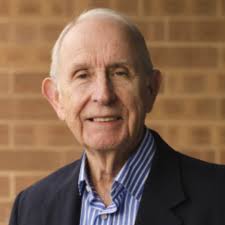
Emmanuel School of Religion President Robert Wetzel retired in May, succeeded by Michael Sweeney. A few days before the transition, the two men sat down to talk about the once and future seminary.
Learning with Head and Heart
In his 15 years as president of Emmanuel School of Religion, Robert Wetzel saw how seminary education must include more than simply learning theology, history, and ministry methods in a classroom.
Intellectual rigor and academic discipline are crucial to Wetzel, but the education must “make it more than that. It must be head and heart.”
Wetzel retired at the end of May, after a five-decade academic career. On June 1, Michael Sweeney entered the president’s office at the seminary, a pink-marble-and-limestone building perched on a bluff overlooking Milligan College, near Johnson City, Tennessee.
Sweeney worked in Papua New Guinea as a Bible translator for 15 years before coming to Emmanuel three years ago to teach courses in world mission and New Testament. He is the fifth president in the 44-year history of the seminary. (Wetzel also served on the mission field, leading Springdale College, a new theological school in England, for 11 years.)
“What we do best is prepare people for ministry in community, and so we want to model what it means to be the church,” Wetzel said. “The early days of Emmanuel were very ‘heady,’ influenced by the Enlightenment. It’s not that we’ve abandoned that, but we put more emphasis now on helping students create and experience a sense of community.”
Building Community at Emmanuel
Perhaps the most visible symbol of that emphasis, and the most tangible legacy of Wetzel’s presidency, is Emmanuel Village. The student-housing project, 10 years in planning and building, was designed to emulate a small English village—complete with stone “cottages,” winding streets, and a community center—not because Wetzel is an Anglophile, but to nurture a community that would be absent in cookie-cutter apartments.
There’s literally a price to be paid, however, particularly during a decade when seminary enrollment nationwide was stagnant. Emmanuel, with a $3.5 million annual operating budget, carries an $8 million debt, mostly in a $7.5 million, 20-year bond program that funded the last phase of the village and other projects. The past year’s economic downturn took a toll as well. Although no faculty members were released, several staff members were laid off. The actions were painful, Wetzel said, but the school has kept its strong donor base and holds $24 million in assets.
Serving Churches in a Changing Climate
Sweeney is taking office not only during difficult financial times but also in a changing church atmosphere.
“Colleges and seminaries aren’t as influential as they once were,” Sweeney said. “The most influential leaders now are ministers of large churches. In many Christian churches, degrees don’t mean as much as they once did. A lot of people just want to take a class or two. So we must relate more closely to the churches and be aware of issues they contend with and help the ministers develop the gifts they have.”
The school launched the Emmanuel Institutes in 2005 to do just that, offering workshops in local churches or engaging them in research projects on topics ranging from church finances to studying the effects of marketing. Emmanuel will also increase its online offerings.
While the school will aim to increase its traditional enrollment—Sweeney thinks Emmanuel’s headcount can grow by 100, to about 250—its job description is expanding. (Seminaries across the nation are showing signs of increasing enrollment, according to the Association of Theological Schools. Emmanuel is anticipating this fall’s entering class to be among the largest in its history.)
“Our biggest challenge is to revamp what and how we teach, to serve churches in their situations,” Sweeney said. “There’s a role for seminaries to fill.”
Theological Depth and the Lord’s Supper
Both men are convinced that seminaries like Emmanuel, even as they reinvent themselves, are vital for the health of churches they serve and, by extension, the society where they operate. Wetzel and Sweeney are disturbed, for example, about theological shallowness among large numbers of churchgoers and even entire congregations.
“Americans assume success is a fundamental value that is generally unquestioned,” Wetzel said. “So I’m concerned that churches are going on models of success: They do what they do to bring in crowds. They’ll say, ‘We’re trying to meet the culture where it is.’”
“There’s a tension in providing better solid biblical teaching and how it fits in worship,” Wetzel said. For his prime example, he pointed to the Lord’s Supper.
“In the Stone-Campbell Movement there’s always an attempt to recognize the centrality of the table,” he said. “But many congregations work to ‘do the Lord’s Supper’ in the shortest time possible—and I’ve heard some people use that phrasing. There’s a prayer that might be irrelevant to the moment, and then servers appear and trays are passed. From an engineering standpoint, it’s successful.”
But Wetzel thinks such an emphasis on “engineering” diminishes the Lord’s Supper, reducing it to “a command to be obeyed instead of a participation in this act with God.
“We can thank God there are churches with thousands of people,” he said, “but there is pressure on the centrality of the Lord’s Supper.”
Sweeney agreed but saw a silver lining.
“Many of the early leaders of the movement would be delighted at the centrality of worshiping Christ, rather than focusing on artificial distinctions (of denominations),” he said. “People have no denominational loyalty.”
Still, he is troubled by the suspicion that large numbers of churchgoers “just don’t care” about theology or do not think much about its place and importance.
“They go where there are good children’s programs, where they feel comfortable, where there are good restrooms for women,” he said, maybe only half joking. “There’s a lack of depth.”
But for both Sweeney and Wetzel, the perils of shallowness only underscore the opportunities—and responsibilities—for seminaries. As congregations attract new people and win new disciples, seminaries can provide classes and other tools for theological teaching.
“We’re in a cultural shift,” Sweeney said. “People aren’t asking the same questions in seminary as I was. Much of my seminary experience was about engaging in fun, intellectual discussions. It’s not that anymore. Theology needs to be a way of thinking how I carry on my life. If it’s not, people aren’t interested.”
S. J. Dahlman is associate professor of communications at Milligan College and writes “Seen and Heard” each week for Christian Standard. An earlier version of this article appeared in “Face to Faith,” his weekly column on religion for the Johnson City (Tennessee) Press. His blog, “Facing Faith,” is at http://sjdahlman.wordpress.com.