Global Christianity and the Church’s Changing Center
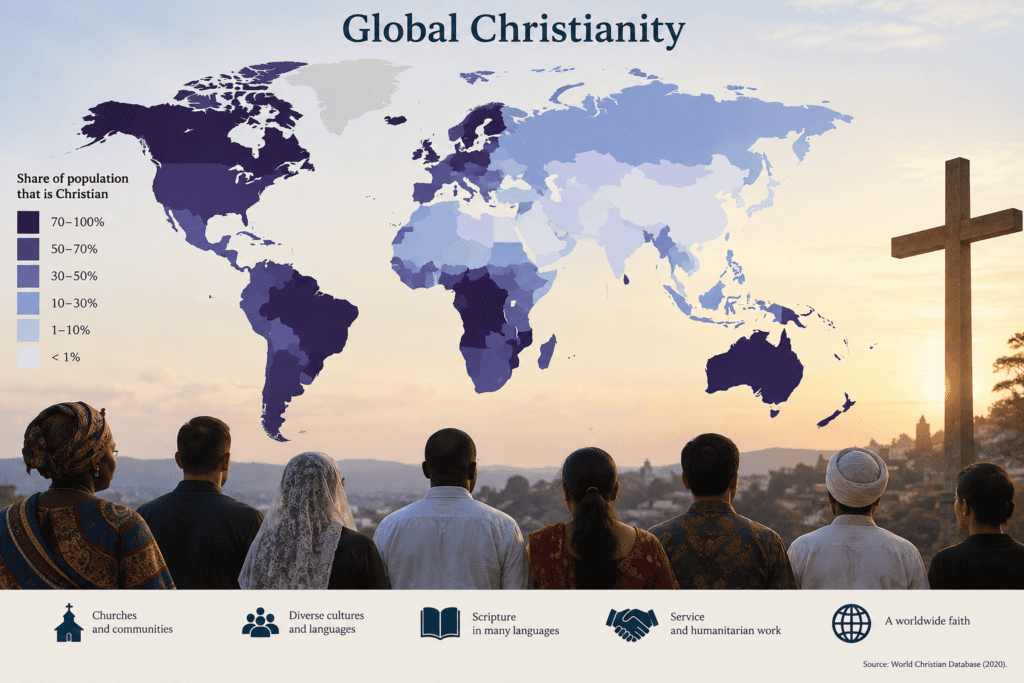
Global Christianity is shifting as the church declines in influence across parts of the West while growing rapidly in Asia, Africa, and Latin America. Rob Kastens calls Western Christians to renew their focus on making disciples while supporting and learning from the growing global church.
- The Western church faces declining participation and the danger of becoming more institutional than disciple-making.
- Christianity’s geographical center has shifted significantly toward Asia, Africa, and Latin America.
- Western churches can focus on making disciples while using their resources to strengthen the global church.
Nothing challenges us to think about changing times more than the transition from one year to the next. On this first day of 2012, we asked six Christian leaders to think about the church a year from now and to draw a picture of our progress—and our problems—then.
* * *
By Rob Kastens
 While I pray that I am wrong, my sense is that as the year 2012 draws to a close in the United States, we will be increasingly aware that God’s marvelous church is losing sight of her prime purpose of knowing him, growing in him, and worshipping him by making disciples!
The Fading Light of the Western Church
Much has been written about the fading light of the church in Western Europe, which is currently “enjoying” 2-4 percent of its population in regular church attendance. According to research conducted by David T. Olson, the American church is following the course set by our European forefathers. Numbers from actual counts of people attending churches in the United States show that 17.5 percent of the population attended a church on any given weekend in 2005. This includes those attending Catholic, Evangelical, mainline or Orthodox churches.1
Throughout history, Christ’s church has become less relevant in its culture as it becomes less viral and more institutional. This has certainly been true in Western Europe and North America. Our churches today are focused less on making disciples who come together as a community to transform their neighborhoods, nation, and world; and instead we are striving to acquire and protect our influence and power so we can be a “Christian” nation. Regardless of how hard we strive in this regard, according to statistics and the current reality, we are not a Christian nation.
Church, Government, and Disciple-Making
Throughout history, whenever there has been a linkage of church and government, it has precipitated a decline in the church’s influence (Rome and England, for examples). Instead of hearts being transformed as the gospel takes root, people close their ears to the raging political faction screaming for change. However, wherever the church has remained viral, individuals being discipled as vibrant image bearers of the King who then contagiously spread this “good news” to others, the church has flourished. This is true even in the cultures where government restricts and attacks the church. It seems the more Christianity is blatantly opposed, the more it seems to flourish.
The Global Shift of Christianity
Many scholars around the world today are noticing the trend of Christianity losing its light in the West but rising as the new light in Asia, Africa, and Latin America. Todd Johnson writes, “Over the past 100 years, Christianity has experienced a profound southern shift in its geographical center of gravity. Whereas in 1900 over 80 percent of all Christians lived in Europe and Northern America, by 2005 this proportion had fallen to under 40 percent, and will likely fall below 30 percent before 2050.”2
Mark Hutchinson, chairman of the church history department at Southern Cross College in Australia, also noted, “What many pundits thought was the death of the church in the 1960s through secularization was really its relocation and rebirth into the rest of the world.” Africa is gaining 8.4 million new Christians a year, and South Korea grew in number of believers from 300,000 in 1920 to 10 to 12 million now, which is about 25 percent of the population. The country with the fastest Christian expansion ever is China, now at 10,000 new converts every day.
Author Philip Yancey said, “As I travel I have observed a pattern, a strange historical phenomenon of God ‘moving’ geographically from the Middle East, to Europe to North America to the developing world. My theory is this: God goes where he’s wanted.”3
Doug Priest wrote this in CHRISTIAN STANDARD:
If in the past it has been assumed it was the responsibility of primarily Western nations to share the gospel around the world, that assumption is no longer true today. Not only are there more Christians from the Majority World (also called the Global South) than in Western nations, but the number of missionaries from the Majority World has far eclipsed the number of missionaries being sent from the West.4
Learning from and Resourcing the Global Church
Christians in Europe, North America, and Oceania already have their hands full with spiritual problems at home: they are stinging from cultural setbacks over the last 50 years and fighting to keep secularism from capturing even larger swaths of the populace. Even as we in the Western church strive to turn the tide in our culture, not through our voting blocs but through an increased focus on making disciples, let us also leverage the resources God has blessed us with to resource the global church. That is needed because, honestly, for the Western church to see a turn, it may take missionaries from the Global South to bring the light, not only to the 10/40 Window, but back to us in North America and Europe as well.
May we be encouraged by Paul’s words to the church in Galatia, “So let’s not allow ourselves to get fatigued doing good. At the right time we will harvest a good crop if we don’t give up, or quit” (Galatians 6:9, The Message).
________
1 ©2006 David T. Olson, www.TheAmericanChurch.org.
2 “Christianity in Global Context: Trends and Statistics,” Todd M. Johnson, director, Center for the Study of Global Christianity, Gordon-Conwell Theological Seminary.
3 “Scholars Find Decline of Christianity in the West,” Vivian S. Park, http://newyork.christianpost.com/news/scholars-find-decline-of-christianity-in-the-west-19971.
4 “And God Bless America,” Doug Priest, https://christianstandard.com/2011/07/and-god-bless-america.
Rob Kastens is executive pastor at Mountain Christian Church in Joppa, Maryland.








Rob is right on target with two key strategic points. An increased focus on making disciples is the root necessary to turn our people and our nations back from secularization. Social justice is a fruit, not a path, but many churches put their primary focus there. Also, the zeal of ministers God is raising up in parts of the global church is truly amazing, but their resources are often meager. Our support can literally be a river of life.