ASL Version of Bible Nearing Completion
Deaf Missions is translating Scripture into American Sign Language. Jennifer Johnson explores the unique challenges of visual-language translation, the organization's process, and its mission to make the Bible accessible to Deaf communities.
American Sign Language Bible Translation: Deaf Missions’ Work to Make Scripture Accessible
American Sign Language Bible translation is the focus of this article about Deaf Missions and its efforts to make Scripture available in a visual language. Jennifer Johnson explains why ASL requires its own translation rather than a word-for-word rendering of English. Deaf Missions executive director Chad Entinger describes the translation process, the project’s progress at the time, and the importance of providing the Bible in people’s native languages.
- American Sign Language has its own grammar and structure and is not simply English expressed through hand movements.
- Deaf Missions translates Scripture through research into Hebrew and Greek texts, video drafts, and community review.
- At the time of the article, the organization had completed the New Testament and reported progress on the Old Testament.
Why American Sign Language Bible Translation Matters
Many native English speakers assume all sign language is the same—that it’s all based on English, and it’s simply signing English sentences as they’re spoken. However, American Sign Language is one of more than 400 different sign languages around the world, and it has a unique structure and grammar independent of English.
“Sign language is a visual language, not a written or spoken one,” says Chad Entinger, executive director of Deaf Missions, a ministry based in Council Bluffs, IA. “It’s not ‘English with hands.’ In fact, you might not sign every word the way you speak or write a sentence in English, and you might have signs for concepts for which there aren’t exact words in English.”
How Deaf Missions Translates the Bible into ASL
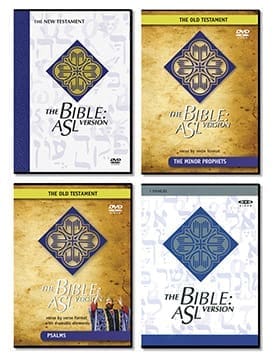
For these reasons, Deaf Missions has been working on an ASL version of the Bible since 1981. Today the entire New Testament has been completed as well as 60 percent of the Old Testament.
“The process is very similar to written translation work,” Entinger says. “We begin with extensive research, working with the original Hebrew and Greek texts. We video our drafts as we go and invite scholars and members of the deaf community to review and critique the translation efforts along the way.”
The final product includes visual chapter and verse indexes, graphics, maps, and other information. The “ASLV” is available via mobile app and download as well as DVD.
Deaf Missions has been a pioneer in this effort; no other organization has produced a complete sign language translation, but Entinger says it plans to complete the remaining Old Testament books by 2020.
“When the ASL version is done, we would love to then work on translating the Bible into other sign languages,” he says. “It’s so important for people to have the Bible in their native language.”

Author: Jennifer Johnson
Sponsored

For 160 years Christian Standard has served the churches of the Restoration Movement. Your gift keeps articles like this one free for every church leader.
Sponsored

Keep reading
More in Theology & Bible



From the archive
Christian Standard has covered this since 1866.





