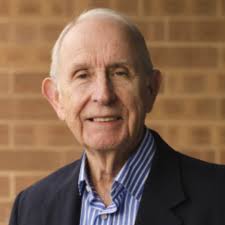
Dr. Mark Scott wrote this treatment of the International Sunday School Lesson. Scott teaches preaching and New Testament at Ozark Christian College, Joplin, Missouri. This lesson treatment is published in issue no. 13 (weeks 49-52; December 8—December 29, 2019) of The Lookout magazine, and is also available online at www.lookoutmag.com.
________
Lesson Aim: Let the One who was born for us bring light into your life.
________
By Mark Scott
People speak unscientifically about sunrise—technically the sun does not rise. But the sun does “rise” at first very incrementally. Then, almost before it can be observed totally, the sun is “up” and light floods the landscape. Maybe Isaiah thought about a sunrise as he predicted the coming of the Messiah in our text today.
Predictive prophecy is usually piecemeal, partial, and fragmentary in the context of the prophet’s historical situation. Predictive prophecy is easiest to understand once its fulfillment takes place as hindsight is 20/20. In the darkness of the coming Assyrian invasion, Isaiah predicted how God was going to act on behalf of his people. But what he predicted would find its ultimate fulfillment in the coming of the light of the world (John 8:12). On this Christmas Sunday we can appreciate the prologue of John’s Gospel, “In him was life, and that life was the light of all mankind. The light shines in the darkness, and the darkness has not overcome it” (John 1:4, 5).
Light Has Dawned So Darkness Is Defeated | Isaiah 8:19–9:2
The darkness for Israel was due to sin. God’s people chose to consult (seek; implore) the dark side (mediums and spiritists—necromancers, those who speak to the dead, wizards, and soothsayers) instead of the God who is Spirit (John 4:24). The mediums and spiritists can only whisper (chirp; peep) and mutter (mourn; growl). Some of God’s people were essentially playing for the other team (the devil and his minions).
They should have been consulting God’s instruction (Torah or law) and his testimony. Instead there was distress, extreme hunger, anger, and cursing (despising) God—signs that they were not obeying Deuteronomy. When they looked around and saw distress and darkness and fearful gloom it should have caused them to repent (see Revelation 9:20, 21). No wonder all they had was utter darkness.
But the slightest light dispels the darkness. From the strangest and most vulnerable places, such as the northern tribes of Zebulun and Naphtali, there would be no more gloom (darkness). These two tribes were on the northern side of the land of Israel. The armies usually invaded Israel from the north. Those tribes were right in the path of the invaders. But God’s light would honor (glorify) Galilee. The day would come when the people walking in darkness (sin) would see God’s light of deliverance. This would be realized most when Jesus worked his miracles in this area (Matthew 4:12-16).
Light Has Dawned So Joy Is Increased | Isaiah 9:3-5
Where there is light there is joy. In the previous section Isaiah spoke to the people on behalf of God. In this section he spoke to God about what his light had done. The you in verses 3 and 4 is God. In many ways Isaiah was a gospel prophet. He prophesied the good news, so why should we be surprised that Isaiah mentioned joy 24 times in his book?
This joy is likened to two things—harvest and victory in war. The first metaphor of harvest is touched on briefly. The people of Israel welcomed harvest with great joy. Farming was challenging in the ancient world, and it was a ton of work. When harvest came there was much joy. In fact, at least two major Jewish faith festivals (Pentecost and Tabernacles) were matched with harvest. The second metaphor, of victory in war, is extended. When soldiers divvy up the spoils from war, they rejoice. When Gideon led Israel against the Midianites and won, there was joy. When Israel was able to throw off the yoke, bar, and rod of their oppressors, there was joy. When Israel used the bloody battle gear for fueling her fires, there was joy.
Light Has Dawned So God’s Government Is Established | Isaiah 9:6, 7
This is the most well-known part of the passage. Its significance and beauty are unsurpassed. The child who is God’s son will be the light bearer. His government (mentioned twice in the text) and kingdom (reign) will be on his shoulders (maybe kingly robe). His names are exceptional (Wonderful Counselor, Mighty God, Everlasting Father—yes, the Messiah is called Father, and Prince of Peace).
The greatness of his government and peace will last forever. He will fulfill the promise made to Israel’s greatest governor, King David (2 Samuel 7:16; Luke 1:32, 33). His government will uphold justice and righteousness forever (Daniel 7:14, 27; Revelation 11:15). The Lord of hosts (Almighty) will be the one to bring it about. Let the one who was born for us bring light into your life.
________
Lesson study ©2019, Christian Standard Media. Print and digital subscribers are permitted to make one print copy per week of lesson material for personal use. Lesson based on the scope and sequence, ©2019 by Christian Standard Media. Scripture quotations are from the New International Version, ©2011, unless otherwise indicated.

Author: Mark Scott
Dr. Mark Scott wrote this treatment of the International Sunday School Lesson. Scott teaches preaching and New Testament at Ozark Christian College, Joplin, Missouri. He also serves as minister with Park Plaza Christian Church in Joplin.