Renegade Preachers
An 1870 Christian Standard report recounts how a Michigan convention addressed ministers accused of misconduct, revealing historical approaches to church discipline, congregational accountability, and public warnings about disputed preachers.
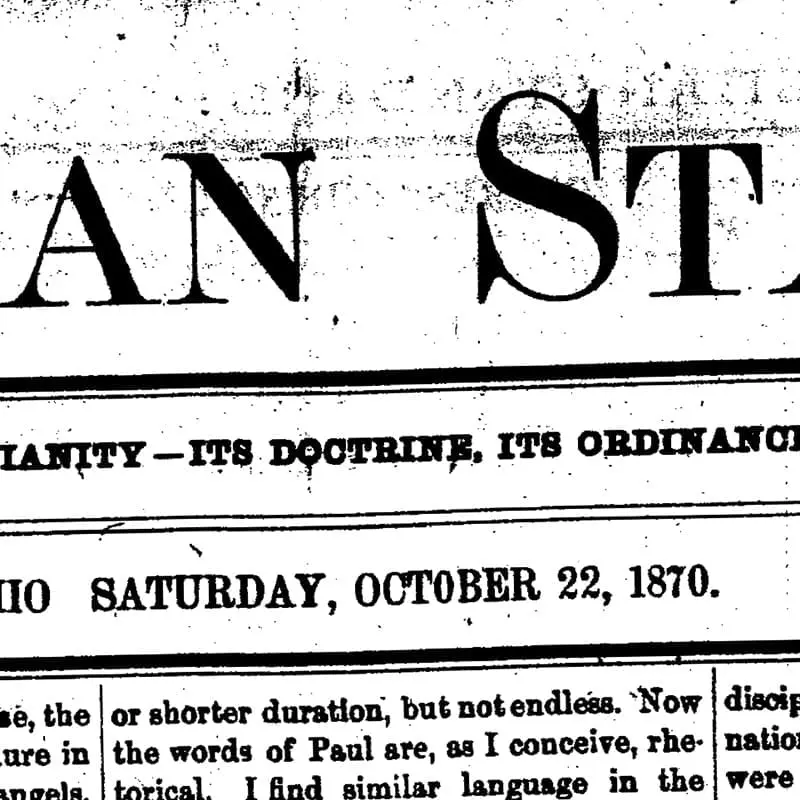
Renegade Preachers: An 1870 Christian Standard Archive Report
This Christian Standard archive selection revisits an 1870 report about renegade preachers and church discipline. The historical account describes how a Michigan convention responded to ministers whose conduct had been challenged by other congregations. Introduced as part of the publication’s Throwback Thursday feature, the excerpt offers a glimpse into how church leaders discussed accountability and public warnings 150 years earlier.
- The October 22, 1870, report describes a Michigan convention’s refusal to recognize a delegate previously dismissed by an Indiana congregation.
- The historical writer discusses using local newspapers to alert other congregations about ministers accused of misconduct.
- The archival excerpt illustrates historical approaches to church discipline and ministerial accountability.
The “Throwback Thursday” online feature from Christian Standard’s archive has been on hiatus for a few months. We hope it was missed. We resume the feature this week with a short item about punishing “renegade preachers” that appeared in our pages exactly 150 years ago today.
MICHIGAN CONVENTION—RENEGADE PREACHERS
Oct. 22, 1870; p. 3
It will be remembered that one J.H. Davis was dismissed from the Franklin, Ind., Church in May, 1869, and was published for “lying, hypocrisy, and for keeping company with bad men and women generally.” About a year ago he retired to Michigan, and went to preaching again, and was sent up to the recent State Convention as delegate from a small church. The brethren decided to sustain the action of the Franklin Church, by “declining to recognize him as a member of the Convention.” A kind letter was then written to the church that sent him, informing them of his standing in Indiana, and explaining our reasons for the course pursued.
It was then thought best to inform certain churches in Michigan of the character of J.W.C. Covey, and A.B. Edwards, who are still operating as Christian preachers up there. As our religious papers do not circulate much where they circulate, it was decided to use the county papers to give these men an airing. And if they leave for other counties, the State Secretary was instructed to get them into those county papers also. A capital idea. Follow them all round with the county papers, and when they leave for another State, just inform the State Board of it and we will soon get rid of them. In this way [we] can . . . compel respect for the discipline of the Church.
Thomas Munnell
—Jim Nieman, managing editor, Christian Standard

Author: Jim Nieman
Sponsored

For 160 years Christian Standard has served the churches of the Restoration Movement. Your gift keeps articles like this one free for every church leader.
Sponsored

Keep reading
More in Restoration Movement History

What’s the Right Sort of Institution for an Anti-Institutional Bunch Like Us?

The NACC: A Story of Separation, Independence, and Faithfulness

A Century Ago: The Conflict and Controversy That Created the North American Christian Convention
From the archive
Christian Standard has covered this since 1866.





