Communion Meditations Sponsored by …

Violent Table
Tom Lawson reflects on the violence of Christ's crucifixion and the meaning of Communion, calling believers to remember persecuted Christians and stand with those who suffer for following Jesus.

Communion and Persecution: Remembering Christ’s Suffering
Communion and persecution are closely connected in Tom Lawson’s reflection on the suffering of Jesus and his followers. The Lord’s Supper remembers a Savior who endured violence and rejection, rather than offering an escape from the world’s suffering. Drawing on Hebrews 13:12–14, Lawson calls believers to stand with fellow Christians who face hatred and persecution.
- The bread and cup remind believers of the physical suffering and violent death of Jesus.
- Communion calls Christians to acknowledge the persecution experienced by followers of Christ.
- Hebrews 13:12–14 challenges believers to identify with Jesus and bear the reproach he endured.
Right now, in this time of worship, it is easy to forget how much violence there is outside these walls. We come into this welcoming place, we sing songs of praise, we greet friends and visitors, and we come to the time of Communion. All very nice and so very far removed from all the ugly that’s out there.
Communion Remembers the Violence of the Cross
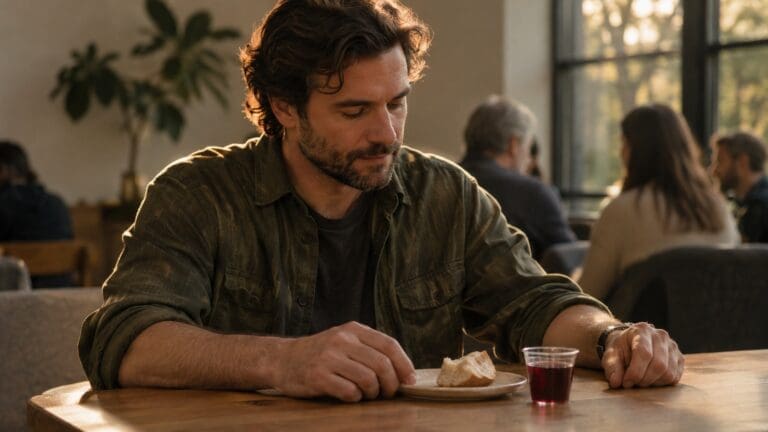
 It’s surprising, then, to consider for a moment that this brief meal is all about . . .
- a human body broken.
- human flesh torn and bleeding.
- an innocent man hanging by nails in unimaginable agony.
- slow and painful death before a largely uncaring and mocking crowd.
It is a scene so violent we would cover our children’s faces and turn our own eyes away in shock. Behind and within this meal is terrible violence.
I know that seems far removed from this quiet moment in worship. But Communion is rooted and wrapped in terrible violence.
You see, God has not called us here to worship in order to insulate us from violence. Church is not a hideout from the harsh realities of suffering and a cold, cruel world. Each week we are confronted by a great and terrible truth: Our king was hated. Our Lord was beaten. Our best friend was murdered. And none of us, not a single one of us, who decides to align ourselves with this king and Lord can ever think we can be safe from mockery, hatred, and even violence.
Standing with Christians Who Suffer Persecution
Every single day, now more than ever, people are still out there doing violence against our king by mocking or beating or murdering the children of the king. The age of martyrs is not some distant century of swords and crosses. It is the age of social media, YouTube, AK-47s, and Islamic terrorists. The blood of the martyrs is not found on the pages of dusty old books about ancient history; it meets us every time we watch the news or go online.
It is understandable we’d like to come here and not think about it. We’d like to imagine we can all be safe and comfortable, knowing we’ll all sleep tonight snug and safe with our own families in our own homes. But, then, we come to this quiet moment each Lord’s Day—a moment when we are forced to acknowledge the very center of our faith in the love of God seen most clearly only in the midst of a swirling sea of hatred and violence leading from Gethsemane to Golgatha.
The writer of Hebrews brings us face to face with the same reality: “So Jesus also suffered outside the gate in order to sanctify the people through his own blood. Therefore let us go to him outside the camp and bear the reproach he endured. For here we have no lasting city, but we seek the city that is to come” (Hebrews 13:12-14, English Standard Version).
To share in this meal is to sit at both the king’s table and the blood-soaked table of martyrs. To share in this meal is to commit ourselves not only to share in his love, but to also embrace our share of the rejection, the hatred, and maybe even the violence he endured. To an outsider or the uninformed, it seems nothing more than a safe religious action, something church people like to do on Sunday to remember they are loved. But, and I want to make this very clear, it is also something to do to remember how much we are hated.
We are the servants of a murdered king, the children of a rejected Savior, the followers of one who was despised and rejected by men. We do not come here to hide from violence, but to commit ourselves to stand with our brothers and sisters who will suffer and die this very week at the hands of violent men. We are, all of us here, remembering his body broken and blood spilled, and commit ourselves anew to be worthy children of such a king.
Tom Lawson is a professor at Ozark Christian College in Joplin, Missouri.

Author: Tom Lawson
Sponsored
For 160 years Christian Standard has served the churches of the Restoration Movement. Your gift keeps articles like this one free for every church leader.
Keep reading
More in Theology & Bible


From the archive
Christian Standard has covered this since 1866.





