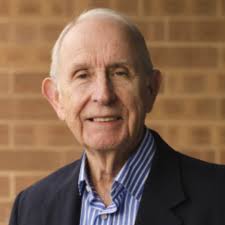
Dr. Mark Scott wrote this treatment of the International Sunday School Lesson. Scott teaches preaching and New Testament at Ozark Christian College, Joplin, Missouri. This lesson treatment is published in issue no. 5 (weeks 21-24; May 26–June 16, 2019) of The Lookout magazine, and is also available online at www.lookoutmag.com.
______
Lesson Aim: Give thanks for God’s great love, rich in mercy making us alive with Christ.
______
By Mark Scott
Ephesians, Philippians, Colossians, and Philemon are known as “the prison epistles” because they were written from prison (either Caesarea or Rome, Acts 24-26 or 28). Ephesians is known as “the queen of the prison epistles.” It was written by Paul as a circular letter, meant to be read and distributed among churches in the Asia Minor area and not restricted to Ephesus alone. We know much about this church (Acts 18-20; Ephesians; 1 and 2 Timothy; and Revelation 2:1-7). In these next three months we will learn from three of these four epistles.
On this weekend Christians will participate in activities to memorialize and honor those who died in service to their country. But by the great love of God, Christians actually overcome death. “In him” (a phrase that appears numerous times in Ephesians) believers are “made alive.”
Culture of Death | Ephesians 2:1-3
The above heading comes from Between Two Trees, a new book by Shane Wood. Sin makes us embrace a culture of death. This is the theme of verses 1-3. Whenever we fail to trust the goodness of God (Genesis 3:6, 7) and disobey him, we kill ourselves spiritually (Romans 5:12). And that sin is not singular. It is ongoing and plural (transgressions and sins). In Greek these first three verses combine to form one sentence. There is just one ugly phrase after another and a downward spiral of depravity.
Transgressions (crossing a line) and sins (missing a mark) make us follow the ways (age) of the world. This worldliness is generated by the devil since the world lies in his power (1 John 5:19). He inspires an evil spirit who works in people who disobey God. We continue to live in this culture of death because we desire to gratify the cravings (passions) of our flesh. At the end of this downward spiral, we are immature children deserving God’s wrath.
Alive in Us | Ephesians 2:4-9
The above phrase is found in the lyrics of Alive by Hillsong. With Jesus, death always yields to life. In one of the great contrasting phrases of the New Testament, Paul wrote, “But God.” There is death . . . “But God.” When God entered the camp of death, death had to flee (Luke 7:14; Mark 5:41; John 11:43; 1 Corinthians 15:55-57). God’s great love, his rich mercy, and his amazing grace made life possible again for those sold out to a culture of death.
The three great qualities of God drove his three great actions. God’s love (benevolent goodwill toward another), God’s mercy (loving kindness for when we feel helpless), and God’s grace (unearned, undeserved favor) resulted in our being made alive by Christ, raised up with Christ, and made to sit with Christ. These three great actions speak of our salvation. Saved people are resurrected people (made alive), exalted people (raised), and royal people (made to sit or enthroned). While believers await ultimate resurrection and exaltation, these actions are actually realized in this world. Christians live in the heavenly realms already (literally “heavenlies,” meaning the spiritual realm that is transcendent and imminent).
Believers who have been made alive in Christ become “exhibit A” of the incomparable riches of his grace. As trophies of grace (a word that appears three times in this passage) believers are the best representation of God’s resurrection power to a watching world. This process of being made alive is by grace . . . through faith. Verses 8-10 are some of the most telling salvific verses in the New Testament. Every person who became a disciple in the book of Acts did so through this formula. “Grace” is God providing salvation. “Faith” is us appropriating salvation. While we do cast a vote in our salvation (through our acceptance), God is clearly the genesis and senior partner of that saving experience. Paul makes this abundantly clear by reminding us that it is not from ourselves. The salvation “grace through faith plan” is from God. Any boasting has to be directed heavenward.
Practice Resurrection | Ephesians 2:10
The above heading comes from the title of a commentary on Ephesians by Eugene Peterson. Saved people have moved from their cemetery of death to an Easter parade. This new life is demonstrated in good works. Christians can do “life works” because they have, by virtue of their salvation, become God’s handiwork (the English word “poem” comes from this Greek word).
On this Memorial Day weekend we might remember Abraham Lincoln’s famous Gettysburg Address. The speech was delivered at a cemetery, but the main metaphor in the address was conception. And when there is a conception there is life. Give thanks for God’s love that made us alive.
_______
Lesson study ©2018, Christian Standard Media. Print and digital subscribers are permitted to make one print copy per week of lesson material for personal use. Lesson based on the scope and sequence, ©2018 by Christian Standard Media. Scripture quotations are from the New International Version, ©2011, unless otherwise indicated.

Author: Mark Scott
Dr. Mark Scott wrote this treatment of the International Sunday School Lesson. Scott teaches preaching and New Testament at Ozark Christian College, Joplin, Missouri. He also serves as minister with Park Plaza Christian Church in Joplin.