Why Ordination Still Matters for Church Leadership
This article reflects on the value of ordination as a serious act of recognition, accountability, and encouragement. Using Hananiah’s integrity as a starting point, it urges local churches and elders to take greater care in preparing, vetting, and supporting ministry leaders.
- Churches need high-integrity leaders who fear God deeply.
- Ordination should affirm calling, character, doctrine, and readiness for ministry.
- Elders and congregations should maintain ongoing accountability after ordination.
By David Faust
Hananiah isn’t a well-known character, but I like how the Bible describes him: “He was a man of integrity and feared God more than most people do” (Nehemiah 7:2, New International Version). Families and churches need high-integrity leaders with above-average reverence for God.
Hananiah contrasts sharply with fallen leaders who “have suffered shipwreck with regard to the faith” (2 Timothy 1:19). A shipwreck is a vivid way to illustrate spiritual damage. When ships crash on the rocks, journeys are disrupted, possessions are squandered, and travelers drown.
Like shipwrecks, leadership wrecks damage God’s work. How can we prevent church leaders from succumbing to moral failure and losing their doctrinal bearings? One small solution would be to improve the way we practice ordination.
My Ordination Journey
I didn’t seek ministry ordination immediately after graduation from Bible college and seminary. My faith was sincere, but I wasn’t sure about my life’s work.
Another reason for my hesitation? I didn’t want to be a “clergyman,” and I wasn’t sure how ordination fits with the biblical concept that all Christians belong to the “royal priesthood” (1 Peter 2:9-10). Some members of the body preach and teach, while others give, labor with their hands, and serve in countless other ways. Some are paid for their work and others are not, but in a broad sense, all of Jesus’ disciples enter the ministry when we accept him as Savior and Lord. Whatever ordination means, it shouldn’t contradict the ministry of all believers.
Eventually, though, I realized some form of kingdom work was what the Lord meant to be my primary vocation. And I discovered that in small but significant ways, my ordination would remove unnecessary obstacles and help our church move forward. So, on a warm Sunday evening in June, on the day before my 25th birthday, I was ordained as a minister of the gospel by the elders of the church where I grew up.
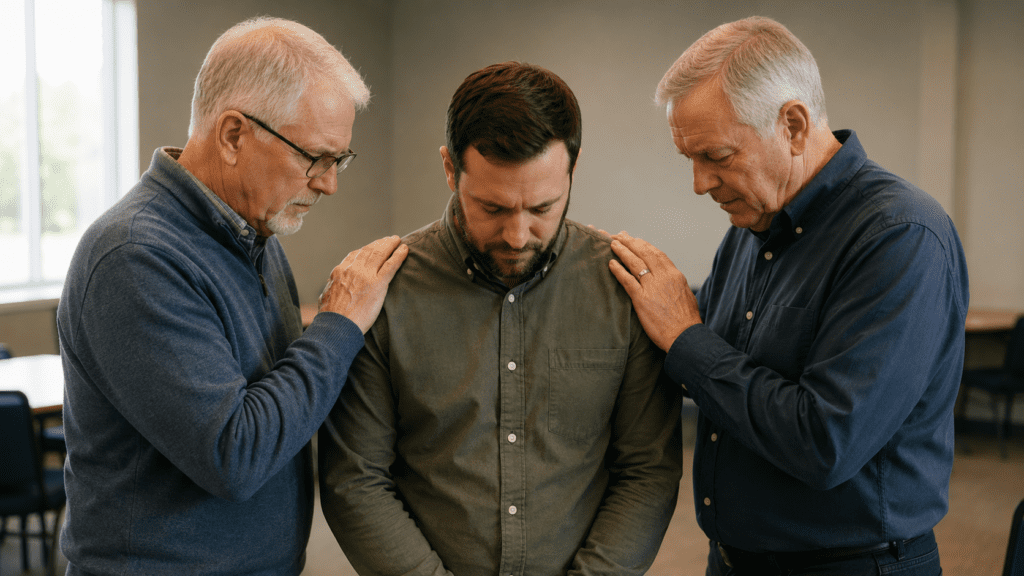
The apostle Paul told Timothy, “Do not neglect your gift, which was given you . . . when the body of elders laid their hands on you,” and “Fan into flame the gift of God, which is in you through the laying on of my hands” (1 Timothy 4:14; 2 Timothy 1:6). There is nothing magical about the laying on of hands, but I can attest that there is something very motivational about it. For years, I have kept my ordination certificate hanging on the wall above my college and seminary diplomas. Most of the men who signed that certificate have died, but their signatures continually remind me of the trust they placed in me. I would never want to disappoint those faithful leaders by being unfaithful to the Lord.
What Does Ordination Mean?
Ordination acknowledges and celebrates God’s call. Throughout history, the Lord has selected and equipped individuals—like Abraham, Moses, Esther, Jeremiah, Peter, and Paul—to carry on his work.
Ordination recognizes the Holy Spirit’s activity in a person’s ministry. In Acts 6, the Holy Spirit led the church to set apart seven qualified servant-leaders to oversee a benevolence ministry—caring for widows in need. Later the Holy Spirit said, “Set apart Barnabas and Saul for the work to which I have called them,” and the believers in Antioch fasted, prayed, laid their hands on these men, and sent them off as missionaries (Acts 13:2-3).
Ordination affirms the local church’s endorsement of a person’s integrity and fitness for ministry. In Paul’s letters, he commended servants like Phoebe (Romans 16:1-2), Tychicus (Colossians 4:7), and Mark (Colossians 4:10). Through ordination a congregation publicly recommends servant-leaders to the church at large, endorsing their character, doctrine, and giftedness—which implies some level of ongoing accountability to the elders of the ordaining congregation. (A safeguard is not a guarantee, so the endorsement can be withdrawn if a minister goes off the rails.)
Further, ordination signifies a congregation’s commitment to provide ongoing encouragement and support to their Timothies. It’s a way “to acknowledge those who work hard among you, who care for you in the Lord and who admonish you” and to “hold them in the highest regard in love because of their work” (1 Thessalonians 5:12-13).
Improving the Process
In a movement that rejects denominational hierarchies and values congregational autonomy, local churches bear the responsibility to recruit, equip, vet, and send out kingdom workers.
In 1981, Christian Standard published two articles by E. Richard Crabtree called “Who Monitors the Ministry?” in which he urged elders of local congregations to take three steps: (1) ordain with care, (2) keep in touch after ordination, and (3) maintain responsible oversight. Crabtree wrote, “Some congregations do not regard the responsibility of ordination with the seriousness it deserves,” noting, “The quality and integrity of the church’s ministry is dependent upon the continuing oversight of these ordaining congregations.”
When ministry prospects seek ordination, a small group of two or three elders (and perhaps another experienced ordained minister) should be assigned to walk with them through a process of prayer and evaluation, examining their motivation, giftedness, educational and practical preparation, doctrinal beliefs, and character.
In a 1999 editorial, Christian Standard’s editor Sam Stone reminded readers of the need to encourage young people to enter what he called “specialized Christian service.” In a comment that rings true today when many worry about filling the leadership pipeline, Sam wrote, “Unless we challenge our finest youth to consider God’s claim upon their lives, the church will lack leadership in the years ahead.” He urged search teams hiring preachers to contact the elders of ordaining churches and ask about the ministers’ strengths and weaknesses. Stone added, “When the elders lay hands on a minister and set him apart to do a special work, their responsibility is not over; it has just begun.” Elders should maintain periodic contact with those they ordain, “supporting the discouraged, giving praise for good works, and correcting those who have erred.”
If we follow this wise advice, fewer shipwrecks will tear our leaders and churches apart.

Author: David Faust
David Faust serves as contributing editor of Christian Standard and senior associate minister with East 91st Street Christian Church in Indianapolis, Indiana. He is the author of Not Too Old: Turning Your Later Years into Greater Years.







Thank you, Dr. Faust. Well said and very needed. Always appreciate your articles.