Benchmarking
Smaller churches can learn from larger churches without copying them wholesale. Benchmarking, team visits, and simple facility changes can help leaders adapt creative ideas for their own ministry context.
Learning from Larger Churches Without Losing Your Context
This article encourages smaller-church leaders to learn from larger churches without becoming discouraged by differences in scale, budget, or facilities. Through examples from Willow Creek, Indianapolis-area churches, and Sam Walton’s learning posture, it shows how benchmarking can lead to practical, affordable ministry improvements.
- Smaller churches can adapt useful ideas from larger churches without copying everything they see.
- Simple changes in space, seating, lighting, and technology can make a meaningful difference.
- Great leaders keep learning from successful models, even in unlikely places.
Any visit to a metropolitan megachurch is a disheartening experience to a church leader from a smaller community. It begins with the parking lot. Just looking at the architecture says, “I can’t do that!” I remember driving onto the campus of Willow Creek the first time. There was a beautiful diamond pattern on the manicured lawn. A picturesque lake reflected the beautiful building in the morning sun. The closer I drove, the better it looked. I walked through the doors into a light-filled atrium with coffee bar, food court, and upstairs bookstore all set against a wall of glass. There wasn’t a stain to be found on the floor. People were sitting in comfortable conversation areas, drinking designer coffees and talking. Some were reading or working on their laptop. There were small groups seated at tables set for eight with their Bibles open in front of them. It was awesome! It felt like community! The gap between this and what I would go home to was getting wider and wider. The diamond shaped auditorium had glass on two sides. Motorized shades came down to dim the room for the worship experience. I sat in my comfortable theater chair as I scanned their bulletin. Their weekly financial need was twice my annual church budget. The technology looked something like the bridge of the starship Enterprise. The bar was very high.
Benchmarking Churches Without Breaking the Bank
Well, that was there … not in my little town. There were a number of things I could learn from this church that I could incorporate into mine without breaking the bank. The fact was, even small inexpensive changes would set us apart in Quincy. Going to a megachurch and adapting what we learn there is something we call benchmarking. Benchmark churches have come up with so many creative things that a smaller church can adapt and use for its target. When our church was running 500 in attendance, I planned a trip to Indianapolis and scheduled to visit four churches that ran between 1,000 and 2,500 for benchmarking. They were happy to take an hour or so out of their day to do what we asked. First, we wanted a tour of their building. A tour allows you to see how another set of creative minds do ministry. The size of the church is important, as monster megachurches are so far removed in size that practical applications and adaptations might be difficult. These were just right. All sorts of ideas and discussions were born just out of those tours. Second, we scheduled one hour to sit down with our counterpart and ask specific questions about ministry approach. After our meetings, our team would get together and talk about what had inspired them. Changes on our campus came quickly after that. Doing this as a team was also critically important as it is hard to communicate something that someone else hasn’t seen. It’s that “You-had-to-be-there” syndrome.
Simple Changes That Can Shift a Worship Space
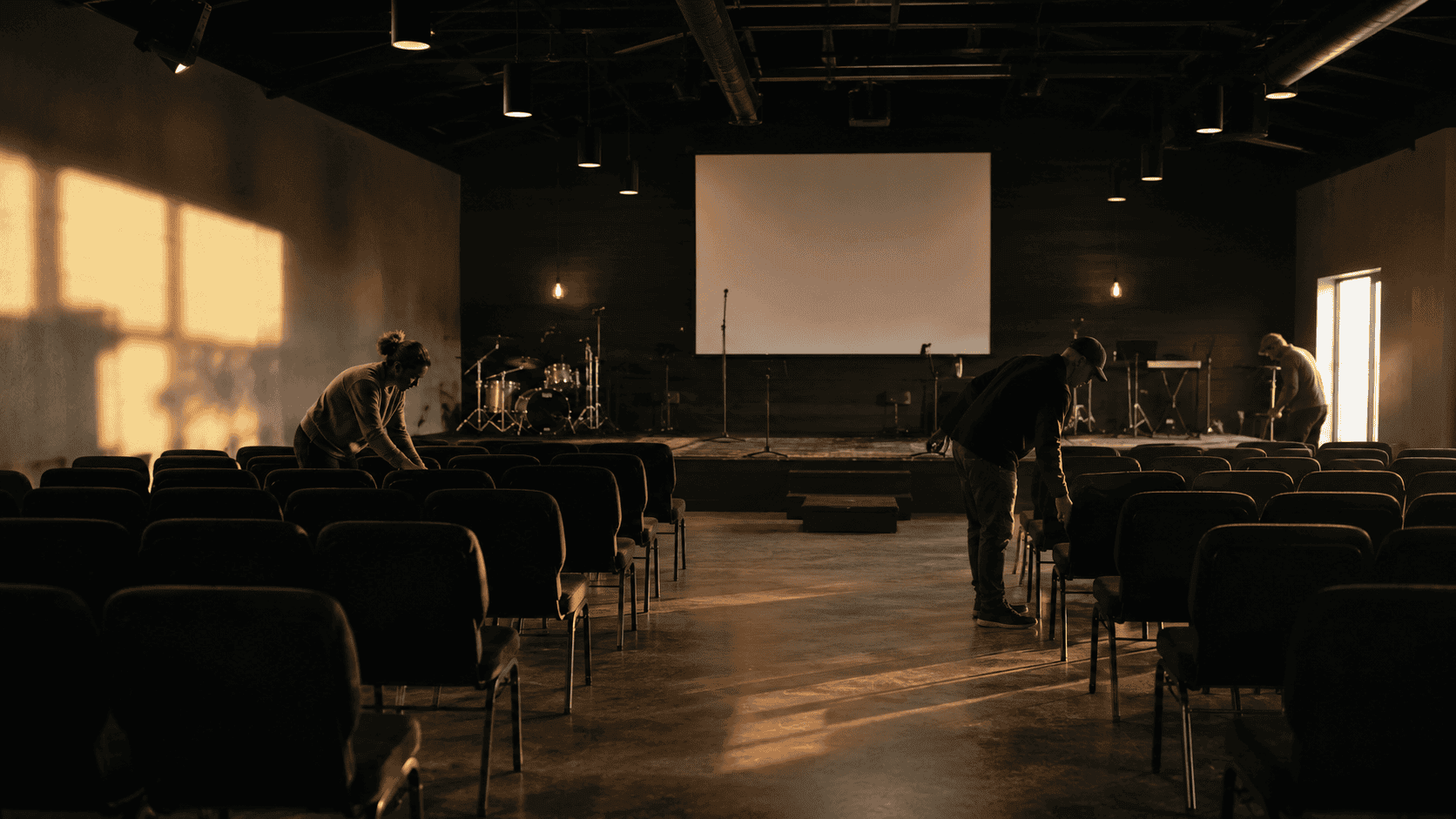
It was incredible what something as simple as black paint did. Painting the ceiling black made it disappear, giving the feel of an auditorium. Painting the stage black made the worship leaders and band pop visually. Leaving a square of white and framing it in the middle of the back wall for projection cost nothing. Great projectors or LED screens are much more affordable now than then. New stage or house lighting fixtures aren’t very expensive either. There was a whole group of technically savvy people in the church who finally had a place to honor the Lord with their passion. Comfortable stackable chairs allowed us to change seating configurations.
The impact of just seating configurations, the auditorium style, some well-placed lighting, and projection technology will immediately set a church in your area apart. It’s as much about what goes out the door as what comes in. Getting rid of the pulpit takes away a division from preacher to congregation. It gives an air of vulnerability and approachability. Losing the Communion table and chairs, while setting the Communion around the room is more about looking inward instead of how it’s administered. Projecting a slide on what to do for both believers and non-believers removes misunderstanding.
Great Leaders Keep Learning
Jim Collins relates a story about a Brazilian company looking to pick the brains of American company CEOs involved in a similar business as theirs. Ten requests were made but only one CEO responded to the idea: Sam Walton. The Brazilian executives flew to Bartlesville, Oklahoma and were met with the famous pickup truck complete with Sam and his dog. They had lunch at his nondescript house that concluded with Sam washing the dishes in the kitchen sink. While he was washing the dishes, Sam began probing the Brazilians with questions about their business, their culture, their approach, and their goals. The point is that Sam wasn’t entertaining these guests just to impart his Wal-Mart wisdom. He was learning. He was always looking for opportunities to learn how to do business better, knowing that those revelations come from unlikely places. Great leaders love learning and one of the best ways to learn is to discover successful models and adapt their ideas. Who knows how many conversations will come from it that will give more traction to the cause of Christ?

Author: Jerry Harris
Jerry Harris is publisher of Christian Standard and former teaching pastor at The Crossing, a large, multisite church located in three states across the Midwest.
Sponsored

Jerry Harris
Jerry Harris is publisher of Christian Standard and former teaching pastor at The Crossing, a large, multisite church located in three states across the Midwest.
More from Jerry Harris →For 160 years Christian Standard has served the churches of the Restoration Movement. Your gift keeps articles like this one free for every church leader.
Sponsored

Keep reading
More in Church & Ministry



From the archive
Christian Standard has covered this since 1866.






OK, I’ve been to large churches and small churches, I still don’t get the dark auditorium aspect of Worship, why do we go DARK to worship the LIGHT of the World…Jesus Christ.