The Bible College Movement: How Our Schools Served Our Churches for 100 Years (And Can for Many More)
Bible colleges helped shape generations of Restoration Movement leaders. But with schools closing and ministry graduates declining, do we still need them? A look at their history, changing role, and future.

Do We Still Need Bible Colleges? Their Past, Present, and Future
Bible colleges have played a defining role in preparing ministers and missionaries for independent Christian churches. But school closures, changing educational models, and declining ministry graduates raise important questions about their future. This article explores how these colleges shaped the Restoration Movement, how they have adapted, and why their mission still matters.
- Bible colleges historically helped prepare generations of ministry leaders who strengthened independent Christian churches and missions.
- Although all 17 accredited ICC colleges in the U.S. still offer ministry training, their combined ministry graduates declined significantly between 2013 and 2024.
- Churches, colleges, and other ministry training programs can work together to develop the next generation of vocational Christian leaders.
1990s nostalgia is sweeping pop culture (beepers, Backstreet Boys, baggy jeans!), and for the independent Christian Churches (ICC), the 90s were good days. Every church leader read Christian Standard, thousands attended the annual North American Christian Convention (NACC), church plants and megachurches were popping up like dandelions, and the New York Times said we were the fastest growing evangelical group of the decade. Our movement was moving!
And in the 1990s, our colleges were flourishing.
Do We Still Need Bible Colleges?
I graduated from Ozark Christian College in the early 90s and returned to teach in the late 90s. Like almost all of our sister colleges that decade, two things were true: our enrollment grew, and our focus was training men and women for vocational Christian service. In the 90s, virtually every well-known minister in our movement had attended one of our colleges (as did Rich Mullins!), and the ministry pipeline was full. The future of our schools seemed bright.
But it’s 2026 now.
Next year unofficially marks the 100th anniversary of our fellowship of churches. You may remember: the American Restoration Movement of the early 1800s eventually split into three groups. The non-instrumental Churches of Christ officially separated from the Disciples of Christ in 1906, and though the ICC’s separation from the progressively liberal Disciples happened more slowly, the very first NACC in 1927 is often viewed as our symbolic start.
Among those three groups, Bible colleges are uniquely an independent Christian church thing. Is that a good thing?
Since the booming 90s, our fellowship of churches has continued to thrive, but the last few decades have called our colleges into question. In 2012, the Christian college presidents were invited to our movement’s annual megachurch minister’s get-together. We gathered in San Antonio, and one preacher stood to share his view: “To be honest, do we really need these colleges? So many are small and struggling, and I hire most of my people from within. Maybe it’s time to let them die.”
Ouch.
He wasn’t wrong: some were struggling, and in recent years, several have closed. It’s a good question: do we still need Bible colleges? To answer, Christian Standard asked me to explore three related questions.
How Have Bible Colleges Historically Shaped Our Fellowship?
Our patriarch Alexander Campbell believed strongly in higher education, but the school he founded—Bethany College—was not a Bible college. Scripture was part of a larger liberal arts curriculum to train ministers alongside lawyers, teachers, farmers, and businessmen, and in the 1800s, the Restoration Movement started dozens of such schools. But by the early 1900s, many of these Disciples colleges drifted toward liberal theology.
Conservative congregations “no longer trusted these schools, so educational alternatives emerged” (James North, “Bible College Movement,” The Encyclopedia of the Stone-Campbell Movement, Grand Rapids, MI: Eerdmans, 2004, 93). The theologically progressive colleges (like Texas Christian, Butler, and even Bethany) stayed with the Disciples. The non-instrumental Churches of Christ started their own schools using Campbell’s liberal arts model—universities like Pepperdine, Abilene, Harding, and Lipscomb (The non-instrumental Churches of Christ also have a number of non-accredited “preaching schools,” often hosted by a local congregation).
Meanwhile, a newer ministry education model known as Bible colleges had emerged (See S. A. Witmer, The Bible College Story: Education with Dimension, Wheaton, IL: Channel Press, 1962). Single-purpose institutions specialize in a given field—West Point in military officers, Juilliard in performers, Mayo Clinic College in doctors—and Bible colleges were single-purpose institutions specializing in training ministers and missionaries.
The independent Christian Churches embraced this model, and between 1927 and 1957, the ICC formed at least 21 new schools, almost exclusively Bible colleges (A small handful of our colleges—like Cincinnati, Johnson and Kentucky—were established before 1927, including Milligan, the one liberal arts college that did not retain affiliation with the Disciples of Christ). In 1944, Lincoln Bible Institute’s founder Earl Hargrove rallied congregations to the new school with this promise, “The preachers are coming! The preachers are coming!”
The preachers did indeed come.
From 1927 to roughly 2007, as a general rule, our Bible colleges flourished. Every school had seasons of struggle, and a few closed their doors. But over those 80 years, our Bible colleges adjusted, seeking to become more sustainable and effective, and attracted thousands of students. Did it work? Did the colleges become a productive model of ministry leadership preparation?
Yes, they did.
Our fellowship of churches flourished, and the men and women who led the way were largely trained in our Bible colleges and seminaries, including:
- Missionaries and cross-cultural leaders like Isabel Dittemore, Max Ward Randall, LaVerne and Lois Morse, Ziden and Helen Nutt, David and Deloris Filbeck, Kevin and Kim Dooley, Wing Wong, Etienne Prophete, Ajai and Indu Lall, and George and Vera Bajenski.
- Parachurch ministry leaders like Sam Stone and Jerry Harris (Christian Standard), Bob Stacy and Jayson French (CIY), Walter Birney and Rob Maupin (ICOM), Phyllis Sanders and Kay Moll (Standard Publishing VBS), and Roy Weece and Greg Swinney (campus ministry).
- Professors and writers like Jack Cottrell, Mark Scott, J. K. Jones, Jackina Stark, Knofel Staton, Fred Craddock, James Strauss, Paul Blowers, Jan Johnson, Lewis Foster, Robert Lowery, Gareth Reese, Seth Wilson, Eleanor Daniel, David Faust, and Mark Moore.
- Preachers like Bob Russell, Ben Merold, Wayne Smith, Leon Appel, Don Wilson, Dave Stone, Gene Appel, Dudley Rutherford, Kyle Idleman, Rick Rusaw, Cam Huxford, Ben Cachiaras, Jon Weece, Tyler McKenzie, Aaron Brockett, Dave Ferguson, Jud Wilhite, and Drew Sherman.
Of the three streams in the Restoration Movement, the Disciples and the non-instrumental Churches of Christ have begun to decrease, but by God’s grace, the independent Christian churches continue to grow (Kent Fillinger, “2025 Continued Growth,” Christian Standard, May-June 2026, 33-37). Does that have something to do with leadership? A 40-something leader in the non-instrumental churches said to me, “We have large liberal arts colleges and small churches, while you all have small Bible colleges and large churches. I would trade with you all in a heartbeat.”
It seems the Bible colleges have served us well.
How Have Our Bible Colleges Adjusted Over the Years?
Our Bible colleges likely “worked” for a number of reasons: the curricular emphasis on Scripture produced biblically grounded leaders, the energetic atmosphere of “start-up” schools produced entrepreneurial leaders, the “collegial” approach to ministry training (vs. only one mentor) produced well-rounded leaders, the faculties of credentialed ministry-practitioners (vs. “ivory tower academics”) produced church-focused leaders, and the single-purpose institutions full of ministry majors produced well-networked leaders.
Those were the constants. But over the last 100 years, the Bible colleges also “worked” because they grew in several healthy ways.
We moved from anti-liberalism to pro-evangelism. Several schools began as a reaction to theological infidelity, and though rightly contending for the “faith once for all delivered,” the tone could become sectarian. In focusing on “what we’re against,” we isolated ourselves from faithful denominational brothers. Our colleges now focus on “what we’re for”—training Great Commission leaders. We still maintain our movement’s doctrinal distinctives, but as “Christians only, not the only Christians,” we prepare ministry leaders from many evangelical backgrounds.
We moved from legalistic campus cultures to grace-filled campus cultures. Well-intentioned schools once wrote thick student handbooks with rules like no card-playing, no attending movies, and no beards (“Sorry, Jesus, you gotta shave first”). Colleges still pursue holiness, but now they cultivate a campus culture focused on the “grace of God that … teaches us to say ‘No’ to ungodliness” (Titus 2:11-12).
We moved from academic inconsistency to academic excellence. Academic standards at Bible colleges were once a “controversial topic. In their early years, many schools were regarded as intellectual lightweights” (North, ibid., 94). However, most have now “chosen to come under the scrutiny of established accrediting agencies” and maintain the same rigorous standards as well-known universities (Ibid.).
By the 1990s, our ICC colleges were booming because they had matured well. Campuses were full of students (in their Saved By the Bell wardrobes), and our movement’s ministry pipeline was flowing strong. In the 2000s, however, at least three other significant changes began to occur, which have affected the role the colleges play in our movement:
- About 30 percent of our colleges are gone. In 1997, the independent Christian churches had at least 25 accredited colleges in the U.S. (The ICC has both international colleges—like Alberta Bible College, Colegio Biblico, Maritime Christian College, TCM International, and others—and unaccredited U.S. colleges—Blueridge College of Evangelism, Louisville Bible College, Northeast Ohio Bible College, Summit Theological Seminary, and others—doing good work. But since they’re not required to make the publicly available reports from which I’ve gathered this information, I’ve not included them here). But in 2007, Puget Sound Christian College closed, and since then, at least seven more have closed or merged: Cincinnati, Crossroads, Emmanuel, Florida, Lincoln, Nebraska, and St. Louis. The contributing factors varied—financial struggles, enrollment drops, accreditation challenges—but we now have 17 accredited ICC colleges in the U.S. (Bushnell University is the former Northwest Christian College, alma mater of Christian Church leaders like Dr. LeRoy Lawson. It is unique in that its bylaws require its Board of Trustees to have significant representation from both the Disciples of Christ and the independent Christian churches).
- About 60 percent of our colleges have broadened their curricular focus. Though most of our schools began as traditional Bible colleges—with the majority of graduates going into ministry—many have since broadened their curriculum. Ministry is now one major among others like chemistry or accountancy. (And we need biblically-grounded chemists and accountants). Of the 17 accredited ICC colleges in the U.S., 10 are now Christian liberal arts colleges, while seven are Bible colleges (This observation is based on each institution’s spring 2024 graduate numbers self-reported to the federal government. The U.S. Department of Education gives each type of degree a code—or CIP [Classification of Instructional Program]—and CIP 39 is “Theology and Religious Vocations.” For this article, a college where at least 50% of graduates receive a Bible/ministry degree [CIP 39] is considered a Bible college. Among the seven Bible colleges in our movement, the percentage of ministry graduates ranges from 70% at some institutions to 100% at others. Among the ten Christian liberal arts colleges, the percentage of ministry graduates ranges from 2% at some institutions to 41% at others).
- 100 percent of our colleges still train ministers, but we train fewer total (and mostly at a smaller number of colleges). All 17 ICC colleges in the U.S. include Bible and ministry as a major. But in 2013, our colleges graduated 940 ministry majors, whereas in 2024, they graduated 473 ministry majors—a 50 percent drop in 11 years. Of the 473 ministry graduates, six colleges accounted for 80 percent of those, and two colleges accounted for over 50 percent. (See table.)
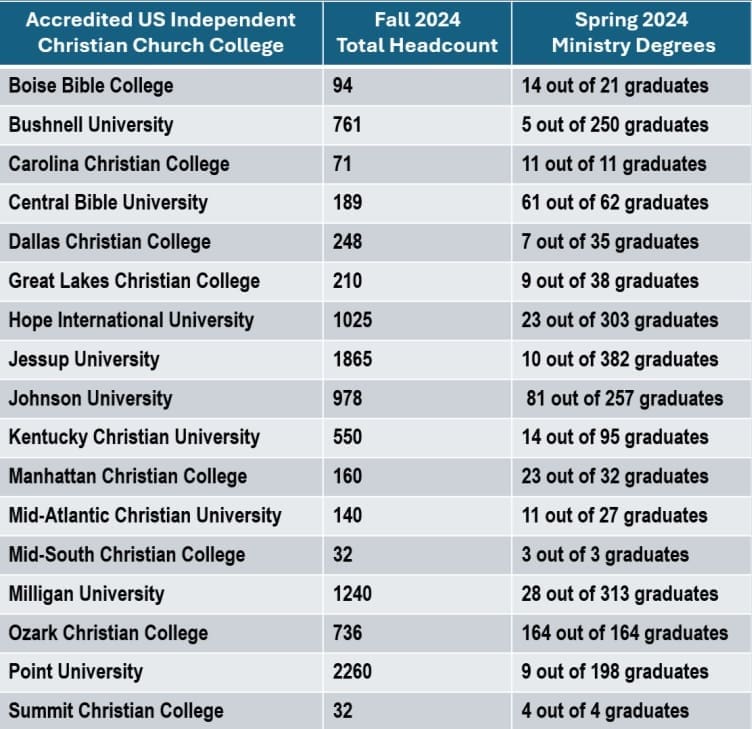
In other words: the ministry pipeline is shrinking.
What Role Can Our Colleges Play in Today’s Ministry Landscape?
Indeed, stories now abound of churches (and mission fields) facing challenges in finding the leaders they need. Do we still need Bible colleges? The answer, it would seem, is yes.
But we can’t bring back the 90s (We don’t need 90210 haircuts again anyway). We grieve the loss of beloved schools in recent years, but movements—like the Bible college one—often follow a discernible cycle: crisis/need, uprising response, peak, contraction, adjustment/evolution, and new normal. I’m hoping we’re near the end of the contraction phase. As we take to heart its lessons, we can wisely adjust for a new, effective, sustainable normal (Space prohibits me from exploring those lessons here, but another article would discuss the importance of things like missional clarity, gracious-but-boldly-biblical convictions on gender and sexuality, debt-free finances, wide relational and financial support among the churches, endowment building, accredited academics, the effects of geographical location, serving adult learners alongside traditional students, detailed reporting to wisely-focused college boards, and more than anything: a bedrock-deep dependence on and trust in God).
The best question now might be: how can we as a movement shape our schools as they shape future ministry leaders? A handful of concluding suggestions:
- Pray for all of our colleges, and especially the Bible colleges. Our liberal arts colleges are mostly larger, our Bible colleges mostly smaller. One higher education group projects that “442 of the nation’s 1,700 private, nonprofit four-year colleges” could close or merge in the next 10 years, especially those with enrollments under 500 (Jon Marcus, “More than a quarter of private colleges are at risk of closing, a new projection shows,” npr.org, April 13, 2026. The “under 500” note was mentioned by a regional accreditor). Ask God to provide for all our schools, and especially for the smaller Bible colleges—we need them.
- Encourage our Christian liberal arts colleges to keep waving the ministry banner. As the table shows, three of our top six producers of ministry graduates in 2024 were not Bible colleges, but Christian liberal arts colleges. Cheer them on in this work—we need them.
- Explore college partnerships with other “ministry pipeline” sources. In addition to our colleges, at least three other sources help train ministers for our movement: church residencies, campus ministries, and non-accredited institutes (Ozark Christian College is partnering with Lincoln Christian Institute. See also ministries like the 4C Ministry Institute, Advance Center for Ministry Training, the Merold Institute, Renew University, and Oil Belt Christian Camp’s Bible and Ministry Training Center. Some are independent, while others are based in a particular congregation). Our colleges can come alongside these good ministries, offering accredited biblical and theological education to their students—we need them.
- Make vocational ministry leaders a metric for your church. Jesus commanded, “Ask the Lord of the harvest, therefore, to send out workers into his harvest field” (Matthew 9:38, New International Version). In addition to measuring yearly attendance and baptisms and engagement, measure how many vocational harvest workers your church raises up—we need them.
Connect both traditional students and adult learners with our colleges/seminaries. If your church hires from within—people with marketplace training but no biblical/theological training—our colleges and seminaries offer educational options to ground them more deeply in Scripture. Challenge young people to ministry, but don’t leave out these mid-career folks—we need them.
Our fellowship’s oldest Bible colleges started in the 1890s and flourished in the 1990s. I do not know if our schools will still be around in the 2090s, but I do know this: for whatever reason, God has chosen us in this season to serve his church—educational tools to train leaders for kingdom work. We are bridesmaids, here to serve the Bride.
May he use us as colleges to train a tidal wave of workers for the harvest field, and through those leaders, may the gospel be preached, souls saved, children taught, marriages mended, and addictions broken. May churches be led, the hungry fed, the wounded healed, communities transformed, and nations reached with the good news of Jesus Christ.
However long the Lord gives us, may we be faithful in that task.

Author: Matt Proctor
Matt Proctor serves as president of Ozark Christian College, Joplin, Missouri.
Sponsored

For 160 years Christian Standard has served the churches of the Restoration Movement. Your gift keeps articles like this one free for every church leader.
Sponsored

Keep reading
More in Church Leadership



From the archive
Christian Standard has covered this since 1866.