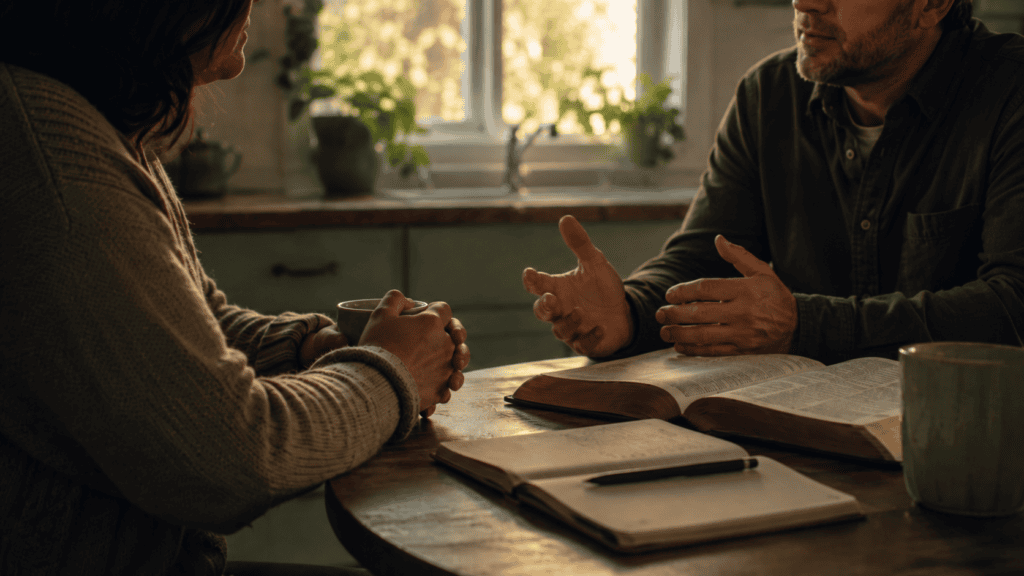
A Conversation with Glen Elliott

Meet Our Contributing Editors: Glen Elliott, minister with Pantano Christian Church in Tucson, Arizona, talks about the fruit of faithfulness in a city with stagnant growth and a culture oriented toward “success.” Interview by Jennifer Johnson Your life motto is “Faithfulness, not success.” What do you mean? Arizona is one of the fastest-growing states, but after the recession, our county experienced almost zero growth. That affected our church. There weren”t any huge problems with me or my staff, but for a couple years our church didn”t grow. Pretty soon, a few elders started asking questions, and critics became more critical.

Leaders Will

By Eddie Lowen   I”ve come to a surprising realization about all the churches where my friends and family lead: they all are healthy. In fact, many of these churches are outright thriving! Statistically, that reality is striking because research suggests the majority of churches are in decline, spiritually and numerically. Yet, among my close connections, I can”t think of anyone who presides over a dying or wilting church. And I think I know at least one reason why. Because we are fallen, individually and corporately, the tendency of a church is toward decline. My friends” and family”s churches defy that propensity because,

Fix It!

By Teresa Welch   “What”s wrong with education in the church today?” As a professor and practitioner of Christian education, I have posed this question in workshops and classrooms and received no shortage of replies. Inexperienced teachers. Antiquated methods. Lack of organization. Bland curricular materials. The question often riles up the room. There”s something cathartic in complaining about how the church bungles education. At some point, however, I end the conversation. I look straight at the group, and I share three simple words: “Then fix it.” You have probably heard complaints about the lack of biblical literacy in today”s congregations.

We Are in This Together

By Glen Elliott   It”s the “secret sauce” in any successful team effort. It”s a key factor helping a church to thrive. A question for the leaders at my church: are we convinced that “we”re in this together”? Ever notice how some sports teams with mediocre talent or limited resources seem to play better than those teams with big-name stars earning lots of money? That makes for a great movie. Or maybe you”ve seen a struggling team that fires its head coach, hires a new coach, and suddenly the same group of players starts winning. (I won”t call out any

To Congregate, or Not to Congregate?

By Don Bennett I”m convinced the sheep should not choose their shepherds. It”s time to get rid of policies and procedures that allow this. I spent my formative years in two Restoration Movement churches that seated their leadership through a voting process that usually occurred at an annual congregational meeting. This was the norm in the 1960s and “70s, with many churches actually allowing nominations from the floor on the day of the vote! As I witnessed this tradition over several years, I became convinced of this system”s flaws. For starters, few if any of those present and voting were

The Elder and Staff Relationships

By David Roadcup For centuries, the devil”s playground in a congregation has been the relational web between the paid staff and elders. Love, encouragement, support, understanding, and communication must flow between staff and elders. In many cases however, struggle, misunderstanding, lack of communication, and sometimes extreme frustration are more likely to be prevalent. Ministers need the relational support and undergirding of the elders. Elders need the encouragement and support of the paid staff members. It”s a two-way street. The need flows both ways. This issue is important in the life of a church because when unity is broken and a

A Conversation with Randy Gariss

Interview by Jennifer Johnson Last time we talked, you”d just finished a sabbatical. How has it changed you and the church? We decided on my six-months sabbatical partly to give me prep time for the next five to eight years, because all leaders need some extended time to study and refill the well. But the other reason is no congregation accidentally gets younger. There are four of us on staff who had been here 25 years or longer, and that wasn”t setting us up for the future. Clearly, we”re not a “throw-out-the-old” type of church. But you only get younger

Interview with Phil Scott

By Paul Boatman Phil Scott is in his sixth year as senior minister with First Christian Church in Dodge City, Kansas. This is his fifth ministry focused on leading a declining church into “turnaround” principles and practices.   “Turnaround church,” “comeback church”””help us understand these terms. As I use “turnaround church,” I”m using a concept deeply rooted in Scripture. It relates to leaving past patterns that were ineffective and choosing new patterns for living out our faith by returning to God. That describes repentance, but not all of the issues that led a church into decline are obvious sin patterns.

Sheep-Care 101

By James Riley Estep Jr. The imagery of shepherding is, without question, Scripture”s dominant metaphor for leadership formation. The patriarchs, Moses, David, and Amos the prophet had experience as shepherds, and that experience prepared them, in part, to assume their places as leaders of God”s people. The Old Testament and New Testament both use the shepherd metaphor frequently, yet few people today are familiar with the profession. In Ezekiel 34 and elsewhere, the qualities of bad shepherds vs. good shepherds are described. The shepherd image is so pronounced in the ancient world that the rulers and kings of Israel were

Institute Completing First Term

By Jennifer Johnson This month, adults of every age and from every background are completing their first term at the Eastside Institute for Spiritual Growth and Leadership, a new educational initiative created by Eastside Christian Church and Hope International University. The two Fullerton, CA, ministries have partnered to develop a two-year, four-term “night school” that introduces students to the Bible, the character and nature of God, his covenant, the teachings of Jesus, the mis-sion of the church, and more. “The Institute is providing three things,” says Charles Stoicu, director. “One is a focus on Bible knowledge””many people are biblically “˜illiterate,”

Mistakes Are Good and Conflict Can Be Productive

By Mark A. Taylor If there”s one thing too many Christians avoid, especially with other Christians in church settings, it”s conflict. Bad situations fester because leaders fail to confront. Inferior ideas get implemented, and sometimes enshrined, because someone in charge is afraid to say no. A better way goes undiscovered because those discussing the future are too willing to follow the first plan proposed. A minority voice sways a decision because others in the group will not stand up and say, “Brother, you”re wrong.” Yet the greatest progress is often the product of freewheeling dialogue where dissent is welcome. Bob

Learning to Lead

By James Riley Estep,  Jr. It”s a complaint commonly heard in some churches: “We”re having trouble finding men to serve as elders,” or “Younger men aren”t stepping forward to serve as elders!” Leadership is oftentimes more caught than taught. Solomon wrote, “Iron sharpens iron, so one person sharpens another” (Proverbs 27:17). He understood what we now understand””leaders form other leaders.  Recruiting and equipping elders in the church is not just a matter of programming, and the solution is not as simple as starting a leadership class. Leaders are formed over a lifelong process of experience, training, nurturing, and intentional relationship

Imperfect People””Perfect Plan

By Dyke McCord   Let me tell you about how my elders and I function together. While there will always be differences of opinion, the elders and ministry staff at my church demonstrate unity (Ephesians 4:11-13). Our support for one another privately and corporately leads to high levels of trust within the body. These are not yes-men, but rather men with strength of character and a level of support that demonstrates, “No matter what, we”re going to get through this together.” We all work to be genuine and transparent. Leadership credibility is the result.   Boundaries Our elders don”t protect

Interview with Steve Wingfield

By Paul Boatman Steve Wingfield serves as senior pastor with First Christian Church in Florissant, Missouri. With an average attendance of 1,200, this church in the largest suburb of St. Louis faces challenges endemic to churches in changing suburban communities.   Give us a brief summary of your history with First Christian. My dad, Charles Wingfield, was called to preach here in 1972 when I was 10 years old. The church was running about 150 to 170. I grew up in this church, went away to Bible college, and then ministered four years in another place. In 1987 the church

The Ministry of Christian Scholarship

By Thomas Scott Caulley Nearly 20 years ago, Mark Noll, then a professor at Wheaton College, began his book, The Scandal of the Evangelical Mind, with a simple and provocative assertion: “The scandal of the evangelical mind is that there is not much of an evangelical mind.”1 He described his work as a “cry of the heart” on behalf of the intellectual life by one “who embraces the Christian faith in an evangelical form.”2 Compared to other religious groups, Evangelicals fare poorly on the intellectual scene. One symptom of this problem, according to Noll, is they support no specifically Evangelical

Educating Ministers as They Serve

By Jennifer Johnson “Old methods of seminary training assume an outdated model that”s primarily baptizing, marrying, and burying,” says Mark Love, dean of the School of Theology and Ministry at Rochester College (Rochester Hills, MI). “But we don”t live in that world anymore. We need to be teaching students how to read a culture and relate to it as missionaries.” To this end, Love created the Master of Religious Education in Missional Leadership, a two-year, 36-hour program designed to educate students while they serve in a local ministry. “Their ministry context is their primary classroom,” Love says. “So we combine

30 Years, 50 Elders, 2 Lessons

By Jon Walker   Which of these two lessons, if fully learned, could most help the elders at your church do their job more effectively and bring the greatest glory to God? Lesson 1: The RATS Formula One of the first elders I worked with said the life of a church is full of change, which is challenging because change changes things, and changing things can cause people to feel like they”re losing something, and when people lose something they grieve, and grief is not a widely celebrated emotion. That is why a congregation may look askance at change, even

I Did a Cannonball in the Jordan River

By Tim Harlow I”m writing this from Israel. We brought a group here to walk where Jesus walked, pray where Jesus prayed, and get baptized where Jesus got baptized. I did a cannonball. A cannonball is when you jump into the water with your arms holding your knees tight against your chest. It makes a huge splash. I thought it would make a good video moment for our church as we are in the last months of a capital campaign we”ve called “Cannonball””All in and Making Waves.” We borrowed the metaphor from our friends at Mountain Christian Church in Joppa,

How We Choose Our Elders

By Ron Kastens When I arrived in October 2001, CrossWay Christian Church was still a very young church and I was able to help shape our elder process, role, and culture. I am grateful to the fellow elders with whom I have served during my time at CrossWay. One of the things I am most pleased with is our process for selecting new elders. When I was growing up, and during college, it seemed many churches selected elders by simple nomination and secret ballot vote. Yet as I read the New Testament, I see no example of this in the

They Need a Friend!

By Mark A. Taylor Young adults may lead the way in social networking, but their hours with Facebook, Twitter, and Instagram don”t help all of them feel connected. In fact, among Americans today, the youngest adults are most likely to say they”re still looking for a friend. The Barna Group reports 20 percent of Americans describe themselves as lonely, up from about 10 percent just 10 years ago, “a paradoxical reality in the full swing of the social media age.”Â  In that same decade, the number of Americans “trying to find a few good friends” has increased from 31 to

Help Keep Christian Standard Free & Accessible with a Tax Deductible Donation

We can do more together!

Every gift makes a difference!

No, thank you.
100% secure transactions - receipts provided.
Does Your Church Want to Support Christian Standard?

Would your church consider including support for Christian Standard in its annual missions budget? Your support would help us not only continue the 160-year legacy of this unifying ministry, but also expand the free resources, cooperative opportunities, and practical guidance we provide to strengthen churches in the U.S. and around the world.

We can do more together!

Every gift makes a difference!

No, thank you.
100% secure transactions - receipts provided.
Secret Link