December 9, 2025

Restore & Renew: Preserving the Legacy of Alexander Campbell
A major new initiative is underway to preserve one of the most significant collections in the Stone-Campbell Restoration Movement: The Alexander Campbell Papers.
December 9, 2025
A major new initiative is underway to preserve one of the most significant collections in the Stone-Campbell Restoration Movement: The Alexander Campbell Papers.
April 18, 2024

When Isaac Errett [1820–1888] came into leadership in the Restoration movement there was need of a new type of literature. . . . His writings were more Scriptural and less theological, more practical and less philosophical. . . .
March 21, 2024

"Not 1804, not 1809," Ira M. Boswell wrote in 1924, "but that day in January, 1832, when the union between the Disciples of Christ and the Christians was consummated, is the greatest date in religious history between Pentecost and now" . . .
March 14, 2024
"Their [the Restoration pioneers'] troubles were many. There were enemies without and within," Ira M. Boswell wrote in 1924. "I shall not have time to notice them all, but will give my attention to those which prevailed before the union between the disciples of Christ and Christians" . . .
March 1, 2024
Exploring the pivotal issues that gave rise to two major divisions (and a number of smaller ones) . . .
February 2, 2023

In preparation for the 1931 North American Christian Convention, slated for June 17 to 21 of that year in Lexington, Ky., Christian Standard published a list of important dates in Restoration Movement history. . . .
October 26, 2022
News briefs about a "Declaration and Address" original copy on display, three notable deaths, Mulberry International's efforts in Ukraine, Ends of the Earth Cycling's schedule, and this weekend's big football game (Point University vs. Kentucky Christian University).
October 13, 2022

"With the passage of years the movement . . . has been identified with restoration, not unity," Lewis Foster wrote in 1984. "In fact, with many, this early essential unity thrust of the movement has been allowed to drift out of sight compared with the place it once occupied."
May 1, 2022
Can We Restore the Unity of the Restoration Movement?
August 11, 2020

By Ben Merold As I think about Marshall Leggett, who passed away on March 2 at age 90, two personal experiences keep coming to my mind . . .

In 1940, Christian Standard published a lengthy series of articles called “Stars” by Frederick D. Kershner, then serving as dean of the School of Religion at Butler University in Indianapolis. In introducing the series on March 9 of that year, Kershner wrote, “We shall strive to interpret the ongoing of a great movement in the life of the church through the contribution of six of its most significant advocates. . . . We shall be occupied only secondarily with the mere details of biography. . . .” Those six Restoration Movement “advocates” included: • Thomas Campbell . . . “who
November 7, 2019

The signature gathering marking the 100th anniversary of Thomas Campbell’s Declaration and Address took place in Pittsburgh in October 1909. It was called the Centennial Convention of the Disciples of Christ. Here is a summary of the keynote sermon from Oct. 11, opening night of the convention. I. J. Spencer, minister with Central Christian Church in Lexington, Ky., preached on “Centralization in Christ; or, The Sovereignty of Jesus.” _ _ _ The Keynote Sermon By I. J. Spencer;Oct. 16, 1909; p. 11 I thought at first of love as a fitting theme for a “keynote sermon,” but Christ is greater
September 5, 2019

During this past year of sharing articles and editorials from the archives of Christian Standard, we have featured several pieces written by Isaac Errett, leader of this magazine from its founding in 1866 until his death in 1888, but not so much written about Errett. The September 11, 1909, issue of Christian Standard was another “Centennial Special” that commemorated the 100-year anniversary of Thomas Campbell’s “Declaration and Address.” Virtually all of the historical articles in that September issue were about Errett. We will excerpt from one article and run a second article in its entirety. Neither article attempted to tell
January 10, 2019

– Jan. 9, 1909 – Among the crucial earliest triggers of the Restoration Movement, I typically think of two: The Cane Ridge Revival led by Barton W. Stone (1801) and the Declaration and Address penned by Thomas Campbell (1809). In January 1909, Christian Standard began a year-long series under this banner headline: “CENTENNIAL SPECIAL FOR JANUARY” with the subhead, “After One Hundred Years—A Century of Progress in America’s Greatest Christian Union Movement.” A number of articles in the issue carried that theme forward. In a moment, I will zero in on what probably is the most personable of them (“Reminiscences
April 12, 2018

By Michael C. Mack How you view the statistics in this and the next two issues depends on the attitude you decide to take. I suppose you could look at the numbers with a competitive spirit, comparing your figures with those of a nearby church or one in your size category, with envy, suspicion, or snobbery. Some of us might do the same with churches of Bible college friends (and foes), churches where we used to work, or those hip, one-word-name churches—you know, like Vibe, Collage, 24|7, and TheUnpretentiousDeliberatelyIntentionalChurchofAuthenticRelevantChristianCommunity (“Unpretentious” for short). I’d like to suggest two healthier ways to
November 23, 2011
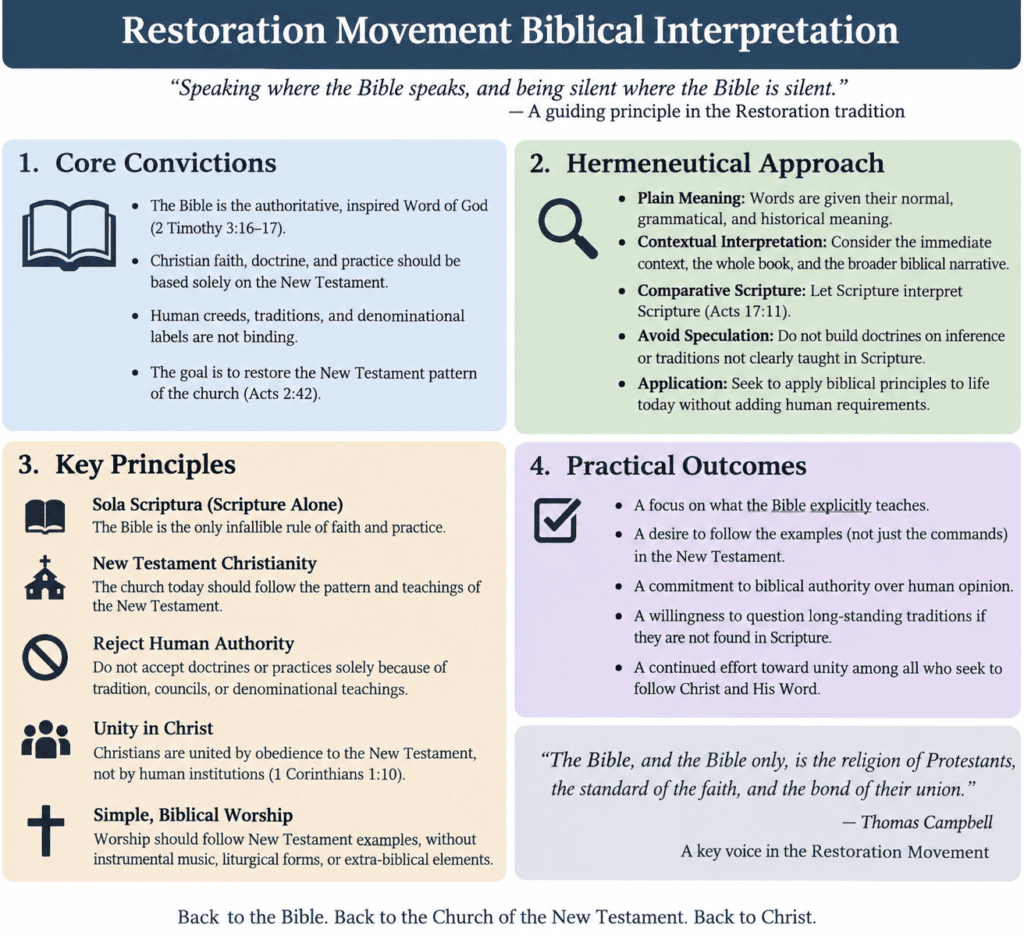
Mark Weedman traces three pivotal moments in Restoration Movement biblical interpretation, from Thomas Campbell’s plea for unity through debates involving Isaac Errett, David Lipscomb, Modernism, and Fundamentalism.
May 29, 2011

The Brush Run Church began with about 30 members and became a small but significant starting point in the Restoration Movement shaped by Thomas and Alexander Campbell.
January 16, 2011

Mark A. Taylor reflects on the Stone-Campbell Dialogue, Great Communion celebrations, and the ongoing call to pursue unity among Restoration Movement churches.
December 6, 2010

The Stone-Campbell Dialogue met in Johnson City, Tennessee, as leaders from three Restoration Movement streams discussed unity, past divisions, and future efforts for continued conversation and cooperation.
June 13, 2010

Dick Alexander reflects on the Restoration Movement, identity, unity, innovation, and the future of Christian churches and churches of Christ in a changing century.
Sponsored

Sponsored

Sponsored


Learn how to turn the sermons you’re already preaching into searchable, shareable content that helps people discover and connect with your local church. Access Be Seen, Be Heard on demand with Wes Woodell and Trey Sheneman. A two hour course for preachers, church media and website teams, and anyone who wants to help their church reach more people online.

September 17, 2026
Quentin Davis

September 15, 2026
David Faust

September 15, 2026
James Thompson