The Accountable Leader
Christian leaders need deep, intentional friendships marked by accountability, humility, and biblical faithfulness to protect character and finish strong.
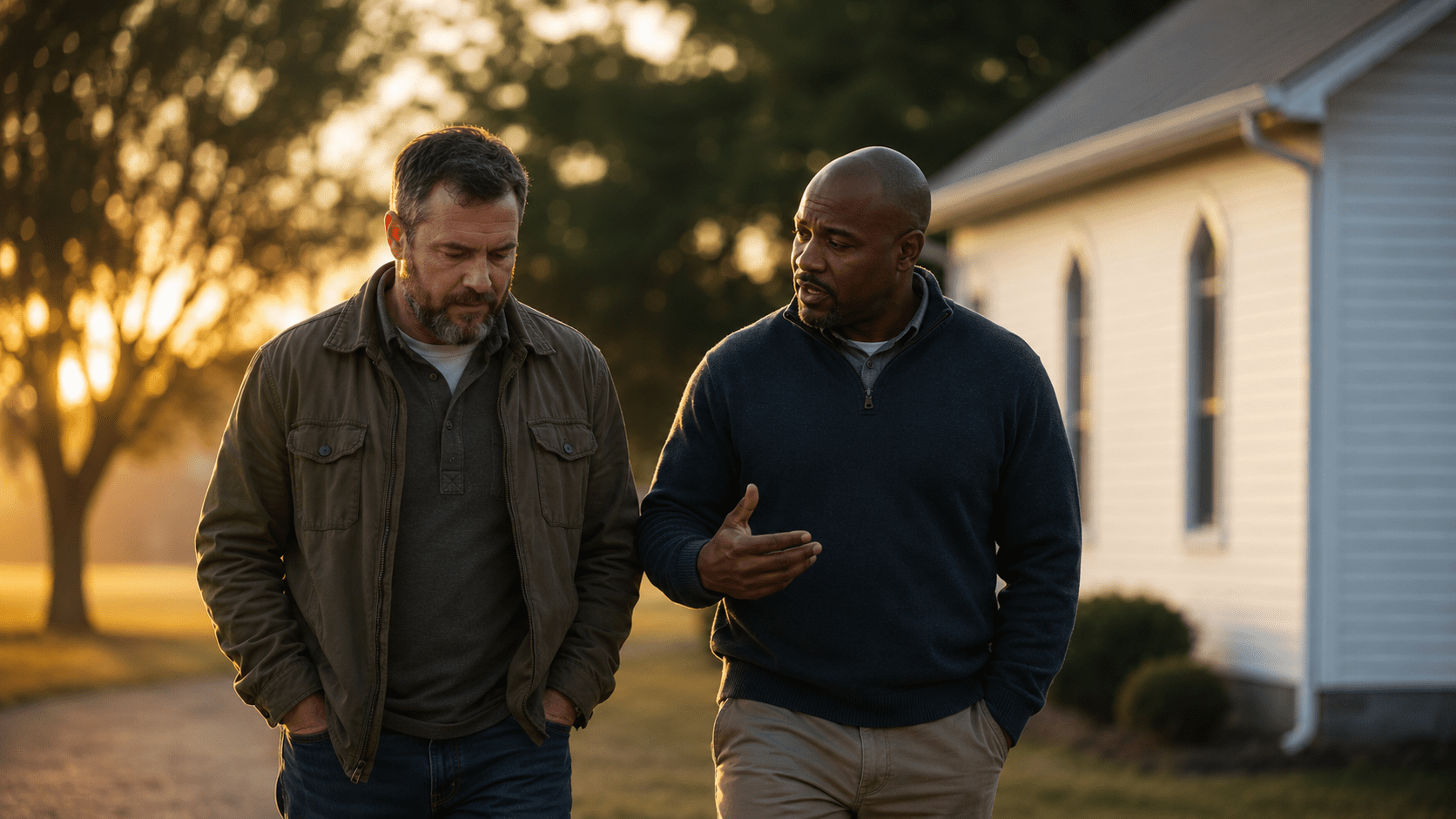
Christian Accountability Helps Leaders Finish Strong
This article reflects on the importance of deep, intentional friendship and mutual accountability among Christian leaders. Drawing from Scripture, personal practice, and the covenant friendship of Jonathan and David, it calls leaders to assess their hearts, embrace biblical accountability, and pursue relationships that protect character and integrity.
- Christian leaders need close, accountable relationships to strengthen character and integrity.
- Accountability is rooted in Scripture and should be practiced intentionally.
- Deep friendships marked by humility, submission, and covenant commitment help leaders remain faithful.
By Gary Johnson
When I was in third grade, a significant event took place in my life; our family bought a color TV. It was the first one on our block. As an eight-year-old boy, my neighborhood buddies came over to watch the antics of Batman and Robin, Charlie Brown and Snoopy, and the Lone Ranger and Tonto—in living color. After an action-packed episode of Batman taking out his arch nemesis, the Joker, we would run outside and reenact the episode before our moms would call us home for bed. Now that I am grown-up, I have not outgrown my need for close friends.
Television programming—then and now—reflects a biblical truth: We need to do life in relationship. After all, Genesis 1:26-27 reminds us that we have been made in the image of God, and God is in the mysterious threefold relationship of God the Father, Jesus the Son, and the Holy Spirit. Moreover, God declared, “It is not good for the man to be alone” (Genesis 2:18, New International Version). Hence, we are stronger and better when we are doing life in relationship with others, particularly with followers of Jesus.
When thinking of people in Scripture, we quickly notice individuals doing life with one another such as Moses and Joshua, Jonathan and David, Elijah and Elisha, Naomi and Ruth, Priscilla and Aquila, Peter and John, Paul and Timothy, Barnabas and John Mark, and more. These “famous pairs” were doing life two-by-two. Similarly, when Jesus trained and equipped his disciples, he “sent them out two by two” (Mark 6:7).
Why Accountability Matters for Christian Leaders
Deeper, more intentional friendship among Christian leaders helps to build resilient character and integrity. Accountability is a must have. Just as we must have air to breathe, water to drink, and food to eat, we must have deep relationships with a few key people with whom we experience mutual accountability.
But we must want and pursue this dimension in our friendships. All too often, we shun being held accountable for our actions, decisions, and attitudes. After all, who wants to live a life examined by others?
I wish we could say that as Christian leaders, we relish friendships with one another characterized by transparent accountability. Yet that is not the norm. For example, because of rugged individualism, we believe we can handle things in our own strength and wisdom. Too often, we are of the opinion that we do not need others in our lives. Moreover, because of rigid isolationism, we keep people at a safe distance, choosing not to share our fears and failures with others. On the contrary, when we intentionally move into accountable relationships with others, we protect and safeguard our integrity. Character still counts.
To move into and benefit from authentic accountability, consider three essential aspects of deeper relationships among leaders. The three are as simple as A-B-C to remember, but more difficult to pursue.
Assess
We measure what’s important. For example, if we struggle with over-eating, we may step on the scales daily to measure our weight. We assess our progress in our on-going struggle. Similarly, each of us has an on-going struggle in becoming increasingly like Jesus. The Word tells us, “Anyone who says he is a Christian should live as Christ did” (1 John 2:6, Living Bible). Speaking for myself, I find myself on the proverbial struggle-bus when it comes to being sanctified. However, my struggle is not in vain. Not only do I have the in-dwelling person of the Spirit (1 Corinthians 6:19-20) to empower me, but I have invited select people to speak into my life when it comes to my Christian character.
Years ago, I read Donald Whitney’s Ten Questions to Diagnose Your Spiritual Health. This book was transformative in that I have memorized Whitney’s questions, and for years I’ve asked myself these questions every morning to assess my walk with Jesus (i.e., spiritual health). We easily—and regularly—assess our physical health, asking ourselves, “Am I getting the flu, are my allergies acting up, etc.?” As Christians, we should do the same spiritually.
In addition, I create a personal Life Map each year, with clearly stated objectives to chart a day-to-day journey to become increasingly like Jesus. Think in terms of using the GPS feature on your phone. GPS will only work if I enter my starting location to let it map out my ending location. Similarly, to map out a journey to increasingly become like Jesus, I must know my “starting point” (i.e., assessing where I am spiritually). Once I complete my Life Map, I give it to a few people relationally close to me and I give them permission to “hold me accountable” as to what progress I am making in protecting my character while becoming more like Jesus. After all, “as iron sharpens iron, so one person sharpens another” (Proverbs 27:17, NIV).
On April 24, 2016, Tim Peake ran the London Marathon in 3:35 hours. It was an incredible feat because as an astronaut for Great Britain, Peake completed this 26.2-mile race while on the International Space Station, orbiting 250 miles above the earth! Being in zero-gravity, Tim tethered himself to a treadmill and finished the marathon. While running, Mission Control often asked Peake, “How’s your heart?” Officials monitored his cardiac function. Having run a few marathons in my life, this story caught my attention, and since hearing it, I have asked people to ask me, “Gary, how’s your heart?” I am not referring to my cardiac function, but to my character. We must give select people permission to regularly and purposefully inquire about our interior world. Character still matters.
If we are to deliberately and intentionally pursue accountability, we must individually, and in community, assess our character. Accountability and assessment go hand-in-hand.
Biblical
If we are to be a “people of the Book,” we must affirm that accountability is biblical. We find evidence of accountability rooted in Scripture, from cover to cover.
“So then, each of us will give an account of ourselves to God” (Romans 14:12).
“Nothing in all creation is hidden from God’s sight. Everything is uncovered and laid bare before the eyes of him to whom we must give account” (Hebrews 4:13).
“Have confidence in your leaders and submit to their authority, because they keep watch over you as those who must give an account. Do this so that their work will be a joy, not a burden, for that would be of no benefit to you” (Hebrews 13:17).
There came a time when Paul and Barnabas traveled to Jerusalem to meet with the apostles and elders of the church, and “when they came to Jerusalem, they were welcomed by the church and the apostles and elders, to whom they reported everything God had done through them” (Acts 15:4). Paul and Barnabas practiced accountability before the leaders of the Jerusalem church—the very church that originally sent Barnabas to Antioch on mission (Acts 11:19-26). The same “reporting” took place by the disciples after they returned to Jesus from the mission on which he sent them: “And [Jesus] called his twelve disciples together and began sending them out two by two … The apostles returned to Jesus from their ministry tour and told him all they had done and taught” (Mark 6:7, 30, New Living Translation). When these Christ-followers “reported in,” they practiced being held accountable.
Can we say that we are intentionally “reporting in” with those we have invited to speak into our lives? Being a “people of the Book” calls us to live increasingly under its authority, and that includes pursuing and practicing accountability.
Simply put, accountability is biblical. We must not shun accountability; but rather, run toward it.
Covenant
Jonathan and David are a “famous pair” in the Old Testament. Their paths crossed on the battlefield when David killed Goliath, and we read that “they became one in spirit” and that “Jonathan made a covenant with David” (1 Samuel 18:1-4, NIV). Being one in spirit denotes that what God loved, they loved; what God hated, they hated. They were aligned as men of God; both men were living for God. They were on the same page spiritually, having a common cause, as well as an uncommon covenant.
Throughout their story, their friendship was called a covenant, a Hebrew word that means they formed “an alliance.” And to form their alliance, Jonathon gave David his robe and tunic (i.e., military uniform), his sword, bow and belt (i.e., weapons that were in short supply, 1 Samuel 3:16-22). These items belonged the prince, the king’s son, denoting that Jonathan was heir-apparent to the throne. When Jonathan gave these pieces to David, he declared that David would become king. Hence, their alliance was characterized by mutual humility and submission, as well as with commitment that endured beyond Jonathan’s death (1 Samuel 20:14-15).
Do you have a friend like that, one with whom you are on the same page spiritually and have formed an alliance, perhaps “signed and sealed” with a significant gift? In marriage, such a gift is called a wedding ring. If your married, your spouse must be your essential accountability partner. Marriage is a sacred, God-honoring relationship marked with absolute, never-ending accountability. In addition, are you doing life with a friend who sticks closer than a brother? Have you formed an alliance with that individual, living in mutual accountability built on the bedrock of humility and submission? Aristotle once said, “Friendship is a single soul dwelling in two bodies.”
Nowhere in Scripture are we commanded to be successful. To the contrary, Jesus said, “Be faithful, even to the point of death, and I will give you life as your victor’s crown” (Revelation. 2:10). We are called, by Jesus himself to be faithful to the very end of our lives. For that to happen and to finish strong, we must pursue and practice genuine accountability.
Character still counts.

Author: Gary Johnson
Sponsored

For 160 years Christian Standard has served the churches of the Restoration Movement. Your gift keeps articles like this one free for every church leader.
Sponsored

Keep reading
More in Church Leadership



From the archive
Christian Standard has covered this since 1866.





