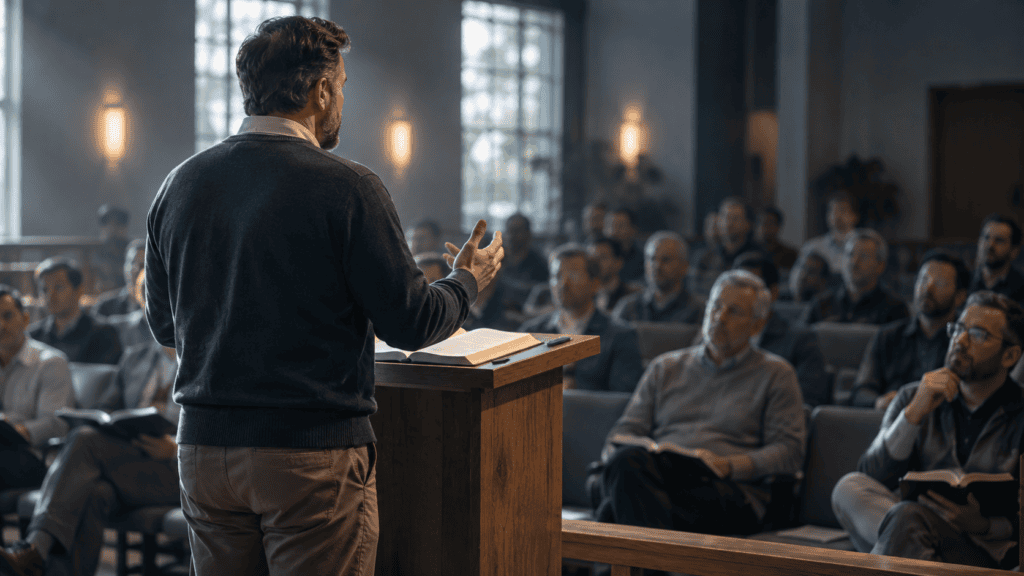
Leading a Divided Church
Church conflict can exhaust even experienced leaders. These three perspectives encourage leaders to reframe conflict, seek trusted mentors, and make reconciliation and restored relationships an intentional part of church life.

Leading Through Church Conflict and Division
Church conflict can leave leaders exhausted, discouraged, and unsure how to respond. By putting conflict into perspective, connecting with trusted mentors, and restoring holiness, leaders can pursue reconciliation and healthier relationships within the church.
- Reframe conflict around restoring broken relationships rather than winning a fight.
- Find trusted mentors who can offer perspective, prayer, encouragement, and support.
- Make reconciliation, forgiveness, and peacemaking intentional parts of church life.
“What did we walk into?”
I was physically sick. It was the first Sunday at our new ministry. Within five minutes of the service being over, 150 people escaped the premises without saying a word to one another. A fire alarm could not have moved them more quickly.
I later learned that there had been a coordinated effort during my interview process to hide just how divided the church was. The stories would have been amusing if they were not so real.
For example, when one former minister began to preach, half the congregation began reading the newspaper in protest. In another instance, half the congregation held a New Orleans funeral dirge during the sermon. That minister finally gave up, and half the congregation gave up with him.
It’s one thing to discuss conflict in a seminary class; it’s another when you feel the true weight of it firsthand. Here are three thoughts to help reframe our response to conflict, along with a resource every church leader should have on their shelf.
Place Conflict into Perspective
If you’ve been part of the church for any length of time, you’ve seen and experienced conflict. At its core, conflict is about broken relationships. But Jesus’ entire purpose in living, dying, and rising again is to restore the ultimate broken relationship—ours with our Father God.
Broken relationships often begin with self-centeredness. It has been that way from the beginning. Satan desired what God had. Sin was introduced. Adam and Eve’s relationship with God was broken, and life has not been the same since. Unity was replaced by enmity. People think they’re fighting about an issue, but the deeper problem is the broken relationships driving the tension.
We must remember what Jesus promises in Matthew 18:20: “For where two or three are gathered in my name, there am I among them” (English Standard Version). A divided church is a weakened church, but a united church is unstoppable. Our goal should not be to win a fight, but rather to restore what has been lost, namely our relationship with God and others. By reframing the conflict, our attitude and strategies begin to shift in a very healthy way.
Connect with a Mentor
Exodus 17 contains several stories offering lessons on how to lead divided people. The Israelites quarreled with Moses in the desert because they were thirsty (v. 2). In a moment of exhaustion and frustration, Moses cried out to God, “What am I to do with these people?” (v. 4, New International Version). We’ve all been there.
Later Moses encountered another crisis when the Amalekites attacked Israel. Accompanied by Aaron and Hur, Moses went to the top of a hill overlooking the battle. As he held his hands above him, the Israelites prevailed in battle. As exhaustion set in and he lowered his hands, the Amalekites begin to prevail. Aaron and Hur saw what was happening and held his hands up, leading to victory.
As a leader, you’ll grow tired and hurt in the battle to restore relationships. You may even be tempted to give up. You need Aarons and Hurs to walk alongside you, speak truth into your life, and to pray for and encourage you. Every leader needs trusted people to walk alongside them who can remain objective and bring calm to the chaos.
Restore Holiness
Conflict and division are normalized in our culture. We are called to be different, to be peacemakers. Division and conflict are not obstacles to hide from, but opportunities to be embraced.
Paul reminds us in Romans 12:2, “Do not conform to the pattern of this world, but be transformed by the renewing of your mind.” If the Bible is the story of broken relationships restored, our preaching needs to reflect that truth. Long before conflict is visible, our preaching and teaching should routinely and intentionally incorporate lessons on conflict resolution. Small groups offer an opportunity to put those lessons into practice and provide accountability as we strive to grow.
Most people in your church are wrestling with some sort of conflict right now. It may be at home, in the workplace, with parents, or even at church. Traditionally, churches incorporate time to reflect on the broken relationships in our lives through partaking in the Lord’s Supper. Paul warns Christians that these moments are not passive, but a call to action.
In 1 Corinthians 11:27–28, Paul writes, “So then, whoever eats the bread or drinks the cup of the Lord in an unworthy manner will be guilty of sinning against the body and blood of the Lord. Everyone ought to examine themselves before they eat of the bread and drink from the cup.”
Weekly, many Christians come to church and partake in Communion yet do nothing about the broken relationships in their lives. They may even take the Communion elements while refusing to talk to someone in the very same room. As we plan Sunday services, what would it look like to take a very practical step and make reconciliation, forgiveness, and restoring broken relationships more than a time of reflection?
A Needed Resource
Outside of Scripture, there is one book that every church leader needs to read. Your leadership can make a difference between healthy and destructive conflict. I highly recommend reading Making Peace by Jim Van Yperen.


Author: Eric Bingaman
Sponsored

For 160 years Christian Standard has served the churches of the Restoration Movement. Your gift keeps articles like this one free for every church leader.
Sponsored

Keep reading
More in Church Leadership



From the archive
Christian Standard has covered this since 1866.