Restorer of Gospel Evangelism

As promised last week, here is an article about Walter Scott by Enos E. Dowling, who was then serving as librarian of the School of Religion at Butler University in Indianapolis. This article is from January 27, 1945. Dowling begins the article by describing what some call “the most important sermon ever delivered on American soil.” _ _ _ Restorer of Gospel Evangelism Walter Scott Logically Comes First in a Series on ‘Great Evangelists of the Restoration Movement’ By Enos E. Dowling January 27, 1945 Every seat in the meetinghouse of the Baptist church was filled. Many stood around the

Have We Restored New Testament Christianity?

In his editorial of February 20, 1954 — 65 years ago — Christian Standard editor Burris Butler shared a rather harsh assessment with readers. _ _ _ This Is News (an editorial) February 20, 1954 When members of a local church recently pledged themselves to practice the Golden Rule for one month, the story was carried in newspapers across the land. Why? What was the “man bites dog” factor that made this experiment in Christian living noteworthy? The Golden Rule is only a small part of the teaching of Jesus. It is just a fraction of the Sermon on the Mount.

An Epistle on Debt from Mrs. Alexander Campbell

This brief article by and about the second wife of Alexander Campbell developed in a roundabout way. The February issue of Christian Standard deals with finances, including “In the Arena” articles by Matt Merold and Chris Philbeck that take stands on the question, “Should churches embrace and utilize debt?” (Matt says yes; Chris says no.) I wondered if writers from the magazine’s past had weighed in on this subject, so I dug into the archives of the Christian Standard’s first 100 years of publication. I turned to the listing for DEBT—an obvious place to begin the search—and was surprised to

A Basic Lesson on the Bible and God (by Isaac Errett)

Today we feature another item from a series that appeared throughout 1909, a year Christian Standard was celebrating “One Hundred Years—A Century of Progress in America’s Greatest Christian Union Movement.” The magazine devoted an issue each month that year to articles explaining our movement, its history, and our beliefs. The item we shared Jan. 10 was J. W. McGarvey’s personal reminiscences of Thomas Campbell (printed in the Jan. 9, 1909, issue). This month we focus on a portion of correspondence written by Christian Standard founding editor Isaac Errett. In January 1909, the magazine published—republished, actually—part one of “Historico-Doctrinal Sketch of

The Financing of the Restoration Movement
 (Part 2 of 3)

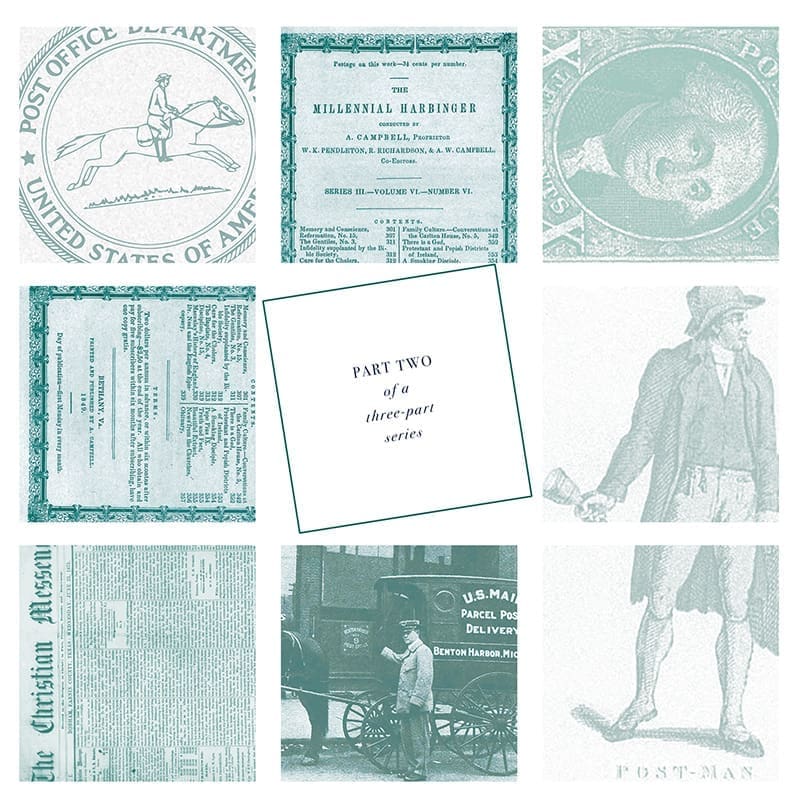
(Part two in a three-part series)   By Steve Carr In our digital society, postage stamps seem archaic. But in Alexander Campbell’s day, they symbolized wealth. And as postmaster at Buffaloe, Virginia, he was able to wield this wealth to benefit the Restoration Movement. During the colonial era, postal service was sketchy. It was so costly and inconsistent that the United States made it an official government institution after the Revolutionary War. As the country expanded westward, mail became essential in providing access to critical information, thoughts, and ideas. As a result, postmasters became among America’s most important citizens. Campbell

The Fortification of the Restoration Movement (Part 3 of 3)

By Steve Carr “What religion are you?” “Christian.” “Well I get that, but what kind of Christian?” “Um, just Christian.” Growing up on Cincinnati’s west side, where Roman Catholicism reigned supreme, I constantly had this exchange with kids at school. Raised in a Restoration Movement congregation, I was taught that our church was simply Christian—nothing more, nothing less. It wasn’t until years later in seminary that I learned another biblical name that could describe my tribe. Alexander Campbell was repulsed that some referred to his group as “Campbellites,” so he sought a more biblical description of our fellowship. Terms like

Orrin Root and ‘Sound the Battle Cry!’

I was thinking about Orrin Root the other day. He comes to mind quite often. Mr. Root was retired when I met him in 1998, but he still was writing The Lookout’s weekly Sunday school lesson commentary, as he had done since 1949. When Mr. Root died in 2003, he was several months ahead on his lesson writing. Oh, and he was 98. I always thought he wrote like a young man, only with much wisdom. Mr. Root came to work at Standard Publishing (former parent company of this magazine) in 1945, when he was 40 years old. He became

J. W. McGarvey’s Reminiscences of Thomas Campbell

– Jan. 9, 1909 – Among the crucial earliest triggers of the Restoration Movement, I typically think of two: The Cane Ridge Revival led by Barton W. Stone (1801) and the Declaration and Address penned by Thomas Campbell (1809). In January 1909, Christian Standard began a year-long series under this banner headline: “CENTENNIAL SPECIAL FOR JANUARY” with the subhead, “After One Hundred Years—A Century of Progress in America’s Greatest Christian Union Movement.” A number of articles in the issue carried that theme forward. In a moment, I will zero in on what probably is the most personable of them (“Reminiscences

The Past, Present, and Future of the Restoration Movement (Part 1 of 3)

(Part one of a three-part series) By Steve Carr Let me start with the story of two movements. By virtue of reading this magazine, I’m sure you can guess the first one, so I’ll introduce you to the other. About four decades after the inception of the Restoration Movement, American innovation led to the creation of a game that would quickly become the national pastime: baseball. Abner Doubleday is often credited with creating the game, but historians have virtually refuted this. Regardless of who started it, the history of baseball is robust. It continued to spread rapidly across the United

Henrietta Heron — ‘The Friendly Counselor’

— Jan. 7, 1939 — I recognized the name Henrietta Heron, but knew next to nothing about her until I stumbled upon the column we feature today. Research revealed that she worked at Standard Publishing (parent company of this magazine until recent years) before serving as president of the World Wide Baraca Philathea Union from 1928 until 1933, and then as general counselor of the organization after that. According to Gordon-Conwell Theological Seminary’s website, “Baraca Philathea was an ecumenical movement designed to facilitate adult evangelism through Bible study. A million strong during the early twentieth century, it tried to bridge

What’s New? [‘Standing . . . at the Edge of 1969’]

– Dec. 28, 1968 – Please forgive me for rerunning yet another classic editorial. This, by my count, is the third week in a row. And yet, after scouring a half-dozen end-of-the-year issues searching for something to share, I think this editorial from the final issue of 1968—one of the most turbulent years in our nation’s history—will stimulate the most thoughts. Editor Edwin V. Hayden wrote this one. _ _ _ What’s New Standing as we do at the edge of 1969, with the moving hand of time prepared to push us into it whether we like it or no,

‘Glory to God’ Must Come First

– Dec. 22, 1945 – As promised last week, here’s another Christmas editorial—this one from Dec. 22, 1945, just a few months after the end of World War II. The tone of this editorial by Burris Butler is revealing. There is relief that the war is over, but a high degree of unsettledness that is predictive of the decades to come. _ _ _ ‘GLORY TO GOD’ MUST COME FIRST We all need to pause a little while to listen with the shepherds of long ago to the song of the angels which rang out across the Judean hills and

Our Plea Restated

– Dec. 12, 1903 –   In “‘Our Position’ Revisited,” from the June 2018 issue, Jerry Harris summarized Isaac Errett’s “Our Position” editorial from 1872. Harris then wrote: I have always heard the term “Restoration plea,” but outside of this work by Isaac Errett, I couldn’t find any good explanation of its meaning besides the quoting of our mottoes or references to the writings of some of the great pioneers of our movement. As Alexander Campbell’s protégé and the original publisher and editor of Christian Standard, I think it’s important to study Errett’s writings on “Our Position.” That’s one reason

Remembering Hugh McDiarmid, Standard’s Second Editor

At this magazine, we speak often of Isaac Errett, our founding editor. So far as I am aware, his name has appeared in each issue of the magazine since the beginning in April 1866. Can anyone name the editor who succeeded Errett? Anyone? Anyone? Arron Chambers provided the answer—Hugh McDiarmid—in “Lifting Up Jesus,” an article about the magazine’s editors for our 150th anniversary issue (April 2016). But Arron provided only this brief description: Errett’s successor was Hugh McDiarmid (June 10, 1837—August 15, 1901); he served as editor from 1888–92. McDiarmid was born in Kent County, Ontario, Canada. Some information about

A Thanksgiving Editorial from 1881

– November 26, 1881 – Thanksgiving 1881 came at a strange time in the life of Christian Standard. It was only two months after the death of President James A. Garfield, who was shot twice by Charles A. Guiteau in Washington, D.C., on July 2, 1881. Garfield remained alive, but largely in misery, until his death Sept. 19. (The account of Garfield’s medical treatment, and how it likely contributed to his death, is quite fascinating.) Garfield, of course, was one of the initial investors in Christian Standard magazine. The first editor of this magazine, Isaac Errett, surely knew Garfield and

Early Reporting on the Missionary Convention

The International Conference On Missions met for its annual gathering Nov. 15 to 18 in Cincinnati. According to ICOM’s website: In March of 1948, J. Russell Morse was in the home of John T. Chase for dinner, and asked, ‘Why isn’t there a gathering for missionaries?’ He went on to express the need for a time where missionaries can talk shop, fellowship and encourage each other. So in 1948, the day prior to the NACC started, a few dozen missionaries got together. That practice continued for several years growing to a few hundred people. Then in 1954, the National Missionary

1964: When the NMC Traveled to NYC

– October 31, 1964 – The International Conference on Missions is taking place in Cincinnati next week, November 15-18. It’s the sixth time the gathering has come to the Queen City, and the first time it’s been there under its “new” name, ICOM. Cincinnati last served as host in 2007; the conference was known as the National Missionary Convention until 2011. As is the case with the North American Christian Convention—now known as Spire—the best-attended gatherings among our fellowship of churches traditionally take place in the heartland. And so, that’s where most of the ICOM/NMC gatherings have taken place during its

‘Young Missionary’ J. Russell Morse Discusses Foreign Mission Methods

If you haven’t taken the opportunity to read Russell Johnson’s article from our November 2018 issue titled “Prayer, Power, Purpose: J. Russell & Gertrude Morse and Four Generations of Ministry to Southeast Asia and Beyond,” please be sure to treat yourself. The article details hardship, heartache, discouragement, and imprisonment, but also the prayers, purpose, and perseverance through which God’s Word has been faithfully preached over the past century. Thousands of people in isolated areas have heard the message and accepted Christ through God’s grace and the Morse family’s efforts. I scanned Christian Standard’s archives and reviewed the headlines of numerous

‘Cane Ridge Revival VBS’ Draws Praises

By Caleb Kaltenbach CANE RIDGE, KY—Several Restoration Movement churches tried out the first “Cane Ridge Revival VBS” this past summer. “There’s really nothing else like it,” said Tim North, who created the program. “The idea is to help children not only encounter Jesus, but also to experience what it was like to attend this August 1801 revival!” “I’ve never seen a VBS like ‘Cane Ridge,’” said Frank Stone, minister with Ebenezer Christian Church. “There were no fancy decorations, take-home trinkets, crafts, or anything. They wanted these kids to have a true Cane Ridge experience, so they didn’t even need microphones.”

‘Who Are the Christian Churches and Churches of Christ?’

CS Archive from September 25, 1988 _ _ _ On September 25, 1988, Christian Standard published an item that had been prepared for the Encyclopedia of American Religions titled, “Who Are the Christian Churches and Churches of Christ?” The writer was Edwin V. Hayden, who served as editor of Christian Standard from 1957 to 1977. As one might expect, the article is a straightforward introduction to our churches—part history and part snapshot in time. As you read it, I believe you’ll appreciate both the clarity of the writing the clarity of the vision for our churches. Some also will note

Help Keep Christian Standard Free & Accessible with a Tax Deductible Donation

We can do more together!

Every gift makes a difference!

No, thank you.
100% secure transactions - receipts provided.
Does Your Church Want to Support Christian Standard?

Would your church consider including support for Christian Standard in its annual missions budget? Your support would help us not only continue the 160-year legacy of this unifying ministry, but also expand the free resources, cooperative opportunities, and practical guidance we provide to strengthen churches in the U.S. and around the world.

We can do more together!

Every gift makes a difference!

No, thank you.
100% secure transactions - receipts provided.
Secret Link