Articles for tag: Barton Stone

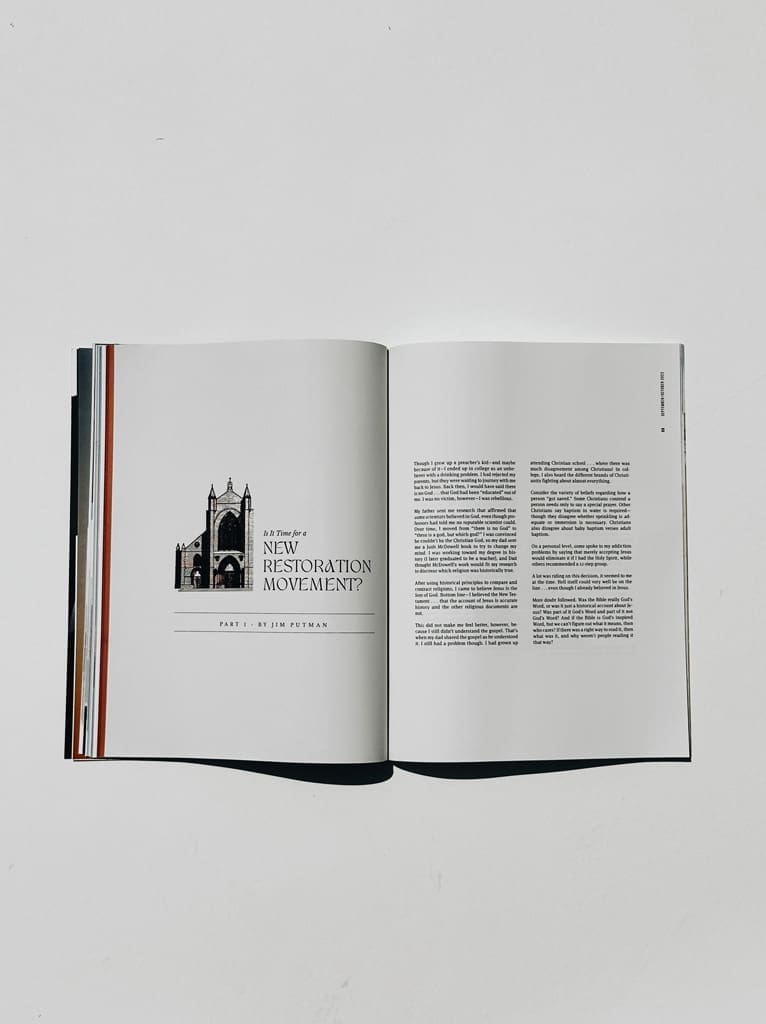
Is It Time for a New Restoration Movement? (Part 1)

Is It Time for a New Restoration Movement? (Part 1)

By Jim Putman  Though I grew up a preacher’s kid—and maybe because of it—I ended up in college as an unbeliever with a drinking problem. I had rejected my parents, but they were waiting to journey with me back to Jesus. Back then, I would have said there is no God . . . that God had been “educated” out of me. I was no victim, however—I was rebellious.   My father sent me research that affirmed that some scientists believed in God, even though professors had told me no reputable scientist could. Over time, I moved from “there is no

A Homecoming of the Heart: The Secret in Our Search for Unity

By Drew Baker The unfortunate consensus in the United States demands that our leaders come across as having all the answers. Whether politicians or preachers, we expect them to have perfect wisdom even if we know it’s an impossible ask. I can’t imagine a politician getting elected on a platform of humility and a willingness to learn even from political opponents. When it comes to preaching, we tend to expect more answers than questions from our pulpits. “Give us this day our daily truth, lead us not into contemplation, and deliver us from mystery.”    In such a culture, it is

Marshall Leggett: Faithful Minister in God’s Service

By Gene Wigginton Marshall Leggett will be remembered by all who knew him as a man whose ambition in life was to be a faithful minister in God’s service. That ambition was never compromised. As a preacher and Christian college administrator, he honored God and touched countless lives with the truth of God’s Word. Marshall Leggett died March 2, 2020, at age 90. Faithful in the Churches He Served I had the privilege of meeting Marshall in the early years of his ministry. While traveling on behalf of a Christian college, I visited Marshall and his wife, Jean, in their

A Biographical Study of Barton W. Stone (Part 4)

Here is the conclusion of our four-part series on Barton W. Stone, as excerpted from Frederick D. Kershner’s 1940 series on six of the “most significant advocates” of the Restoration Movement. (Click on any of these to read the earlier installments of the series: Part one — part two — part three.) _ _ _ “Stars: Message of Barton Stone” May 4, 1940; p. 7  The first relations of [Alexander] Campbell and [Barton] Stone appear to have been somewhat strained and not altogether cordial. The Kentucky reformer was a little dubious about too much emphasis being placed on water regeneration;

The Starfish Effect: Why Our Decentralized Approach Is Our Strength

By Scott Kenworthy A few years ago, I attended the International Conference on Missions with a friend from a different church tradition. As we entered the exhibit hall filled with hundreds of missionaries promoting their various initiatives, I said to my friend, “This is the strength of our movement.” When we left the same hall a couple hours later, he turned around, took one last look, and commented, “That is the weakness of your movement.” Where I saw innovation, entrepreneurship, and bold risk-taking for the sake of the gospel, he saw chaos and the lack of a centralized strategy. So,

A Biographical Study of Barton W. Stone (Part 3)

We continue this week with the third installment of Frederick D. Kershner’s biographical study of Restoration Movement father Barton W. Stone from 1940. (Part one and part two are available here.) _ _ _ “Stars” April 27, 1940; p. 7 There was a group of young ministers, of which Stone was probably the center, which reacted against the high Calvinism of their fathers after the Cane Ridge revival. Stone, McNemar, Marshall, and three or four others withdrew and organized the Springfield Presbytery. They published an apology, some part of which was comprehended in the autobiography of Barton W. Stone. The

A Biographical Study of Barton W. Stone (Part 2)

We continue this week with our second installment of Frederick D. Kershner’s look at Barton W. Stone from 1940. Though Kershner wrote his profile on Stone in three installments, we shared only a portion of part one last week; today we share the rest of the article originally published April 20, 1940. _ _ _ “The Message of Barton Warren Stone” April 20, 1940; p. 7 BARTON WARREN STONE[’s] . . . life may be summarized under the following outline: Early period (1772–1799). Cane Ridge Revival (1799–1801). The Springfield Presbytery (1802–1804). Independent career (1804–1831). Union with the Campbells (1831). Later

A Biographical Study of Barton W. Stone (Part 1)

In 1940, Christian Standard published a lengthy series of articles called “Stars” by Frederick D. Kershner, then serving as dean of the School of Religion at Butler University in Indianapolis. In introducing the series on March 9 of that year, Kershner wrote, “We shall strive to interpret the ongoing of a great movement in the life of the church through the contribution of six of its most significant advocates. . . . We shall be occupied only secondarily with the mere details of biography. . . .” Those six Restoration Movement “advocates” included: •  Thomas Campbell . . . “who

God’s Love for a Lost World

We continue our monthly series of excerpts from Christian Standard, circa 1909. The magazine devoted one issue each month that year to articles of particular interest to our movement. Today we feature a sermon by Barton W. Stone, who allied with Alexander Campbell to form the Restoration Movement (aka, the Stone-Campbell Movement). No date is attached to this sermon, which we will prune some, as it is quite long. Here’s Barton W. Stone (1772–1844): _ _ _ God’s Love for a Lost World A Sermon by Barton W. Stone (Published April 10, 1909; p. 6) The love of God is

The Financing of the Restoration Movement
 (Part 2 of 3)

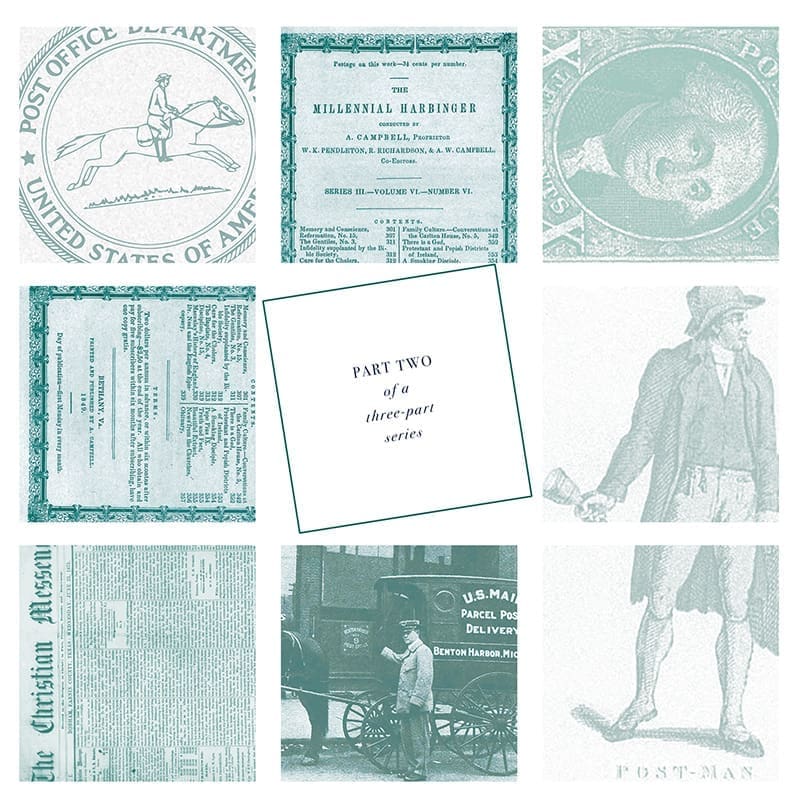
(Part two in a three-part series)   By Steve Carr In our digital society, postage stamps seem archaic. But in Alexander Campbell’s day, they symbolized wealth. And as postmaster at Buffaloe, Virginia, he was able to wield this wealth to benefit the Restoration Movement. During the colonial era, postal service was sketchy. It was so costly and inconsistent that the United States made it an official government institution after the Revolutionary War. As the country expanded westward, mail became essential in providing access to critical information, thoughts, and ideas. As a result, postmasters became among America’s most important citizens. Campbell

A New Critical Juncture in the Restoration Movement

By Jerry Harris The Restoration Movement has faced critical junctures at least twice in its history. The first time was after the Civil War. Deep wounds remained as the nation endeavored to reconstruct itself. Death had silenced the great leaders of our movement: Barton Stone in 1844, Thomas Campbell in 1854, John T. Johnson in 1856, Walter Scott in 1861, Alexander Campbell in 1866, and “Raccoon” John Smith in 1868. Division came from many voices that tore at the fabric of the simple principles of unity based in the restoration of the church of the New Testament. It was into

Why Would You Be the President of the NACC?

By Tim Harlow I made a joke the final day of the North American Christian Convention when I appointed my friend Mike Baker as next year”s president. I knighted him with a sword (because Mike and I are weird that way), and then I said, “But I”m keeping the sword””because you might be tempted to fall on it sometime this year.” In case you are wondering, there is no pay involved in being the president. Actually it”s the opposite; your church or organization will likely have to spend money on it, and it will cost you in many ways. Is

A Conversation with Jennifer Johnson

Meet Our Contributing Editors: In this final interview of CHRISTIAN STANDARD”s contributing editors, we talk with the writer who interviewed all the others. This worker and watcher of the church talks about small churches, megachurches, and the failings and future possibilities of our movement. Tell us who you are””not a recitation of your résumé, but what makes you tick. My parents like to tell the story of coming to pick me up from the toddler”s room at church one Sunday morning and discovering me hiding under a crib, calmly looking out at everybody. That kind of sums it up””I”m an

New Signs of Hope in Eastern Canada

By Jim Tune Eastern Canada (Ontario and the Maritime provinces) was the seedbed for what finally became known as the Restoration Movement in Canada. Long before the thoughts of Barton Stone were circulated north of the 49th parallel, and several decades before Alexander Campbell visited the Canadian churches, a simple movement””similar, but not identical to that in the United States””took root in Canada. It was an appeal to model the church according to the simple doctrine and polity of the New Testament, to pursue unity, and to discard denominational labels and creeds. Scottish “restorationists” arrived upon the shores of New

Rediscovering the Sacred Stones

A church”s new multisite campus. A town steeped in history. The grave of a Restoration Movement pioneer”s wife. A reflection on what this frontier preacher stood for, and the message we still proclaim today.  By Jerry Harris There she was. Her stone lying on its back, broken and weathered among scores of neglected reminders of lives long since past. The inscription was hard to read because of a combination of age, moss, and dirt, but careful examination gave witness to the precious soul long forgotten to so many.   Celia W. Wife of Elder B.W. Stone Died Apr. 23, 1857

The Passion of Barton Stone

By Jim Tune Barton Warren Stone was one of the foremost leaders for religious freedom on the western frontier during the first half of the 19th century. He led a movement with goals many—including me—are still pursuing today. Barton Stone was born in Maryland in 1772 and as a boy decided to become a preacher. At age 19 he was ordained a minister in the Presbyterian church. In 1801, Stone moved to Cane Ridge, Kentucky. As he took up his preaching ministry, he discovered that some of the things he read in his Bible seemed inconsistent with the strong Calvinist

Lesson for Jan. 23, 2011: Light for the Gentiles (Isaiah 49:1-7)

This week”s treatment of the International Sunday School Lesson (for January 23) is written by Steve Carr who serves with Echo Church in Cincinnati, Ohio. Light for the Gentiles (Isaiah 49:1-7) By Steve Carr As a minister and an employee at a Christian institution, I have spent a lot of time talking with people about God”s call in their lives. Through these interactions I have met people who have claimed to hear the audible voice of God speak to them. I”ve also met people who fear for their salvation because they have never felt God speaking in their lives. While

A Religious Man for President

By Jerry Rushford On November 2, 1880, 10 million Americans went to the polls and elected James A. Garfield the 20th president of the United States. Garfield was deluged with congratulatory letters in the week after his election, but none more significant than the one penned by Burke Hinsdale who wrote: “I have been astonished . . . at the hold that your candidacy took of the religious mind of the country. “˜Now we are going to have a religious man for president” is a thought that has swelled in the hearts of thousands of religious men.” James Abram Garfield was born on

Help Keep Christian Standard Free & Accessible with a Tax Deductible Donation

We can do more together!

Every gift makes a difference!

No, thank you.
100% secure transactions - receipts provided.
Does Your Church Want to Support Christian Standard?

Would your church consider including support for Christian Standard in its annual missions budget? Your support would help us not only continue the 160-year legacy of this unifying ministry, but also expand the free resources, cooperative opportunities, and practical guidance we provide to strengthen churches in the U.S. and around the world.

We can do more together!

Every gift makes a difference!

No, thank you.
100% secure transactions - receipts provided.
Secret Link