
The Annual Church Financial Audit
A 2025 annual church financial audit highlights steady electronic giving, lower debt loads, strong cash reserves, and changing giving-unit patterns across congregational sizes.
A 2025 annual church financial audit highlights steady electronic giving, lower debt loads, strong cash reserves, and changing giving-unit patterns across congregational sizes.
January 18, 2022

All independent Christian churches and churches of Christ are encouraged to participate in Christian Standard’s annual survey, which is now available.

From a financial standpoint, most churches performed amazingly well during the course of COVID-19. Now, with unprecedented levels of cash on hand, church leaders must strategize how best to steward these resources.
January 1, 2021

Money helps fuel ministry, so it’s critical for leaders to pause and understand the state of their church’s finances as they start a new year. I encourage leaders to consider short-term strategies to keep their congregation focused on the mission and a long-term approach to develop disciples who are generous. Here are four steps you can take to improve the short-term and long-term financial health of your church. Conduct a “Giving Audit” People’s giving habits can be indications of their spiritual journey; a church typically has givers at various points on that journey. PushPay identified the following eight categories of
January 1, 2021

A couple of exciting events took place in 1956. First, I was born, which was pretty exciting for me. Second, our federal government adopted the official motto, “In God We Trust.” That phrase quickly was stamped onto our currency and coin, where it remains today. Why did America adopt a motto in 1956? We were fighting a Cold War with the Soviet Union, a superpower that championed atheism. While the U.S.S.R. contended God did not exist, the United States not only declared his existence, but that our nation trusted in him. “In God We Trust” is more than a
May 13, 2020

By Chris Moon As coronavirus-related social-distancing rules are eased and churches crack open the doors to their buildings, they do so knowing many things will be different—some for the worse, but possibly some for the better. Churches will need to figure out how to make the most of the challenges and opportunities. SAME STORM, DIFFERENT BOATS“We’re all in the same storm, but we’re not all in the same boat,” said Rick Rusaw, chief executive officer of the Spire Network and former pastor of LifeBridge Christian Church in Longmont, Colo. Spire has been surveying pastors and church members about their attitudes
February 2, 2019

By Michael C. Mack The statistic is alarming. According to a Christian university study reported by the Center for Church Leadership, over a 10-year period 70 percent of ministers drop out of ministry. And some of the biggest reasons for that high attrition rate are financial. CCL’s September 2016 State of the Ministry research study of Christian church/church of Christ ministers reveals that 74 percent of responders who serve in vocational ministry have debt. It also found that 54 percent of churches do not provide retirement benefits and 47 percent don’t offer health/medical insurance. No wonder the survey determined 85
September 7, 2018

E2: Effective Elders Blog Editor’s Note: Each Friday we publish a new blog post from our partners in ministry, E2: Effective Elders. We publish it here simultaneous to E2’s posting on their site. The leaders of E2 write an article for our print and online magazine every month as well. Those articles are full of wisdom and practical help for elders. Please check them out! _____ By Dick Alexander Elder work can be hard work, involving gut-wrenching decisions. On the one hand there is great joy in seeing lives changed and God honored. It’s an undeserved privilege to be used by
December 26, 2017

By Michael C. Mack A 2015 research study revealed that small group participants gave an average of $1,886 more per year to their churches than those not in groups. As a small groups guy, that statistic makes me smile. You”re probably not shocked by this finding. It makes sense that the more connected and involved people are in the life of the church, the more buy in they will have to the church”s vision and the more they will tend to give. But I think there”s more to it. LD Campbell, who was senior minister of First Church, Burlington, Kentucky,
November 29, 2017
The Lexington Herald-Leader, whose November 22 article provided much of the source material for this post, has written a follow-up. Click here to read, “After lawsuit, more turmoil at Lexington church; Attorney expects pastor to be exonerated,” posted November 29. _________ Two members of Southern Acres Christian Church, Lexington, KY, have sued the lead pastor and his wife to block them from spending church money or making real estate transfers. In their lawsuit, members James Keogh and Chad Martin accuse lead pastor Cameron McDonald of concentrating power and financial authority among himself, his wife, and one staff member, according to
May 2, 2015
By Kent E. Fillinger Numbers evoke an array of emotions. How many readers, for example, regularly step on their bathroom scales with more than a bit of trepidation? But the Bible is full of numbers, and almost every healthy church is counting something. We believe the special report of church statistics published here each year is a great time to recognize the uniqueness of our tribe of churches and to capture and celebrate the historic work God is doing. A record 347 churches responded to the survey this year, and I hope we double or triple that number next year!
January 22, 2015
By Brad Walden A longtime friend reported on the latest developments in the church where he had invested years of service. He seemed excited, but also concerned about the changes. So I asked, “Do you think your church is healthy?” He answered, “Oh, yes. We are healthy. We have the largest bank balance in our history.” So that”s it? A healthy church has a healthy cash reserve? That got me to thinking. How would I define a healthy church? Is your church healthy? Can you invite new neighbors to attend your church with total confidence they will find a healthy environment? Will involvement
May 16, 2014
By Will Thomas All churches count “noses” and “nickels.” That”s a good thing. Most of the time, attendance and finances provide a helpful barometer of what”s happening. But other factors also matter. Churches count what they do because they can. The harder-to-measure goals may too often remain hidden beneath the surface. Some churches look beyond the obvious. All churches could. In fact, looking beyond the obvious is probably one of the common characteristics of larger, growing churches. They know numbers for the sake of numbers seldom lead anywhere. Their leaders know a big church needs a big foundation. Churches that
May 30, 2013
By Phil Scott Of the more than 350,000 churches in America, 85 percent are stagnant or declining in membership. This means that “average” churches are actually unhealthy. Healthy growth comes to churches that rise above being typically average. The need of the day is unaverage churches. Average congregations are led by a small number of key older men and some women, paid and volunteer, who replaced previous older leaders. The strong influence of the charter members, founding fathers and mothers, or the founding pastor may be unknown or gone. The first generation is made up of the founding mothers
September 8, 2012

After a recession, costly litigation, and declining church momentum, Alan Ahlgrim shares how Rocky Mountain Christian Church navigated financial hardship and discovered lasting lessons about generosity, stewardship, and trusting God's provision.
July 15, 2012
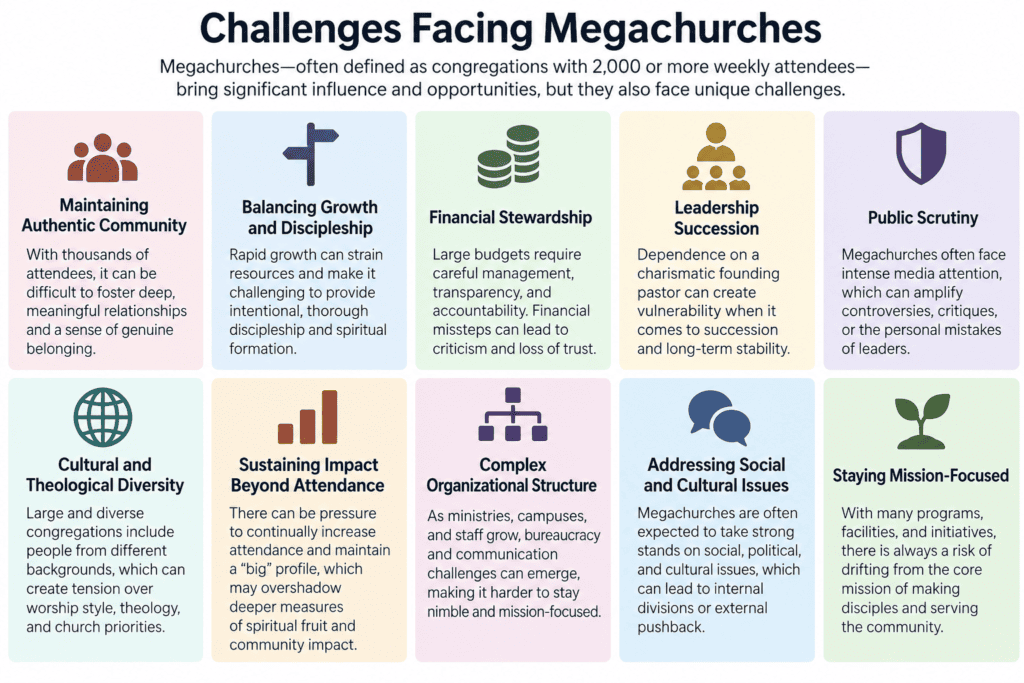
Brian Maris examines three challenges facing megachurches: dependence on smaller churches for growth, changing patterns of financial support, and Sunday-centric systems that can limit missional engagement.
November 14, 2011

Peer coaching cohorts give preachers a place to share ministry challenges, ask precise questions, exchange practical insights, and find encouragement from fellow leaders who understand the pressures they face.

Kent E. Fillinger examines church giving, staffing, spending, debt, and outreach trends among surveyed Christian churches and churches of Christ following the Great Recession.
March 28, 2010

Stephen Bond reflects on how financial scarcity challenged churches while encouraging creative ministry, careful stewardship, deeper dependence on God, and greater sensitivity to people facing unemployment and financial hardship.

Kent E. Fillinger offers practical guidance for churches navigating a shrinking economy through better budgeting, generous stewardship, Acts 4 community, and clear communication rooted in hope.
Sponsored

Sponsored

Sponsored


Learn how to turn the sermons you’re already preaching into searchable, shareable content that helps people discover and connect with your local church. Access Be Seen, Be Heard on demand with Wes Woodell and Trey Sheneman. A two hour course for preachers, church media and website teams, and anyone who wants to help their church reach more people online.

October 6, 2026
Rick Cherok

October 6, 2026
Landon Shuman

October 6, 2026
Doug Redford