Articles for tag: Ronald G. Davis

What to Wear?

(We first ran this Communion meditation in January 2014.) By Ronald G. Davis “What to wear? What to wear?” Millions of Americans echo that question, as seasons change, as holidays and holy days loom. “Should it be the floral print?” “Perhaps little Susie would look good in pink?” “Is it a white shirt and tie day or maybe just a striped henley?” Whatever the answer, for many that is a significant issue. Christians need not ask the question. We have other, more significant truth to ponder and celebrate. Long ago, God answered the question through the pen of Isaiah. Isaiah

Judas at the Table

(We first ran this Communion meditation in October 2016.) By Ronald G. Davis Because of varying details in the four Gospel accounts, scholars disagree over whether Judas was still present in the upper room when Jesus called for a new bread-and-cup occasion, a new Passover meaning. But we know Judas was there long enough to be given one last, gracious opportunity to repent (see John 13:18-30). When Jesus said, “The one to whom I will give . . . ,” it was Judas’s fingers and thumb that grasped the sop, a grasping motion that characterized his lifestyle controlled by greed,

Paul at the Table

(We first ran this Communion meditation in January 2014.) By Ronald G. Davis Paul wrote beautifully and authoritatively of the Lord’s table. But he also sat there. Right across from us, as it were. Was he worthy? Are we? Both he and we are worthy in the gracious eyes of the Lord who invited us here. Paul certainly had sins when he sat here. His tears of repentance were not for imagined occasions he “missed the mark” of God’s righteousness. No doubt, there were occasions at the table he thought about Stephen, the young evangelist, at whose stoning death he

Sangre de Cristo

(We first ran this Communion meditation in January 2014.) By Ronald G. Davis In the 16th century, Francisco Coronado and a group of Spanish soldiers explored the American Southwest, looking for golden cities! A priest accompanied them to carry God’s blessing and protection. When they reached the source of the Rio Grande River in what is now central Colorado, as the traditional story is told, that priest was mortally wounded by Native Americans defending their independence. As he lay dying in the Spaniards’ escape southward, he saw a glorious sunset on newly snowcapped peaks. “Sangre de Cristo! Sangre de Cristo!”

Presidents’ Day

By Ronald G. Davis  The presidents of the United States of America have represented the best among us. And the worst. For every president—whether moral, immoral, or amoral—has sinned. None has been perfect in policy nor in person. The wisest and the most foolish, the politest and the rudest, the honorable and the dishonorable, all are sinners. Oh, many have been men of prayer and public worship, but none has been the perfect example of righteousness and noble behavior. It is appropriate that we express honor to those to whom honor is due. Peter spoke for the Spirit when he

February 5, 2019

Christian Standard

To Love

By Ronald G. Davis  The word valentine speaks to us of love. And to love is to be the most like God we can be. Let me repeat that: to love is to be the most like God we can be. For God is love. The disciple who most sensed the love of God wrote to early Christians and to us, “Whoever does not love does not know God, because God is love” (1 John 4:8) and “Everyone who loves has been born of God and knows God” (4:7). In his image, we want the very best for all those

Can Dry Bones Live Again?

By Ronald G. Davis  Old Doc Richardson, of my Appalachian hometown, kept a human skeleton on display in his office. Carefully wired together and suspended from a metal stand, that skeleton clinked and clanked at the slightest touch of my small-child hand. It was eerie. It was also obvious to my unsophisticated mind: Whoever’s bones these were would never come to life again. Those bones were dead and dry. In Ezekiel 37, when God led Ezekiel back and forth across a field filled with bones, he asked the prophet a simple question: “Son of man, can these bones live?” Now

Flesh and Blood

By Ronald G. Davis John declared it: “In the beginning was the Word . . . and the Word was God. . . . The Word became flesh and made his dwelling among us” (John 1:1, 14). Though John’s Gospel account may emphasize the deity of Christ, it gives full attention to his humanity. Incarnation! The eternal, the nonmaterial, became flesh and blood. Here, we celebrate that fact. Jesus was fully human. He grew from infant in Bethlehem to toddler in Nazareth to a boy of age at the temple to a man . . . at the cross. As

At a Friend’s Table

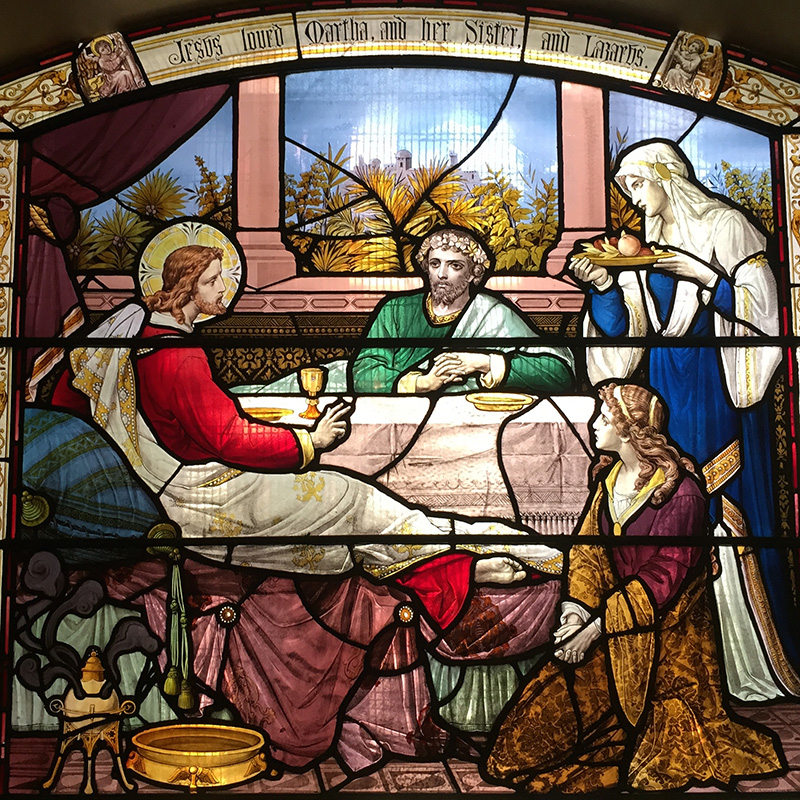
By Ronald G. Davis  Few experiences are as pleasant and satisfying as sitting at a friend’s table for a simple meal. Jesus had that experience on a number of occasions. At the home of Lazarus, Mary, and Martha, as recorded in John 12, it appeared to be especially delightful for him. That meal was, in a certain sense, a funeral luncheon prepared by a congregation for a dearly beloved member of the family. (Read John 12:1-3.) Only, on that occasion, the “dearly beloved” was still alive and present. Though the food prepared by Martha was no doubt delicious and nutritious,

Liking Things More and More

By Ronald G. Davis               Kate Greenaway was a noted 19th-century English illustrator, especially of children’s books. Though you might not recognize her carefully detailed botanical studies, you would probably recognize her images of happy Victorian children in sunbonnets and pinafores or knickers. In fact, Greenaway’s name is attached to the British literature award presented annually for most distinguished children’s book illustration. In a letter to her friend John Ruskin, recognized art critic and writer, she wrote: I go on liking things more and more, seeing them more and more beautiful. Don’t you think it is a great possession to be

The Good Shepherd Lays Down His Life for His Sheep

By Ronald G. Davis John, in his Gospel, borrows the beautiful image of God that permeates the Scriptures: God is our shepherd. And that image may be the most common symbolic image reproduced through the Christian era. From mosaics in the second-century catacomb resting places of those first Christians in Rome to magnificent stained-glass windows in hundreds of 20th-century church buildings from Europe to Australia, the shepherd shows himself ready to protect and feed. When Jesus applies that image to himself, in John 10, he pictures the absolute devotion the shepherd maintains in every circumstance. His whole existence is given

At Eye Level

By Ronald G. Davis A few years ago, a well-known preacher”s morning sermon was titled “God at Eye Level.” That”s a provocative title, isn”t it? In that Jerusalem upper room long ago and at this table today, we are at eye level with God. That”s an intriguing thought to me. Imagine those men who were at the table in the upper room, eye-to-eye with Jesus. Could each look him in the eye? Or did each try to hide his face in the shadows of that dimly lit room, not so much as daring to catch his eyes with their own?

Turning Point

By Ronald G. Davis Turning points sometimes come in a roar. Turning points sometimes come in a whisper. In modern history the roar was heard in the deathly din of D-Day. And the course of modern human history was changed. In biblical history, the whisper was heard by Elijah when he had fled in cowardice from an interloper in the messianic line. God called him with “a still small voice” to return to his ministry in the court of kings. And the course of Israel”s history was redirected toward a Messiah. John 6 pictures just such a dramatic turning point.

Kidnapped by the Taliban

By Ron Davis Many Americans were introduced to one of the stories of the Afghanistan war when they saw the 2014 CBS interview of Dr. Dilip Joseph regarding his experience and the book he had just written with James Lund, Kidnapped by the Taliban (Thomas Nelson Publishers). Dr. Joseph was the medical director for Morning Star Development, active in Afghanistan, serving locals with medical care and training. Returning from a mission of mercy, Dr. Joseph and his party were captured by the Taliban and held for several days. Their captors kept them moving constantly, and they were in moment-by-moment fear

TIME and TIMELESS

By Ronald G. Davis Sunday again. One hundred sixty-eight hours have passed, and now we are here again. How feebly we apply markers to the times of our lives. Yet we are creatures of time, having been destined to be born into time, to suffer all the joys and vicissitudes time offers, to die and find an end to time. Here, at this table, week after week, we assemble to remember that Timeless once entered into time. The Timeless One took on the weaknesses of time, so that he could save us from the inherent weaknesses of being creatures of

January 20, 2017

Christian Standard

An Occasion for Unity

By Ronald G. Davis On the same occasion Jesus put in place this memory meal, he prayed fervently for the unity of those who would assemble around his table. Sadly, this table has often divided those “who believe in him,” the ones for whom he prayed (John 17:20). Churches have had significant and insignificant disputes about the Lord”s table. There have been disputes over who should be at the table. Over which believers should be present. Over what the emblems should look like. Over how often the emblems should be available. Over such small matters as to when in the

The Shedding of Blood

By Ronald G. Davis The Passover of the Hebrew people was inextricably tied to the shedding of blood. How many thousands of Egypt”s firstborn sons had to die to free the Hebrews from their bondage? And how many young and innocent lambs and goats became a hurried meal of roasted flesh? How many gallons of their blood became the blessed stripes on doorjambs and door frames? Exodus 11 and 12 describe the wonderfully awful and bloody events of that solemn and deadly night of redemption. The Passover when Jesus gathered his devoted””and not-so-devoted””12 friends and disciples in the upper room

John at the Cross

By Ron Davis As Jesus died, John stood at the cross. The apostle describes the scene in his Gospel, John 19:25, 26. He is the one who called himself “the disciple whom he loved.” He fully sensed and experienced Jesus” love. Jesus did love John. He saw in John a young man capable of a lifetime commitment. And that was realized. John”s love for Jesus is likewise obvious. He saw in Jesus the One long promised, the One who would save. He saw the Word incarnate. That is why he stood at the cross. Heartbroken. He was losing his good

And When He Had Given Thanks

By Ron Davis One of the curious elements of the Passover Jesus shared with his apostles in the upper room, as recorded in Luke 22:14-20, is the comment, “he gave thanks.” Thanks? For what exactly? Jesus is hours away from being arrested, cruelly abused, and murdered in humiliation. And he knows it full well. Thanks! For what? For the material elements themselves? A simple “loaf” of unleavened bread, the commonest of food, better suited to fill a stomach than to nourish. The drinkable juice of a plant that grew clusters so large and plentiful and of which some shriveled on

Piercings

By Ron Davis Piercings are popular. It started with the ear lobe . . . and worked its way up . . . and down. But piercing is not new. And it did not come from good or noble precedent. The notoriously vicious Assyrians, in ancient times, took their captives home by inserting a hook through the cheeks of those captives. Keep up, or else, as you are dragged along! In fact, many cultures, ancient and modern “marked” their captives as slaves by a ring in the nose or ear. It was always the sign of an ultimate death penalty.

Secret Link