March 1, 2024
The Way We Were
What can we learn by reviewing Restoration Movement history? . . .
March 1, 2024
What can we learn by reviewing Restoration Movement history? . . .

In 2012, Daniel Overdorf and two friends examined 250 Christian Church and Church of Christ websites to determine how they presented their view of baptism to the public. Overdorf offers good suggestions for churches.
February 16, 2023

“Brief word pictures [by evangelist J. Vincent Coombs] of a few of the men [John T. Johnson, ‘Raccoon’ John Smith, J. M. Canfield, L. C. Warren] who have typified the character of our evangelism at various stages of the history of the Restoration Movement. May every preacher be an evangelist.”
February 2, 2023

In preparation for the 1931 North American Christian Convention, slated for June 17 to 21 of that year in Lexington, Ky., Christian Standard published a list of important dates in Restoration Movement history. . . .
September 1, 2022

How to Respond When the World Tries to Dismantle Your God-Given Identity By Wes Beavis “I hear voices inside my head.” This statement raises the sensitivities of a clinical psychologist. Hearing internal voices can be a sign of schizophrenia, which can drive people into homelessness. But schizophrenia is not just limited to the down and out. John Nash, a brilliant mathematician, would carry on conversations with people inside his head. His story was made into a movie called A Beautiful Mind. Despite suffering from schizophrenia, Nash’s intellectual capacity and achievements led to him being awarded a Nobel Memorial Prize in
May 1, 2022

By Tom Ellsworth In 1856, postal authorities accepted a new name for a little community in southern Indiana: Santa Claus. Then, in the 1920s, the Postal Service decided there would never be another Santa Claus Post Office in the United States. Consequently, every December, more than 400,000 pieces of mail are routed through the town because of its Christmas-themed postmark. I suspect the community’s founders never anticipated the full impact of the unique name. On a little knoll just a mile or so south of Santa Claus stands quaint, white-framed Mt. Zion Christian Church, the oldest church building in Spencer
May 17, 2020

By Scott Kenworthy A few years ago, I attended the International Conference on Missions with a friend from a different church tradition. As we entered the exhibit hall filled with hundreds of missionaries promoting their various initiatives, I said to my friend, “This is the strength of our movement.” When we left the same hall a couple hours later, he turned around, took one last look, and commented, “That is the weakness of your movement.” Where I saw innovation, entrepreneurship, and bold risk-taking for the sake of the gospel, he saw chaos and the lack of a centralized strategy. So,

We continue this week with the third installment of Frederick D. Kershner’s biographical study of Restoration Movement father Barton W. Stone from 1940. (Part one and part two are available here.) _ _ _ “Stars” April 27, 1940; p. 7 There was a group of young ministers, of which Stone was probably the center, which reacted against the high Calvinism of their fathers after the Cane Ridge revival. Stone, McNemar, Marshall, and three or four others withdrew and organized the Springfield Presbytery. They published an apology, some part of which was comprehended in the autobiography of Barton W. Stone. The

In 1940, Christian Standard published a lengthy series of articles called “Stars” by Frederick D. Kershner, then serving as dean of the School of Religion at Butler University in Indianapolis. In introducing the series on March 9 of that year, Kershner wrote, “We shall strive to interpret the ongoing of a great movement in the life of the church through the contribution of six of its most significant advocates. . . . We shall be occupied only secondarily with the mere details of biography. . . .” Those six Restoration Movement “advocates” included: • Thomas Campbell . . . “who
September 5, 2019

During this past year of sharing articles and editorials from the archives of Christian Standard, we have featured several pieces written by Isaac Errett, leader of this magazine from its founding in 1866 until his death in 1888, but not so much written about Errett. The September 11, 1909, issue of Christian Standard was another “Centennial Special” that commemorated the 100-year anniversary of Thomas Campbell’s “Declaration and Address.” Virtually all of the historical articles in that September issue were about Errett. We will excerpt from one article and run a second article in its entirety. Neither article attempted to tell
May 23, 2019

This biographical sketch of Dr. Robert Richardson (1806-76)—compiler of the “Memoirs of Alexander Campbell,” among other contributions during the first century of the Restoration Movement—will serve as the May installment of our monthly series of excerpts from Christian Standard, circa 1909. In that year, the magazine devoted one issue each month to articles of particular interest to our movement. We’ll change it up this month by also providing an excerpt from a second article about Richardson, the latter from 1910. _ _ _ Dr. Robert Richardson By M. M. Davis(May 8, 1909; p. 9) Dr. Robert Richardson, the “Historian of
March 21, 2019

We feature today an editorial on baptism from 1866, the inaugural year of Christian Standard, written by founding editor Isaac Errett. This editorial comes by way of a series of articles published throughout 1909, a year we celebrated “One Hundred Years—A Century of Progress in America’s Greatest Christian Union Movement.” The magazine devoted one issue each month to articles that explained our movement, its history, and our beliefs. Carrying that theme forward another 110 years, we are devoting one “Throwback Thursday” each month to items that appeared in those special issues. Today’s article was published—or republished—in March 13, 1909. I
March 7, 2019

As promised last week, here is an article about Walter Scott by Enos E. Dowling, who was then serving as librarian of the School of Religion at Butler University in Indianapolis. This article is from January 27, 1945. Dowling begins the article by describing what some call “the most important sermon ever delivered on American soil.” _ _ _ Restorer of Gospel Evangelism Walter Scott Logically Comes First in a Series on ‘Great Evangelists of the Restoration Movement’ By Enos E. Dowling January 27, 1945 Every seat in the meetinghouse of the Baptist church was filled. Many stood around the
May 31, 2018

By Jerry Harris The Restoration Movement has faced critical junctures at least twice in its history. The first time was after the Civil War. Deep wounds remained as the nation endeavored to reconstruct itself. Death had silenced the great leaders of our movement: Barton Stone in 1844, Thomas Campbell in 1854, John T. Johnson in 1856, Walter Scott in 1861, Alexander Campbell in 1866, and “Raccoon” John Smith in 1868. Division came from many voices that tore at the fabric of the simple principles of unity based in the restoration of the church of the New Testament. It was into
June 19, 2017

By Jerry Harris It”s foolish to want all Christians to be in unity if we can”t be unified in our own brotherhood. We need to fight for relationship in all the issues that could potentially divide us. Otherwise, no one should take this Restoration Movement seriously. The first-century church had more difficult challenges that threatened deeper divisions than we do now. We must learn the same lessons of living out the fruit of the Spirit that they did. We can”t allow ourselves the prideful position of proving ourselves right over the greater need of loving each other. If we can
February 3, 2012
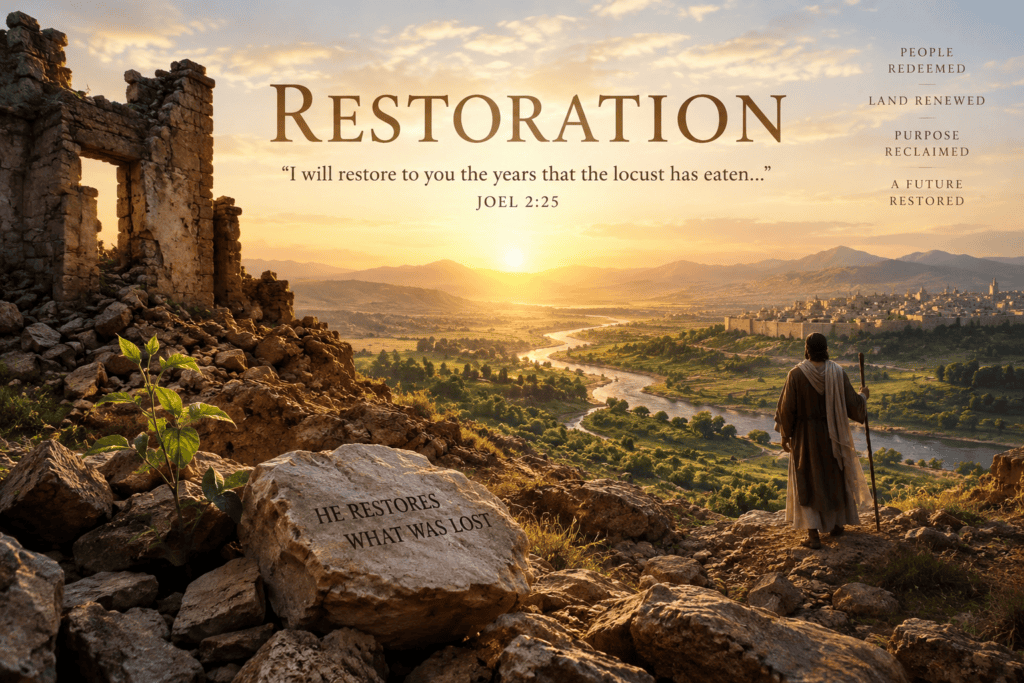
Gary Weedman considers what Christians mean by “restoration,” arguing that the biblical vision reaches beyond restoring church practices to God's larger work of restoring relationships, his rule, and all creation.
July 20, 2011

James B. North examines how Barton W. Stone and Alexander Campbell understood the work of the Holy Spirit, revealing different emphases but substantial agreement among two key Restoration Movement leaders.
May 29, 2011

The Brush Run Church began with about 30 members and became a small but significant starting point in the Restoration Movement shaped by Thomas and Alexander Campbell.

John Derry examines the church fellowship connections that have helped independent Christian churches remain united, highlighting the often-overlooked role Christian colleges play in developing leaders and sustaining shared identity.
June 10, 2007

Gary Weedman reflects on the unfinished work of restoration within the Stone-Campbell fellowship and highlights contemporary voices calling the church back to ancient worship, spiritual life, and unity.
Sponsored

Sponsored

Sponsored


Learn how to turn the sermons you’re already preaching into searchable, shareable content that helps people discover and connect with your local church. Access Be Seen, Be Heard on demand with Wes Woodell and Trey Sheneman. A two hour course for preachers, church media and website teams, and anyone who wants to help their church reach more people online.
October 6, 2026
Rick Cherok

October 6, 2026
Landon Shuman

October 6, 2026
Doug Redford