November 1, 2022

David Roadcup

The Sons of Issachar, the Church at Sardis, and Our Leadership Teams

The Sons of Issachar, the Church at Sardis, and Our Leadership Teams

By David Roadcup  The sons of Issachar are widely noted in church leadership circles for having the ability to read their circumstances and respond in wisdom: “Of the sons of Issachar, men who understood the times, with knowledge of what Israel should do, their chiefs were two hundred; and all their kinsmen were at their command” (1 Chronicles 12:32).   This text comes at a time when Israel had divided into Israel and Judah. The nation needed to reunite under the leadership of David. The sons of Issachar knew it was time for this to happen for the sake of
Primary Identity

By Jeff Faull   Who am I? How do I see myself? How do I want to be perceived? Which aspect of my identity is most important to me? Is there a right way or a wrong way to settle these questions as a follower of Jesus?  When considering these questions, some people focus on racial, ethnic, or national identity. Others are consumed with sexual or gender identity. Still others emphasize economic, professional, cultural, social, or even religious identity. With the furor over people, politics, passions, pride, power, perceptions, and pronouns, identity always seems to be an issue and an unceasing

How to Measure Church Health

How to Measure Church Health

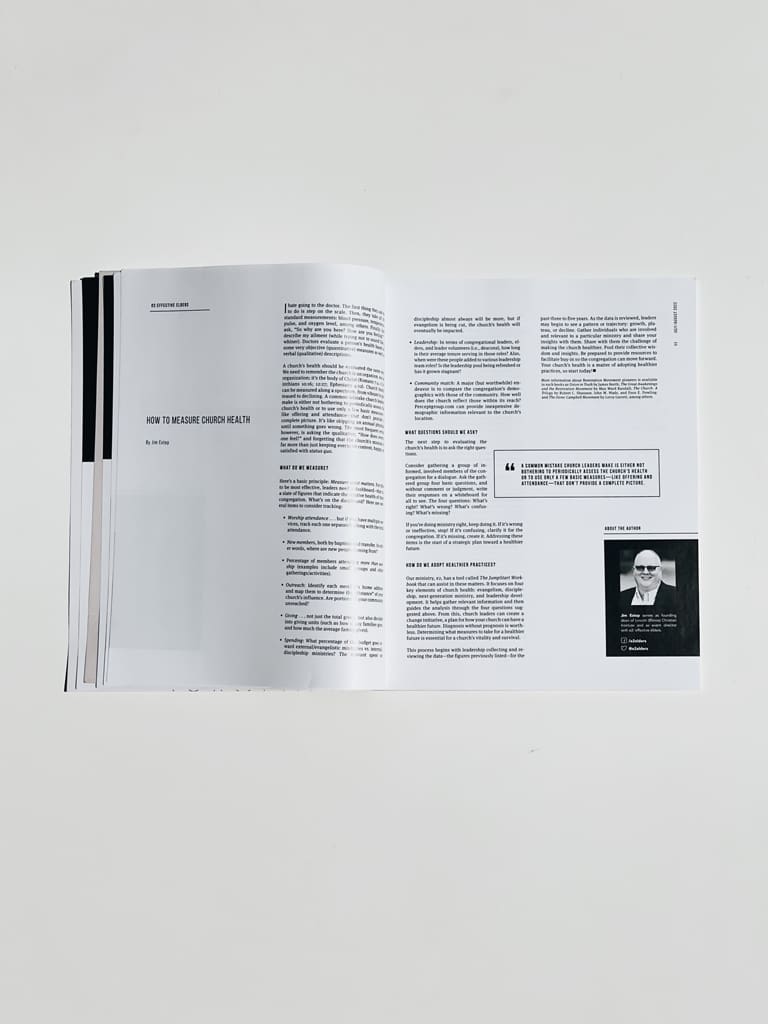
By Jim Estep I hate going to the doctor. The first thing they ask me to do is step on the scale. Then, they take all the standard measurements: blood pressure, temperature, pulse, and oxygen level, among others. Finally, they ask, “So why are you here? How are you feeling?” I describe my ailment (while trying not to sound like a whiner). Doctors evaluate a person’s health based on some very objective (quantitative) measures as well as verbal (qualitative) descriptions. A church’s health should be evaluated the same way. We need to remember the church is an organism, not an

Is the Restoration Movement Relevant?

By Tom Ellsworth In 1856, postal authorities accepted a new name for a little community in southern Indiana: Santa Claus. Then, in the 1920s, the Postal Service decided there would never be another Santa Claus Post Office in the United States. Consequently, every December, more than 400,000 pieces of mail are routed through the town because of its Christmas-themed postmark. I suspect the community’s founders never anticipated the full impact of the unique name. On a little knoll just a mile or so south of Santa Claus stands quaint, white-framed Mt. Zion Christian Church, the oldest church building in Spencer

The Characteristics of an Authentic Leader

By Billy Strother A great deal of discussion and training on the subject of “authentic leadership” has occurred since Bill George published a book by that title in 2003. Authenticity is the quality of being genuine or real. Authentic Christian leaders are those who are perceived as genuine in their walk with the Lord and in their loving investment in the congregants they serve. There remains no agreed-upon definition for authentic leadership theory among those who discuss it. Generally, however, an authentic leader is a person who possesses the characteristics of self-awareness, empathy, relational transparency, consistency, and ethical focus. Authentic

The Leadership Pipeline Crisis

Alyeska . . . Keystone XL . . . Colonial. Each is a commercial pipeline, and each has a unique crisis in its story. Alyeska is the Trans-Alaska Pipeline System, which now transports less oil than in years past. Keystone XL is the pipeline that was once under construction from Alberta, Canada, south to Nebraska; it has now been officially shut down. The Colonial Pipeline made news recently when it was the victim of a ransomware attack that completely shut down its oil flow. Similarly, we face a crisis in the local church, and it has everything to do with

November 1, 2021

Jim Estep

Doing Ministry During the Holidays

By Jim Estep Christmas is undeniably the most celebrated season of the year. It used to begin with Thanksgiving (the time my wife allows me to set up the tree and decorate the house), but it seems like we begin seeing Christmas items on television and on store shelves earlier and earlier. QVC began having Christmas specials in July! Society may be better prepared for Christmas than the church, although for different reasons. The holiday season, particularly from Thanksgiving to Christmas, offers the church an unprecedented opportunity to minister. However, like most opportunities, we can fail to make the most

Elders Who Disciple: One Key to an Effective Church

In his book Disciple, Juan Carlos Ortiz says the greatest problem facing the church today is “the perpetual childhood of the believer.” The fact that most of our churches are made up of spiritually immature believers is a major issue to the church fulfilling her mission. This extreme lack of spiritual development continually cripples the dynamic advancement of our churches. We will never take our cities for Christ if the vast number of our people remain at a “kindergarten” level of spiritual growth and maturity. This deep and widespread problem can be attributed, more than anything else, to the lack

Unity Matters: Two Essentials We Need to Experience Oneness

Words are powerful, especially a person’s final words. A loved one’s final words impact us for years to come. In the same way, the final words of Jesus will continue to impact us until he returns. Jesus not only spoke seven separate times from the cross, but in his last hours, he offered up a prayer that included us. A careful reading of Jesus’ longest recorded prayer (John 17) reveals Jesus prayed not only for his followers then, but for his followers now. Quite literally, Jesus prayed for us. And he asked God for only one thing on our behalf—that

Truth Is Inconvenient

The very idea of truth seems almost to have disappeared. We live in a time of facts and “alternative facts.” We too often focus on favorable information rather than verifiable data. If you don’t like what you hear on the news, simply dismiss it by labeling it “fake news.” We don’t affirm truth, it seems, but truthiness (“the quality of seeming or being felt to be true, even if not necessarily true,” according to dictionary.com). The Oxford Dictionary’s word of the year in 2016 was post-truth (“denoting circumstances in which objective facts are less influential in shaping public opinion than

COVID-19, Elders, and Forgiveness

The challenges of COVID-19 have made it more important for elders and church staff members to manage relationships with great care and discernment. This has not been easy for leaders. Satan has attacked relationships between brothers and sisters in the body with full force. Breaking and shattering relationships has always been one of his greatest weapons. Here is the heart of the problem: COVID-19 and its ramifications have presented our church leaders with stormy seas that are dangerous and difficult to successfully navigate in our relationships in the body of Christ. In meeting with leaders in churches of all sizes

‘In God We Trust?’

A couple of exciting events took place in 1956. First, I was born, which was pretty exciting for me. Second, our federal government adopted the official motto, “In God We Trust.” That phrase quickly was stamped onto our currency and coin, where it remains today. Why did America adopt a motto in 1956? We were fighting a Cold War with the Soviet Union, a superpower that championed atheism. While the U.S.S.R. contended God did not exist, the United States not only declared his existence, but that our nation trusted in him.   “In God We Trust” is more than a

Personal Obedience in the Life of an Elder

Among the many notable things about the Great Pyramid in Giza, Egypt, are the massive foundational stones that were carefully crafted and precisely positioned. The foundation for the Great Pyramid had to be formidable to support the weight that was to come. Foundations are key to the success or failure of a structure. As elders and church staff, it is critical we understand that the foundation for our leadership is our personal, growing relationship with Jesus. Our personal spiritual development forms the foundation for our service. This foundation is made up of several key “stones.” Paul mentions many of them

Giving Honor to Whom Honor Is Due

The chairman of the elders of our church called to invite me to join the elder team of our congregation. At the time, I was vice president for student services at Cincinnati Christian University and an active member at Mason Church of Christ (now Christ’s Church) in Mason, Ohio. I wound up accepting his invitation, which started an interesting chapter in my journey during which I was able to see the work of an elder from an altogether different viewpoint. For the previous 13 years, I had been in leadership ministry in the church or teaching at one of our

What COVID-19 Taught Rural Churches

By Jim Estep State by state, county by county, the COVID-19 pandemic led to limitations, shelter-in-place orders, and essentially a shutdown of “normal.” In rural congregations—which are often smaller, singular in focus (worship), and fairly stable in ministry programming—this became an impetus for reflection, reevaluation, renewal, and a reenvisioning of ministries across the country. Theology of the Church We all know the church is made up of people—it’s not the building or the worship service—but our everyday theology would say otherwise. Whether we like it or not, our default theology turns church into a place or time. (“We are going

Thinking Forward, Moving Forward

3 Church-Leader Challenges as We Merge onto the Virtual Highway By Gary L. Johnson Earlier this year, COVID-19 drove news reports. Every day, every media outlet reported on some aspect of the coronavirus and its impact on our lives. One news story caught my attention. It reported how teenagers had completed driver’s education training, but because of social distancing, their required road tests were waived. That story brought back memories of my driving test. After pulling out of the parking lot and into traffic, the examiner had me drive through busy streets and residential areas. I even had to parallel

Legacy

Like father, like son. He’s a chip off the old block. The apple doesn’t fall far from the tree. These well-worn phrases still impart truth. Life is lived in and through generations. From beginning to end in the Scriptures, we read of generations of people. The genealogy of Jesus is listed in both Matthew and Luke. Today, there are five living generations: builders, boomers, gen X, millennials, and gen Z. Despite the untold volumes written and conferences held about the qualities and particularities of these generations, a far greater concern is each one’s legacy. Many people think of generational legacy

Dual Citizenship

By Jim Estep Lyrics by Buffalo Springfield from 1966 are coming true: “There’s battle lines being drawn, and nobody’s right if everybody’s wrong . . . singing songs and they’re carrying signs, mostly say, ‘hooray for our side.’” Democrat, Republican, independent. Red, blue, purple. Radical right and social democrats. We live in what may be the most polarized period in U.S. history, short of the Civil War. Regardless of where you live, in what country, within which state or province, we all live in the tension between two worlds. Our dual citizenship between here and Heaven. Living in the Dichotomy

Secret Link