Articles for tag: Alexander Campbell

News Briefs for March 11

Ethan Magness, senior minister with First Christian Church in Johnson City, Tenn., gave the opening prayer on March 4 in the U.S. House of Representatives, WJHL.com reported. Magness’s prayer is available at YouTube. U.S. Rep. Phil Roe (R-Tenn.), who hosted Magness at the Capitol, called Magness “a great religious leader in our community.” “It was great to have him here in Washington to share the word of God this morning,” Roe said in a statement. _ _ _ Point University has named a music lab in its fine arts building for a local man who has donated 16 pianos to

Studying Scripture with Alexander Campbell (Part 2)

Today we conclude this two-part article from 1940 explaining the “four aspects” of Alexander Campbell’s Bible study. Today’s article covers aspects three and four. _ _ _ Alexander Campbell’s Contribution to Bible Study (Part 2) By Howard Elmo Short, B.D. (Hartford);Minister, Church of Christ, Cuyahoga Falls, O.;February 10, 1940; p. 5 . . . There is no finer contribution that Mr. Campbell has made to Bible study than this insistence upon original thinking. How often we read, leafing through, just to find the “pet” verses which prove the point we are arguing at the moment! The admonition of Mr. Campbell

Studying Scripture with Alexander Campbell (Part 1)

Restoration pioneer Alexander Campbell’s Bible study methods might be of interest to readers and leaders. A notation above the headline of this article indicated this was “a paper read before a Bible-study conference of the churches in the Akron (O.) area some months ago.” We will break this into two parts, plus edit it a bit for length. Part one will cover the first two of “four aspects of Mr. Campbell’s Bible study.” _ _ _ Alexander Campbell’s Contribution to Bible Study (Part 1) By Howard Elmo Short, B.D. (Hartford);Minister, Church of Christ, Cuyahoga Falls, O.;February 10, 1940; p. 5

Mark Twain’s Connections to Stone, Campbell

Most devotees of American literature know of Mark Twain’s connections to Hannibal, Mo., but few people in the Stone-Campbell Movement likely are aware of Twain’s connections—through his life in Hannibal—to the movement’s namesake pioneers, Barton W. Stone and Alexander Campbell. Donald Tingle shared some research on this topic 40 years ago. _ _ _ Mark Twain was a part of early restoration history Tom Sawyer, Barton Stone’s Grandson By Donald S. TingleJuly 29, 1979; pp. 15, 16 Some of you may stop at Mark Twain’s boyhood home in Hannibal, Mo., on your way to or from the North American Christian

A ‘Rip Van Winkle Faith’ Won’t Work

In 1974, Christian Standard introduced a column called “Reflecting on the News!” The concept was straightforward, allowing much latitude for the writer. Today’s article by John Greenlee from October 1974 references “the expression of concern which came this summer from Lausanne, Switzerland.” That seems a rather vague reference to a newsworthy event, especially 45 years hence. Here’s a little background. The International Congress on World Evangelization—sometimes called Lausanne I, the Lausanne Congress, or Lausanne ‘74—was held July 16-25, 1974, in Lausanne, Switzerland. The gathering was called by a committee headed by Billy Graham and drew more than 2,300 evangelical leaders

SCJ Conference Plans for 2020 Announced

The 19th annual Stone-Campbell Journal Conference will take place at Johnson University Tennessee in Knoxville next March 20, 21. The theme “Politics and the Stone-Campbell Movement” will be developed by featured speakers Shaun Casey, director of the Berkley Center for Religion, Peace and Public Affairs and professor in Georgetown University’s Walsh School of Foreign Service; Jess Hale, attorney with the Tennessee General Assembly; and Richard Cherok, professor of history with Ozark Christian College. Casey will present “The Impact of Stone-Campbell Ideals: My Life in Political and Public Service” and “The Office of Religion and Global Affairs under Barack Obama: My

The Influential Isaac Errett

During this past year of sharing articles and editorials from the archives of Christian Standard, we have featured several pieces written by Isaac Errett, leader of this magazine from its founding in 1866 until his death in 1888, but not so much written about Errett. The September 11, 1909, issue of Christian Standard was another “Centennial Special” that commemorated the 100-year anniversary of Thomas Campbell’s “Declaration and Address.” Virtually all of the historical articles in that September issue were about Errett. We will excerpt from one article and run a second article in its entirety. Neither article attempted to tell

Disciples See Deep Drop in Attendance

If its current rate of decline continues, the Christian Church (Disciples of Christ) denomination could lose half its membership over the next 10 years, according to an Institute on Religion and Democracy blog post by Jeffrey Walton. Numbers provided by the DOC’s Office of General Minister and President show that total membership declined 7 percent from 2017 to 2018, from about 411,000 to around 382,248. Likewise, average worship attendance declined 11 percent, from 140,000 to 124,000, Walton wrote on IRD’s blog, Juicy Ecumenism. Also, baptisms dropped from 4,344 to 3,782, down 13 percent, while other additions (including transfers in) declined

Mid-Atlantic States: Going Back to the City (Part 1)

After 50 Years, a New Generation of Young Leaders Spurs Urban Church Planting in the Mid-Atlantic States By Tim Cole One of the seminal events on the timeline of the Restoration Movement occurred 50 years ago. Although tensions had been brewing for decades with their conservative counterpart, the more progressive wing of our tribe formally adopted a denominational design and officially changed their name to Christian Church (Disciples of Christ) in 1969. In urban areas, which typically espouse a more liberal stance on theological issues, a significant portion of downtown churches aligned with this newly formed denomination. Their impressive buildings,

Remembering Pioneering Disciple James Challen

James Challen wrote a number of articles for Christian Standard during its first dozen or so years of publication. The articles were good, but the most interesting essay to feature Challen likely was his obituary, written in 1878 by founding editor Isaac Errett, with whom Challen was sharing a pulpit in Cincinnati when Challen was struck ill late that year. As you’ll read, Challen “shared the fellowship and the labors of all the leading spirits of the Reformation” during his lifetime. Also interesting to note, Errett referred to the man, who was 18 years his senior, as “Father” Challen. Here

A Profile of ‘Raccoon’ John Smith (Part 1)

When the Stone Movement and the Campbell Movement united in 1832, “Raccoon” John Smith helped seal the deal. Barton W. Stone represented his contingent of churches at those meetings in Kentucky, while Smith represented Alexander Campbell’s interests. Here are Smith’s historic words on that occasion: “Let us, then my brethren, be no longer Campbellites or Stoneites, New Lights or Old Lights, or any other kind of lights, but let us come to the Bible, and to the Bible alone, as the only book in the world that can give us all the light we need.” We start this week with

Remembering Dr. Robert Richardson

This biographical sketch of Dr. Robert Richardson (1806-76)—compiler of the “Memoirs of Alexander Campbell,” among other contributions during the first century of the Restoration Movement—will serve as the May installment of our monthly series of excerpts from Christian Standard, circa 1909. In that year, the magazine devoted one issue each month to articles of particular interest to our movement. We’ll change it up this month by also providing an excerpt from a second article about Richardson, the latter from 1910. _ _ _ Dr. Robert Richardson By M. M. Davis(May 8, 1909; p. 9) Dr. Robert Richardson, the “Historian of

What Is the Restoration Movement?

By Jim Estep The United States is becoming increasingly divided politically. Conservatives keep moving further to the right, liberals are gravitating toward the left, and those in the center are stretched between the two. It’s similar to what has happened to the Restoration Movement. A Formula for Effectiveness When I attempt to describe the Restoration Movement to someone, I draw on this formula: Biblical Authority + Church Unity → Global Disciple-Making The Restoration Movement affirms biblical authority and binds it to a strong commitment to church unity (beyond the level of unity by agreement), all for the sake of making

God’s Love for a Lost World

We continue our monthly series of excerpts from Christian Standard, circa 1909. The magazine devoted one issue each month that year to articles of particular interest to our movement. Today we feature a sermon by Barton W. Stone, who allied with Alexander Campbell to form the Restoration Movement (aka, the Stone-Campbell Movement). No date is attached to this sermon, which we will prune some, as it is quite long. Here’s Barton W. Stone (1772–1844): _ _ _ God’s Love for a Lost World A Sermon by Barton W. Stone (Published April 10, 1909; p. 6) The love of God is

An Epistle on Debt from Mrs. Alexander Campbell

This brief article by and about the second wife of Alexander Campbell developed in a roundabout way. The February issue of Christian Standard deals with finances, including “In the Arena” articles by Matt Merold and Chris Philbeck that take stands on the question, “Should churches embrace and utilize debt?” (Matt says yes; Chris says no.) I wondered if writers from the magazine’s past had weighed in on this subject, so I dug into the archives of the Christian Standard’s first 100 years of publication. I turned to the listing for DEBT—an obvious place to begin the search—and was surprised to

The Financing of the Restoration Movement
 (Part 2 of 3)

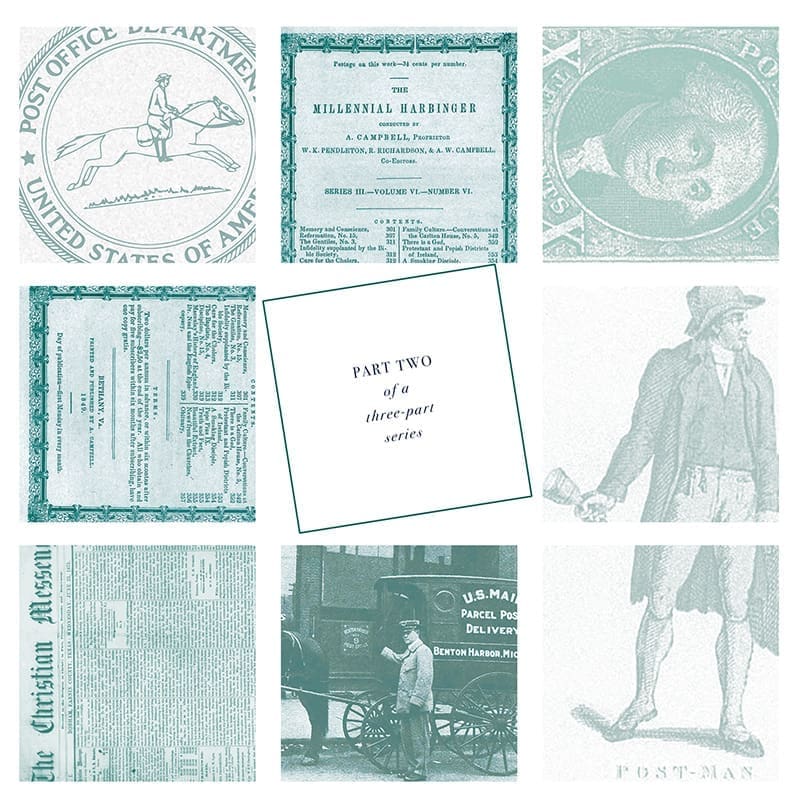
(Part two in a three-part series)   By Steve Carr In our digital society, postage stamps seem archaic. But in Alexander Campbell’s day, they symbolized wealth. And as postmaster at Buffaloe, Virginia, he was able to wield this wealth to benefit the Restoration Movement. During the colonial era, postal service was sketchy. It was so costly and inconsistent that the United States made it an official government institution after the Revolutionary War. As the country expanded westward, mail became essential in providing access to critical information, thoughts, and ideas. As a result, postmasters became among America’s most important citizens. Campbell

The Fortification of the Restoration Movement (Part 3 of 3)

By Steve Carr “What religion are you?” “Christian.” “Well I get that, but what kind of Christian?” “Um, just Christian.” Growing up on Cincinnati’s west side, where Roman Catholicism reigned supreme, I constantly had this exchange with kids at school. Raised in a Restoration Movement congregation, I was taught that our church was simply Christian—nothing more, nothing less. It wasn’t until years later in seminary that I learned another biblical name that could describe my tribe. Alexander Campbell was repulsed that some referred to his group as “Campbellites,” so he sought a more biblical description of our fellowship. Terms like

J. W. McGarvey’s Reminiscences of Thomas Campbell

– Jan. 9, 1909 – Among the crucial earliest triggers of the Restoration Movement, I typically think of two: The Cane Ridge Revival led by Barton W. Stone (1801) and the Declaration and Address penned by Thomas Campbell (1809). In January 1909, Christian Standard began a year-long series under this banner headline: “CENTENNIAL SPECIAL FOR JANUARY” with the subhead, “After One Hundred Years—A Century of Progress in America’s Greatest Christian Union Movement.” A number of articles in the issue carried that theme forward. In a moment, I will zero in on what probably is the most personable of them (“Reminiscences

Why I Love the Restoration Movement

By Rick Chromey   “I believe what I believe is what makes me what I am, I did not make it, no it is making me.” Rich Mullins, “Creed” I grew up in a small independent Christian church in remote central Montana. I cut my teeth in a wooden pew, sandwiched between my grandmother and brother, listening to sermons, learning hymns, and loving the saints. I washed Communion cups as a preschooler, passed offering plates as a child, and led song services and served Communion to shut-ins as a teen. I loved my church family. They made me who I

Alexander Campbell Announced as a 2018 NACC Speaker

By Caleb Kaltenbach INDIANAPOLIS—Church leaders around the world were shocked to learn that Alexander Campbell will be speaking at the yearly convention. 2018 North American Christian Convention President Drew Sherman reportedly hired a Transylvanian scientist—a mad one, no doubt—to fly in and reanimate Campbell, the leading thinker of the early Restoration Movement and longtime editor of the Millennial Harbinger. The process took longer than initially thought, due to good weather. Eventually, however, a thunderstorm passed through the area and made the impossible possible. “We just want to empower leaders and give them an NACC they’ll never forget,” Sherman said. “It’s

Help Keep Christian Standard Free & Accessible with a Tax Deductible Donation

We can do more together!

Every gift makes a difference!

No, thank you.
100% secure transactions - receipts provided.
Does Your Church Want to Support Christian Standard?

Would your church consider including support for Christian Standard in its annual missions budget? Your support would help us not only continue the 160-year legacy of this unifying ministry, but also expand the free resources, cooperative opportunities, and practical guidance we provide to strengthen churches in the U.S. and around the world.

We can do more together!

Every gift makes a difference!

No, thank you.
100% secure transactions - receipts provided.
Secret Link