Think Outward
Every church will tell you they have an outward focus because they know that's Jesus' Great Commission, but the truth is that many are not.
Every church will tell you they have an outward focus because they know that's Jesus' Great Commission, but the truth is that many are not.
January 1, 2026
We need to start thinking and planning for succession earlier rather than later, knowing that the stakes are high, the process takes time, and that we are following a biblical mandate.
January 1, 2026
Retirement doesn’t mean ministry is over. It just means it looks different. The way we influence and serve may change, but God still uses us.
January 1, 2026
Elders and pastors need to intentionally work to identify and develop future pastors and leaders, viewing this as both a calling and a priority.
January 1, 2026
If your main motivation is to please other people, and your self-worth depends on others’ approval, you will be frustrated and disappointed.
January 1, 2026
When done with the guidance of the Holy Spirit, succession and an intentional interim create the smoothest path to pastoral transition.
November 6, 2025
Love has persuasive power. Compassion makes our arguments more convincing, but without love, our arguments sound hollow.
November 6, 2025
If we’re serious about trying to reach lost sinners and fish for people like Jesus told us to, then it’s essential we understand the beliefs, behavior, and belonging of those we’re fishing for so we can use the right kind of “bait.”
September 3, 2025
Dealing with various tensions is a reality in ministry. And experiencing tension often leads to stress and fatigue. These issues must be managed.
While a minister may not want to know what individuals in their church give, it’s wise for them to know about the annual budget, the average weekly or monthly giving, how much debt, if any, the church has, and what percentage of the budget is being spent to service the debt.
September 1, 2024

An echo chamber is an environment where the same opinions are repeatedly voiced and promoted, so that people are not exposed to opposing views. Echo chambers also extend to online groups where people with similar opinions on any topic share their voices and validate each other.
July 1, 2024
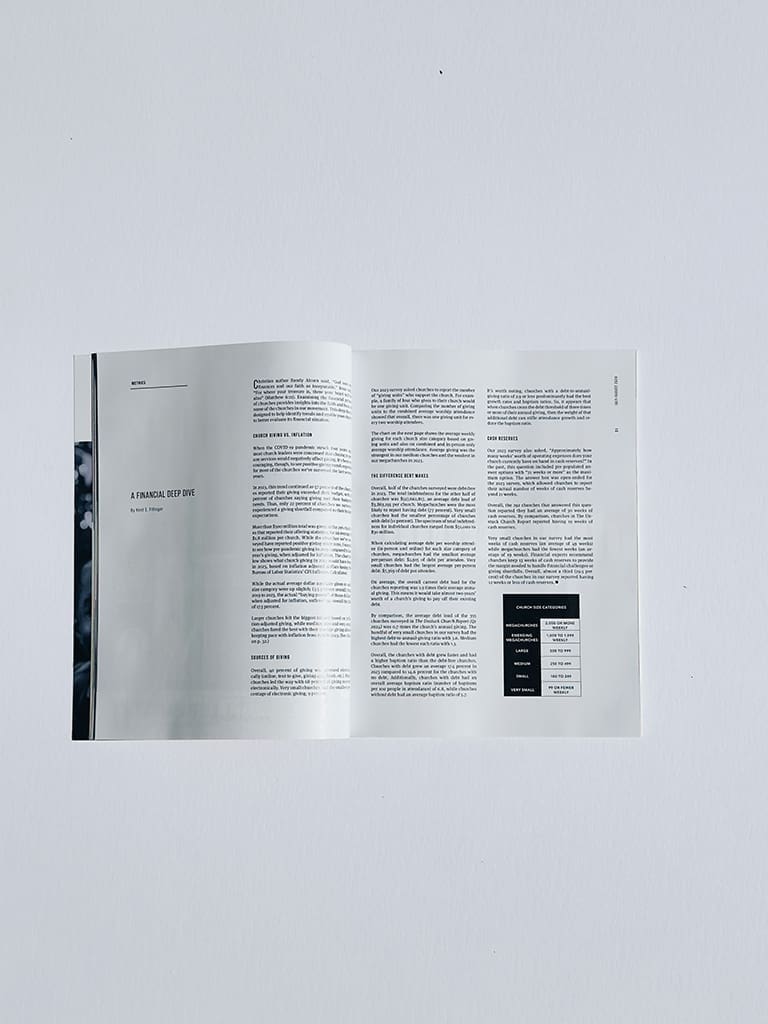
In 2023, 57 percent of churches reported that giving exceeded their budget, with 21 percent saying giving met their budgeted needs. . . .
May 1, 2024
The pandemic caused some churches to refocus or redefine their ministry practices. . . .
March 1, 2024
Reflections on the centennial issue of Christian Standard from 1966 . . .
January 1, 2024
By Kent E. Fillinger “Hurting people hurt people” is a familiar and true phrase. But on the flip side, “healthy people help people.” A minister’s spiritual, mental, emotional, and physical health will directly affect his ability to lead, serve, and help others. The healthier the leader, the more fruitful he can and will be. A recent Gallup survey found that workers are more stressed this year than last year. This coincides with a 2022 survey by ValuePenguin (a research and analysis company) that reported 84 percent of Americans feel stressed at least once in a typical week. A U.S. Surgeon
November 1, 2023

By Kent E. Fillinger Guilty as charged! I admit I’m guilty. And maybe you are too. I’m guilty of not loving my neighbors and those in my network enough to share my faith with them as I know I should. Thomas Dewar said, “An honest confession is good for the soul, but bad for the reputation.” Regardless, maybe it’s time for more of us to confess and repent from living a Christian life that looks holy but may be hollower than it should be. Loving our family, friends, neighbors, and coworkers enough to share the good news of the gospel
September 1, 2023

By Kent E. Fillinger It’s been said that a person can live 40 days without food, four days without water, four minutes without air, but only four seconds without hope. Hope is a power that energizes us with life. The available research on hope is limited, so Christian Standard conducted an online survey in May 2023 to assess how hopeful people are about the future of the church. The survey size was limited—just 141 responses—but the results were informative. It’s worth noting that 87 percent of the survey participants reported attending church “more than once a week” or “once a
July 1, 2023
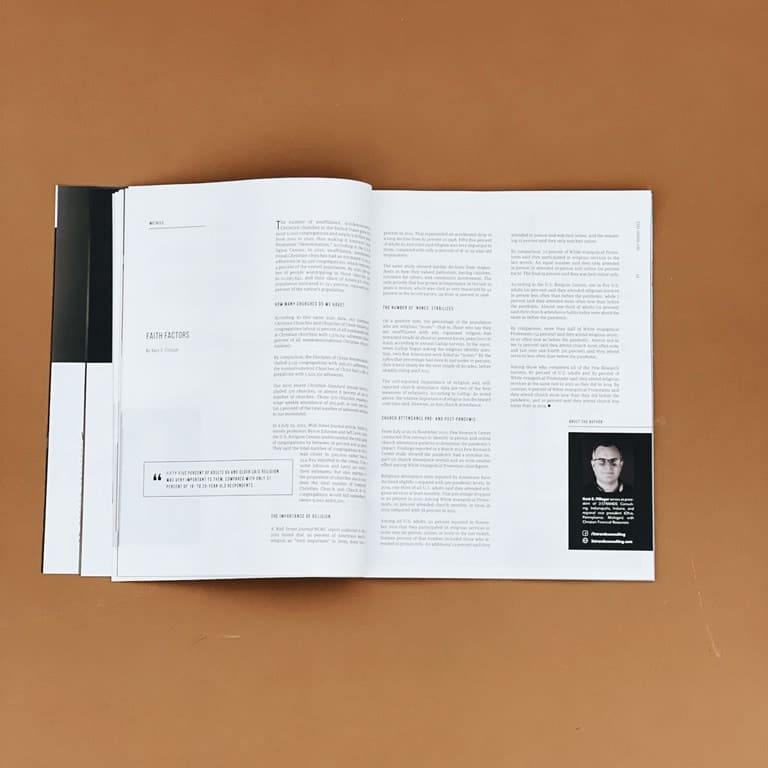
By Kent E. Fillinger The number of unaffiliated, nondenominational Christian churches in the United States grew by almost 5,000 congregations and nearly 9 million people from 2010 to 2020, thus making it America’s largest Protestant “denomination,” according to the U.S. Religion Census. In 2010, unaffiliated, nondenominational Christian churches had an estimated 12,241,329 adherents in 35,496 congregations, which represented 4 percent of the overall population. By 2020, the number of people worshipping in those churches grew to 21,095,641, and their share of America’s religious population increased to 13.1 percent, representing 6.4 percent of the nation’s population. How Many Churches Do We

By Kent E. Fillinger In Bible college, I encountered this simple but powerful two-question outline to discuss the resurrection of Jesus: What proves the resurrection? And what does the resurrection prove? I don’t have the space to unpack the answers to these questions, but I do want to explore what people believe about the resurrection of Jesus to help you consider the array of beliefs you might encounter in your church (and with your family) this Easter. I also want to examine current beliefs regarding the afterlife—heaven, hell, and reincarnation. Views on the Resurrection The 2020 Lifeway Research State of
January 1, 2023
By Kent E. Fillinger A January 2021 Lifeway Research survey found 49 percent of U.S. Protestant pastors say they frequently hear members of their congregation repeating conspiracy theories about something happening in our country. Around 1 in 8 pastors (13 percent) strongly agree their congregants are sharing conspiracy theories. WHAT THE RESEARCH SHOWS An October 2020 research report found that Facebook users engage with misinformation 70 million times per month on average. Though far fewer than the 2016 peak of 200 million monthly fake news engagements, it still is no small figure. On Twitter, people share false content 4 million
Sponsored

Sponsored

Sponsored


Learn how to turn the sermons you’re already preaching into searchable, shareable content that helps people discover and connect with your local church. Access Be Seen, Be Heard on demand with Wes Woodell and Trey Sheneman. A two hour course for preachers, church media and website teams, and anyone who wants to help their church reach more people online.

September 17, 2026
Quentin Davis

September 15, 2026
David Faust

September 15, 2026
James Thompson