Articles for tag: Tyler McKenzie

News Briefs for Jan. 31

Several conferences and gatherings are planned over the next few months, including the Pressing On Conference (April 9-11), e2: effective elders' LeadWell conference (March 15-16), the Fred B. Craddock Lectures on Preaching (March 27), FAME's Night of Hope Banquet (April 27), and the Spiritual Formation Leadership Summit (in April and May). . . .

'Tis the Season for Justice

‘Tis the Season for Justice

By Tyler McKenzie  Did you know that in the past century at least three countries outlawed the public recitation of Mary’s Magnificat (Luke 1:46-55)?  • Before the end of British rule over India, the Magnificat was prohibited from being sung in churches.   • In the 1980s, the Guatemalan government banned it because they believed Mary’s words provoked revolutionary zeal.  • And the military dictatorship that ruled in Argentina from 1976 to 1983 also banned the Magnificat. During that time, those in command “disappeared” 30,000 people. Mothers created signs emblazoned with the names of their abducted children and Mary’s song and took

Why Progressives and Conservatives Hope in the Same Thing

Why Progressives and Conservatives Hope in the Same Thing

By Tyler McKenzie   Neither the hopes of ideological progressives nor those of conservatives are biblical because both locate their hope in the same place . . . humanity. While God has imbued humanity with awesome dignity and seemingly endless potential, grounding our ultimate hope in ourselves will always disappoint.   Progressives’ Hope  Progressives ground their hope in the advancement of human reason and ingenuity. The 19th, 20th, and 21st centuries have seen Western cultures driven by this vision that human progress in areas like technology, science, medicine, economics, and politics will bring us closer and closer to utopia. Every generation will

Tyler McKenzie

Spiritual Formation 101: Three Guidelines for Meeting Our Moment

By Tyler McKenzie  Spiritual formation has become a buzz phrase. It sounds sophisticated, all the influencers use it, and it’s a way to signal my friends that I am one of those neo-monastic types who reads poetry and welcomes strangers into my home. But what does it actually mean, and why does it matter? I believe this is an important discussion in our cultural environment. A spiritual formation mindset can help us reframe the discipleship conversations we are having in our churches to meet our moment. When I’m asked to talk about spiritual formation, I boil it down to three

Gradations of Unity

By Tyler McKenzie  A recent Love Thy Neighborhood podcast detailed how fake news spreads in the church. They told a story from the 2016 election as a case study. On November 5, 2016, just three days before the presidential election, the Denver Guardian ran this headline: “FBI Agent Suspected in Hillary Email Leaks Found Dead in Apparent Murder-Suicide.” The article stated that FBI agent Michael Brown and his wife were found dead in their home. The web article looked legit. It included quotes from the local police chief, comments from neighbors, and links to online sources claiming it was a

How Do We Talk About Grace with a Generation That Feels No Guilt?

How Do We Talk About Grace with a Generation That Feels No Guilt?

By Tyler McKenzie  As generations of young people emerge who are more different than ever imagined, how should our presentation of God’s grace change? Millennials (those born 1981–96) are assuming leadership. Gen Z (born 1997–2012) is entering the workforce. The youngest of those from Generation Alpha (about 2013–25) are upon the age of accountability. They are the new mission field.  From Guilt to Shame  One of my hypotheses is that evangelists of the future will shift from presenting grace through a guilt framework to a shame framework. Guilt is, “I did something bad.” Shame is, “I am bad.” While guilt

How Do We Arrive at Truth?

By Tyler McKenzie  In his book Blue Parakeet, Bible professor Scot McKnight explains that every semester he gives the students in his Jesus class a test. Part one has 24 questions inquiring what they think Jesus is like. Here are four examples:  Is Jesus moody?  Is Jesus talkative?  Does Jesus think marriage is old-fashioned and should be done away with?   Does Jesus prefer to go his own way rather than act by the rules?  This set of questions is followed by another that asks the students what they think they are like. Here’s the catch. Both parts are the same

A Cheeky Article on Travel Baseball

By Tyler McKenzie   I have three young children, ages 7, 4, and 2. With each passing milestone, my desire to see them grow in Christ deepens. As the pastor of a church made up largely of young families, I’ve found this to be a desire many parents share. At our church, we call it being an “intentional parent.” However, I have also found these same parents feel just as strongly that they are doing a bad job at it. When I ask what the problem is, their answers are the same, “Tyler, I just don’t know how.”   I ain’t buying

Crucial Questions for Church Leaders

Crucial Questions for Church Leaders

By Tyler McKenzie   I grew up a preacher’s kid in the rural outskirts of a small city. Every time we walked into a restaurant, my dad visited at least two tables to check-in on people we knew from church. Often, someone would pick up our check. The community honored him. Back then, people looked to clergy for care and accepted their moral exhortation.  Gone are those days! Barna president David Kinnaman reported on the clergy credibility crisis in his 2017 book Good Faith. “The public’s respect for pastors, priests, and other faith leaders has significantly declined,” Kinnaman wrote. “Today only

Tyler McKenzie

8 Ways Church Growth Has Reached an Idolatrous Level (Part 2)

By Tyler McKenzie  Church growth shouldn’t be the crowning pursuit of success among leadership. And yet, we’ve framed the pursuit of growth as natural and celebrate its attainment as health.  In part one of this article, I shared four concerning trends I’ve observed in American evangelical churches/ministries that can be explained (at least in part) as a consequence of the idolatrous pursuit of the gospel of growth. In this conclusion to the article, I share four more trends that may be indicative of that pursuit.   5. A Culture of Competition over Church (big C) Unity   Sometimes I question if this

The Slavery of the Digital World

The Slavery of the Digital World

How to Break the Chains and Build a Tech-Wise Life for You and Your Children By Tyler McKenzie I believe history will remember 2007 as a defining year. Why? In 2007, a nuclear-sized tech explosion occurred. Facebook transitioned from a college to global phenomenon. Twitter went global. “The cloud” took off. Hadoop began expanding the ability of any company to store and analyze enormous amounts of unstructured data (which enabled big data and cloud computing). Amazon released its first Kindle. Google introduced Android. And (drumroll please) Steve Jobs introduced the first-generation iPhone. As I mentioned in my May/June Engage column

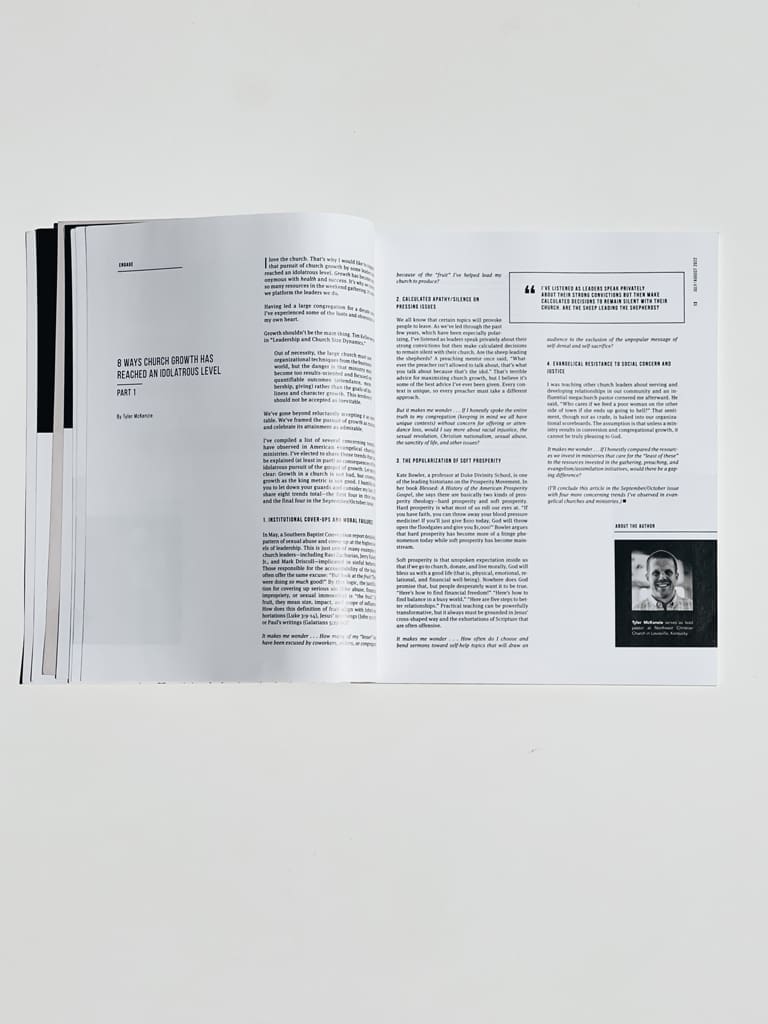
8 Ways Church Growth Has Reached an Idolatrous Level (Part 1)

8 Ways Church Growth Has Reached an Idolatrous Level (Part 1)

By Tyler McKenzie I love the church. That’s why I would like to suggest that pursuit of church growth by some leaders has reached an idolatrous level. Growth has become synonymous with health and success. It’s why we invest so many resources in the weekend gathering. It’s why we platform the leaders we do. Having led a large congregation for a decade now, I’ve experienced some of the lusts and obsessions in my own heart.   Growth shouldn’t be the main thing. Tim Keller wrote in “Leadership and Church Size Dynamics,” Out of necessity, the large church must use organizational

Help Keep Christian Standard Free & Accessible with a Tax Deductible Donation

We can do more together!

Every gift makes a difference!

No, thank you.
100% secure transactions - receipts provided.
Does Your Church Want to Support Christian Standard?

Would your church consider including support for Christian Standard in its annual missions budget? Your support would help us not only continue the 160-year legacy of this unifying ministry, but also expand the free resources, cooperative opportunities, and practical guidance we provide to strengthen churches in the U.S. and around the world.

We can do more together!

Every gift makes a difference!

No, thank you.
100% secure transactions - receipts provided.
Secret Link