May 2, 2026

Is America Going Back to Church?
Are we seeing a religious “vibe shift” in America? Survey data, Bible-reading trends, and stories from Restoration Movement churches point to new openness—especially among younger adults.
May 2, 2026
Are we seeing a religious “vibe shift” in America? Survey data, Bible-reading trends, and stories from Restoration Movement churches point to new openness—especially among younger adults.
March 13, 2026

David Faust explores loneliness across Scripture and in modern life, reminding readers that loneliness isn’t the same as being alone. He offers four practical ways the church can respond with connection, presence, and healing community.
February 23, 2026

Tyler McKenzie weighs the promises and pitfalls of social media activism, arguing it often fuels rage, harms mental health, and encourages slacktivism. He urges sparing, strategic use—and a stronger focus on local, relationship-based church action.
November 5, 2025
A sermon should be long enough to adequately exegete and apply the main point of the passage, but short enough to leave mature Christians willing to listen a few minutes longer.
Christian Standard Church Report for 2024. This is a representative sample of our movement that provides important historical data, current trends, and valuable insights.
April 23, 2024

In his new book, "Not Too Old," Christian Standard contributing editor David Faust explains how "your later years can be greater years." In the book, David encourages readers to continue to "bear fruit in old age" (Psalm 92:14) . . .
July 1, 2023
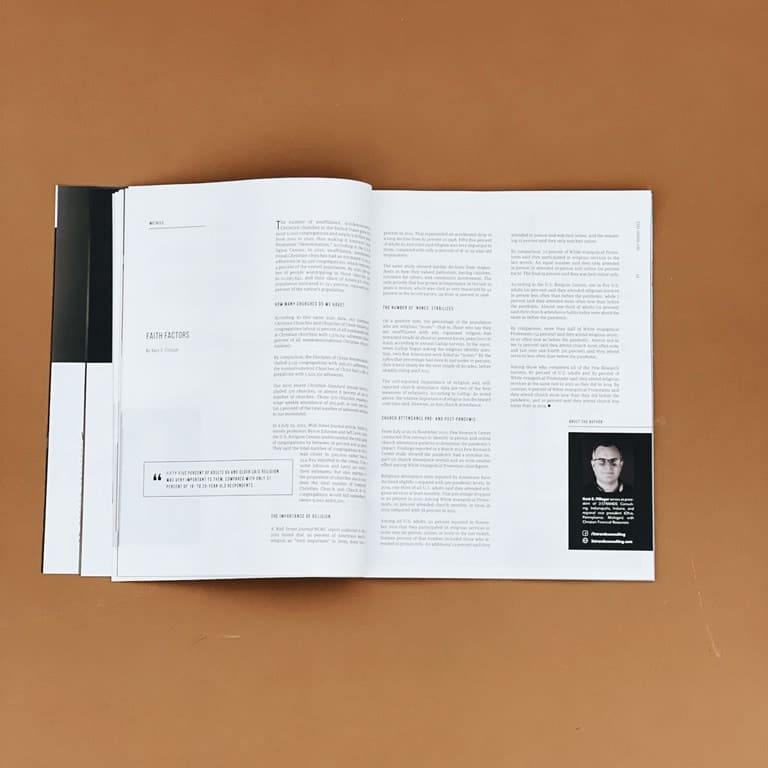
By Kent E. Fillinger The number of unaffiliated, nondenominational Christian churches in the United States grew by almost 5,000 congregations and nearly 9 million people from 2010 to 2020, thus making it America’s largest Protestant “denomination,” according to the U.S. Religion Census. In 2010, unaffiliated, nondenominational Christian churches had an estimated 12,241,329 adherents in 35,496 congregations, which represented 4 percent of the overall population. By 2020, the number of people worshipping in those churches grew to 21,095,641, and their share of America’s religious population increased to 13.1 percent, representing 6.4 percent of the nation’s population. How Many Churches Do We
March 20, 2023

What if the Lord himself doesn’t like our worship services and would rather not attend? Through the prophet Amos, God left no doubt how he felt about the Israelites’ gatherings. . . .
September 1, 2022

By Kent E. Fillinger As a movement, we’ve striven from the beginning to be a church based on New Testament principles. Where the Bible speaks, we speak, and where the Bible is silent, we are silent. No creed but Christ and no book but the Bible. When was the last time your church staff or elders stopped to consider what these maxims mean when it comes to worship gatherings? When did you last study the New Testament to see what it teaches about our purpose for gathering? Have your church leaders ever considered why you do what you do when
July 1, 2022

By Kent E. Fillinger When I was young, whenever a boy and girl played together on the school playground, the other kids typically would tease them by singing “The Kissing Song”: “[Boy’s name] and [girl’s name], sitting in a tree, K-I-S-S-I-N-G! First comes love, then comes marriage, then comes baby in the baby carriage!” The order prescribed in that song is being followed less and less these days. The purpose of this article is to explore recent data on dating, marriage, and parenting to help church leaders better understand current trends to help shape future teaching and ministry possibilities. DATING
November 1, 2021

By Tyler McKenzie Every minister frustrated with their congregation, every person leaving their church, and every millennial who is deconstructing needs to read the opening chapter on community in Dietrich Bonhoeffer’sLife Together. It might save your ministry, your membership, or even your faith. Our communities feel irreparably broken right now. The last 18 months have been relationally traumatic. Most of us have “had it out”—at least once—with someone we love. Maybe it was on the family text thread, over dinner one night, or in the comments section of social media. Or maybe you didn’t have it out. Maybe their outrageous
October 20, 2021
A gunman who shot his estranged wife and killed her male acquaintance at a Carthage, Mo., motel on Aug. 1, 2020, before being arrested the next day—a Sunday morning—at First Christian Church in Lamar, Mo., has pleaded guilty to two felonies. Plus briefs about Fred Gray, First Christian Church (Johnson City, Tenn.), and more.
The most frequently asked question from church leaders in our annual survey was, “How should we count our online attendance?”
June 8, 2021

A recent survey indicates Christian church and church of Christ pastors fall in the middle of the spectrum among Protestant pastors in terms of their views on the morality and legality of using marijuana.
April 1, 2021
In the early 1970s, half of Americans said that most people can be trusted, according to the General Social Survey and the American National Election Survey. In 2020, that figure dropped to less than one-third. The United States is the only established democracy in the world to see a major decline in social trust. Two-thirds of Americans say religious and nonreligious people generally are equally trustworthy, according to a 2019 Pew Research Center survey. Evangelical Protestants are more likely than other Americans to say religious people are more trustworthy than those who are not religious. Forty percent of evangelical Protestants
December 17, 2019
By Kent E. Fillinger This Christmas, you might be looking forward to your adult children returning home. Or maybe they’re home already. A Pew Research Center report found that 15 percent of millennials (ages 25 to 37) were living at home in 2018, nearly double the rate of older baby boomers when they were in that age range. In fact, a smaller percentage of people in the rising generations are checking off the four major life events that historically have signified “adulthood”: leaving home, getting married, becoming a parent, and getting a job. And the percentage of adults in the
October 23, 2019

Belmont Christian Church, Christiansburg, Va., recently was part of a demonstration for a first-of-its-kind drone delivery service in the United States. The Roanoke Times reports that Wing Aviation, a sister company of Google, is launching the delivery zone that will drop off merchandise from several retailers, as well as FedEx packages up to 3.3 pounds. Wing has similar delivery zones in Australia and Finland. Wing spokesman Jonathan Bass said the company chose Christiansburg because of its ties with Virginia Tech and its drone division, Mid-Atlantic Aviation Partnership. _ _ _ The number of people who describe themselves as Christian in
June 22, 2019

By John Whittaker I was sitting in a coffee shop with a young man I had baptized several months earlier. “I’m lost during the sermon,” he admitted. “I don’t know whether the passage comes before Jesus or after. And it feels like the preacher just opens his Bible to wherever.” Fact: Basic Bible or Christian understanding can’t be assumed anymore. Fact 2: Folks have access to infinite amounts of nice-sounding memes and inspirational junk food on social media, and because they have such a limited and shallow understanding of the Christian faith, it all gets mixed together into a sort
By Kent E. Fillinger I grew up in the 1970s when the average American home had no computer, the Internet was little more than an idea, and smartphones had not been invented. Our black-and-white family TV had four channels: the three major networks and the local PBS station. By 2015, the average American home with a TV could access about 200 channels and three-quarters of households subscribed to broadband Internet. By 2018, 77 percent of Americans owned a smartphone, according to Pew Research Center. Since the introduction of Facebook in 2004, the proliferation of social media sites and other apps
April 25, 2019
By Kent Fillinger It might seem hard to believe, but the millennial generation is approaching middle age! The oldest millennials will turn 38 this year, which means they were entering adulthood before today’s youngest adults were born. Many researchers and demographers are now shifting their attention from millennials to generation Z to learn more about them. Researchers quibble about when the millennial generation ends and generation Z begins—the years range from 1996 to 2002—but a Pew Research Center article from January indicates people in the two age groupings aren’t all that different. Here’s the article’s headline (so judge for yourself):
Sponsored

Sponsored

Sponsored


Learn how to turn the sermons you’re already preaching into searchable, shareable content that helps people discover and connect with your local church. Access Be Seen, Be Heard on demand with Wes Woodell and Trey Sheneman. A two hour course for preachers, church media and website teams, and anyone who wants to help their church reach more people online.

October 6, 2026
Rick Cherok

October 6, 2026
Landon Shuman

October 6, 2026
Doug Redford