Articles for tag: Throwback Thursday

Harmony in Giving

This article from 1964 obviously wasn’t the last word on the appropriate level of Christian giving, but it did contain interesting information and the writer effectively applied Scripture to make her points. Before diving in, here’s some context that should help with the section of the article titled “Sacrificial?” The writer says her family’s “take-home pay” in 1964 was $600 per month, or approximately $7,200 for the year. A U.S. Census Bureau online document says, “The median income [not take-home income] of all families in 1964 was about $6,600.” From this we can conclude that the writer’s family was earning

An 1800s Preacher Shares His Story

Buried toward the back of the Oct. 12, 1889, issue was a column by an unknown preacher who shared short recollections of his inadequacies and failings as a young evangelist. This column is several things: raw, uneven, humorous, painful, perceptive, and poignant. _ _ _ Reminiscences from a Young Preacher’s Experience By Y. P.Oct. 12, 1889; p. 11 Yes, I remember quite a number of the firstlies in my ministry. My first sermon was in a new, unfinished, country meetinghouse, painted without, but rough within; the studding, joist and rafters were bare. The benches were slabs from the saw-mill, supported

Absurd and Mundane Ads from Oct. 1, 1904

When people see copies of Christian Standard from 90-plus years ago, they invariably comment on the advertising. There are a number of ads for patent medicines—such as Dr. Shoop’s Restorative (page 25)—typically alongside ads for such brands as Ivory Soap and Royal Baking Powder, and occasionally Coca-Cola and Oldsmobile. This issue from 115 years ago (Oct. 1, 1904) is fairly typical, though with very few products recognizable today. There were more than 50 ads in the issue, some of them rather small . . . no larger than a classified ad (though typically with bolder type). Several mention the World’s

The True Test of Faith

We go back 70 years to Sept. 24, 1949, for today’s feature. In that issue, it was “announced that Dean E. Walker, head of the department of church history of the School of Religion of Butler University of Indianapolis, Ind., has accepted a call to the presidency of Milligan College.” Walker’s start date was Feb. 1, 1950, and he served until retirement in 1968. The presidential announcement serves as a lead-in to our main focus: an article (part of a series) called “The True Test of Faith” written by Dean Walker’s father, W. R. Walker. We also will include a

‘What Does It Mean to Be a Real Christian?’

Christian Standard pushed a program called Christian Action from 1934 to 1943 that James DeForest Murch—a name familiar to many—started “as a means of restoring the spiritual vitality in the church during this time of great social upheaval” (from an article about Murch by Jim Estep, available at www.biola.edu). Perhaps some day we will devote an entire column to Christian Action—and/or to Murch—but today we will focus on a “letter” Murch wrote 85 years ago that was part of that week’s Christian Action section. It seeks to answer this important question: “What does it mean to be a real Christian?”

The Influential Isaac Errett

During this past year of sharing articles and editorials from the archives of Christian Standard, we have featured several pieces written by Isaac Errett, leader of this magazine from its founding in 1866 until his death in 1888, but not so much written about Errett. The September 11, 1909, issue of Christian Standard was another “Centennial Special” that commemorated the 100-year anniversary of Thomas Campbell’s “Declaration and Address.” Virtually all of the historical articles in that September issue were about Errett. We will excerpt from one article and run a second article in its entirety. Neither article attempted to tell

Single, Pregnant, and Heading Off to Christian College

Here’s a heartfelt, first-person essay that undoubtedly was the best-read and most-talked-about piece from the August 19, 1979, issue of Christian Standard. _ _ _ My Experience as an Unwed Mother By a Minister’s WifeAug. 19, 1979; p. 7 The article in your magazine about unwed mothers (March 18, “The Unwed Mother—A Dilemma”) prompted me finally to write of my experiences as an unwed mother. I was much more lucky than those described in the article. I was eighteen, had just graduated from high school, worked at a good job as a secretary, and was going to attend a Christian

Returning to Palestine

It can be fascinating to read an editorial from an old issue of Christian Standard and consider biblical history that preceded it and world history that has occurred since. Such is the case with this piece from 140 years ago. One important note: We don’t believe the editor’s reference to the Jewish people as “the hated race” was intended as a personal slur. Instead, we think he meant to describe the anti-Semitic opinion held by many in the world at that time in history. Sadly, some of these feelings and rhetoric remain today. _ _ _ Jews in Jerusalem An

‘Our Plea for Union Differs from All Others’

Here is the eighth in our monthly series of excerpts from Christian Standard, circa 1909, a year the magazine devoted an issue each month to articles of particular interest to our movement. This editorial from 1871 is a simple but eloquent primer (surely written by Isaac Errett) about what it means to be a New Testament Christian. _ _ _ Union of Christians An editorial originally published Sept. 23, 1871;republished on p. 12, Aug. 14, 1909 Our plea for union differs from all others. It knows nothing of human policy or human invention. It simply proposes to go back to

W. R. Walker: “The Counselor’s Question Box”

In last week’s column we acquainted readers with W. R. Walker by sharing a 1963 article about him published a few weeks after his death. Walker preached for almost two decades in churches in northeast Ohio and, later, for 28 years (1920-48) at Indianola Church of Christ in Columbus, Ohio. In between, from approximately 1914 to 1920, he taught at Christian colleges. Walker also was part of Standard Publishing for about 40 years. In addition to serving as president from the 1920s until 1955, Walker was listed as “editorial counselor” within the pages of Christian Standard from 1945 until his

Names of Christ Followers in the New Testament

We continue our monthly series of excerpts from Christian Standard, circa 1909, a year the magazine devoted an issue monthly to articles of particular interest to our movement. And again this month, as we did in January, we feature an essay by J.W. McGarvey. McGarvey was born in 1829 and died in 1911. Upon the 100th anniversary of McGarvey’s death, Andrew Paris wrote of him in Christian Standard: Although McGarvey enjoyed great success in the located ministry as the preacher of several Lexington churches (including Main Street and Broadway), the great work for which he is best known and esteemed

Bob Wetzel ‘Found a Home in the Christian Church’

As a “Reflections” writer in 1999, C. Robert Wetzel wrote four columns, all of them somewhat personal. This column was the most autobiographical. Wetzel was serving as president of Emmanuel School of Religion in Johnson City, Tenn., at the time he wrote this. He served in that capacity from 1994 to 2009. For the past decade, he has served as chancellor of the school (now called Emmanuel Christian Seminary at Milligan College.) Here’s some biographical info about Wetzel that isn’t revealed in this column: Wetzel received a BA from Midwest Christian College (now Ozark Christian College), an MS from Fort

Remembering Pioneering Disciple James Challen

James Challen wrote a number of articles for Christian Standard during its first dozen or so years of publication. The articles were good, but the most interesting essay to feature Challen likely was his obituary, written in 1878 by founding editor Isaac Errett, with whom Challen was sharing a pulpit in Cincinnati when Challen was struck ill late that year. As you’ll read, Challen “shared the fellowship and the labors of all the leading spirits of the Reformation” during his lifetime. Also interesting to note, Errett referred to the man, who was 18 years his senior, as “Father” Challen. Here

A July 4th Message from 1960

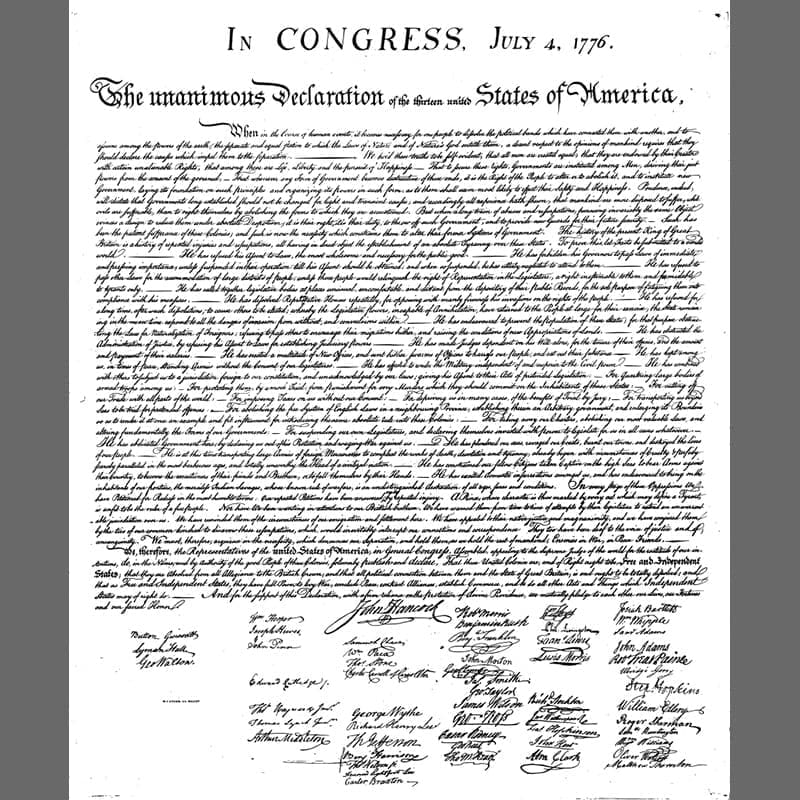
Here is an Independence Day editorial by Edwin Hayden from 1960 . . . 94 years after the founding of our magazine and 184 years after the founding of our nation. _ _ _ Which Kind of Freedom? An EditorialJuly 2, 1960; p. 2 About to talk to a group of school children on the subject of freedom, the preacher asked his young hearers to define the word free. First offered was this: “Like getting into the show without paying.” Free—“without cost”—has been lifted from an obscure and incidental place among the definitions of freedom so that it becomes a

Taking on the Tobacco Habit

Tobacco use was discussed about once a year during Christian Standard’s first century of publication. Smoking evidently has always been controversial. All of the articles reviewed for this piece were anti-smoking and anti-tobacco in nature, but it would truly be surprising if no words supportive of tobacco ever appeared in the magazine. On the whole, most writers going back to 1866 referred to the tobacco habit as dirty, costly, and unhealthy. A “Reader’s Forum” writer from Angola, Ind., in 1931 referred to tobacco as “the Devil’s weed,” and criticized Christians who sold it. Here are a trilogy of editorials and

A Profile of ‘Raccoon’ John Smith (Part 2)

(Read Part 1 of this profile, published June 13.) Before launching into Part 2 of this profile of “Raccoon” John Smith from 1925, we should offer an explanation for how he acquired his nickname. The opening of M.M. Davis’s article about Smith from June 12, 1909, gives this account. _ _ _ “Raccoon” John Smith [1784–1868] is the most unique character in our history. . . . Just why he should have this undignified nickname is not clear, for he was never a hunter of anything, much less of raccoons. But of all names in the world needing a distinguishing

A Profile of ‘Raccoon’ John Smith (Part 1)

When the Stone Movement and the Campbell Movement united in 1832, “Raccoon” John Smith helped seal the deal. Barton W. Stone represented his contingent of churches at those meetings in Kentucky, while Smith represented Alexander Campbell’s interests. Here are Smith’s historic words on that occasion: “Let us, then my brethren, be no longer Campbellites or Stoneites, New Lights or Old Lights, or any other kind of lights, but let us come to the Bible, and to the Bible alone, as the only book in the world that can give us all the light we need.” We start this week with

Whatever Happened to Pentecost Sunday?

All will agree that Pentecost, as described in Acts 2, is foundational to the church. Now, here is an observation (not an accusation): We don’t write or talk about Pentecost as much we used to. It’s true both for our magazine and our churches. The index for Christian Standard’s first 100 years shows there were well over 200 articles about Pentecost published during that time. W.E. Sweeney’s keynote address at the 1929 North American Christian Convention was “The Challenge of Pentecost.” A dozen articles about Pentecost were published during 1930, a year in which the 1,900th anniversary of the birth

Remembering Dr. Robert Richardson

This biographical sketch of Dr. Robert Richardson (1806-76)—compiler of the “Memoirs of Alexander Campbell,” among other contributions during the first century of the Restoration Movement—will serve as the May installment of our monthly series of excerpts from Christian Standard, circa 1909. In that year, the magazine devoted one issue each month to articles of particular interest to our movement. We’ll change it up this month by also providing an excerpt from a second article about Richardson, the latter from 1910. _ _ _ Dr. Robert Richardson By M. M. Davis(May 8, 1909; p. 9) Dr. Robert Richardson, the “Historian of

Off on a Side Track

Here is a curious article from 1904 that could have started, “A preacher gets on a train with a Baptist and a Methodist. . . .” Actually, this is more a transcribed conversation than article. One might wonder, Was this real or imagined? Did it really occur? _ _ _ Off on a Side Track By Joseph A. WaltersOct. 1, 1904; p. 11 “I don’t like your exclusive baptism,” said a Methodist preacher to a Baptist preacher, a few years ago, on a train on which I was traveling in a Western State. B. Why do you dislike it? M.

Help Keep Christian Standard Free & Accessible with a Tax Deductible Donation

We can do more together!

Every gift makes a difference!

No, thank you.
100% secure transactions - receipts provided.
Does Your Church Want to Support Christian Standard?

Would your church consider including support for Christian Standard in its annual missions budget? Your support would help us not only continue the 160-year legacy of this unifying ministry, but also expand the free resources, cooperative opportunities, and practical guidance we provide to strengthen churches in the U.S. and around the world.

We can do more together!

Every gift makes a difference!

No, thank you.
100% secure transactions - receipts provided.
Secret Link