
Statistics from Christian Standard Church Report for 2024
Statistics from Christian Standard Church Report for 2024.
Statistics from Christian Standard Church Report for 2024.
Fast Facts compiled from the 2024 Christian Standard Church Report.
May 1, 2023
By Kent E. Fillinger When I look back at the last few years through the filter of our annual survey results, I would argue that 2020 was a year of crisis, 2021 was a year of adaptation, and 2022 was a year of transition. In-Person vs. Online Worship Attendance One exciting transition churches experienced last year was more people shifted back to in-person worship from watching online. Comparing 2022 in-person worship attendance data to 2021 showed attendance increases for churches of all sizes. The megachurches (with average weekly worship attendance of 2,000 or more) suffered the greatest attendance declines during
May 1, 2023
AVERAGE WEEKLY IN-PERSON WORSHIP ATTENDANCE Megachurches: 5,136 (22 churches) Emerging Megachurches: 1,367 (37 churches) Large Churches: 714 (49 churches) Medium Churches: 361 (61 churches) Small Churches: 159 (83 churches) Very Small Churches: 51 (118 churches) _ _ _ AVERAGE WEEKLY IN-PERSON + ONLINE WORSHIP ATTENDANCE Megachurches: 6,375 (36 churches) Emerging Megachurches: 1,393 (45 churches) Large Churches: 705 (44 churches) Medium Churches: 363 (57 churches) Small Churches: 161 (87 churches) Very Small Churches: 53 (101 churches) _ _ _ TOP 3 FASTEST-GROWING CHURCHES (2021-22)* Megachurches: 67.4%: Southbrook Christian Church, Miamisburg, OH 53.8%: Southeast Christian Church, Louisville, KY 53.7%: The Crossing, Quincy,
September 1, 2022

By Kent E. Fillinger As a movement, we’ve striven from the beginning to be a church based on New Testament principles. Where the Bible speaks, we speak, and where the Bible is silent, we are silent. No creed but Christ and no book but the Bible. When was the last time your church staff or elders stopped to consider what these maxims mean when it comes to worship gatherings? When did you last study the New Testament to see what it teaches about our purpose for gathering? Have your church leaders ever considered why you do what you do when
July 1, 2022
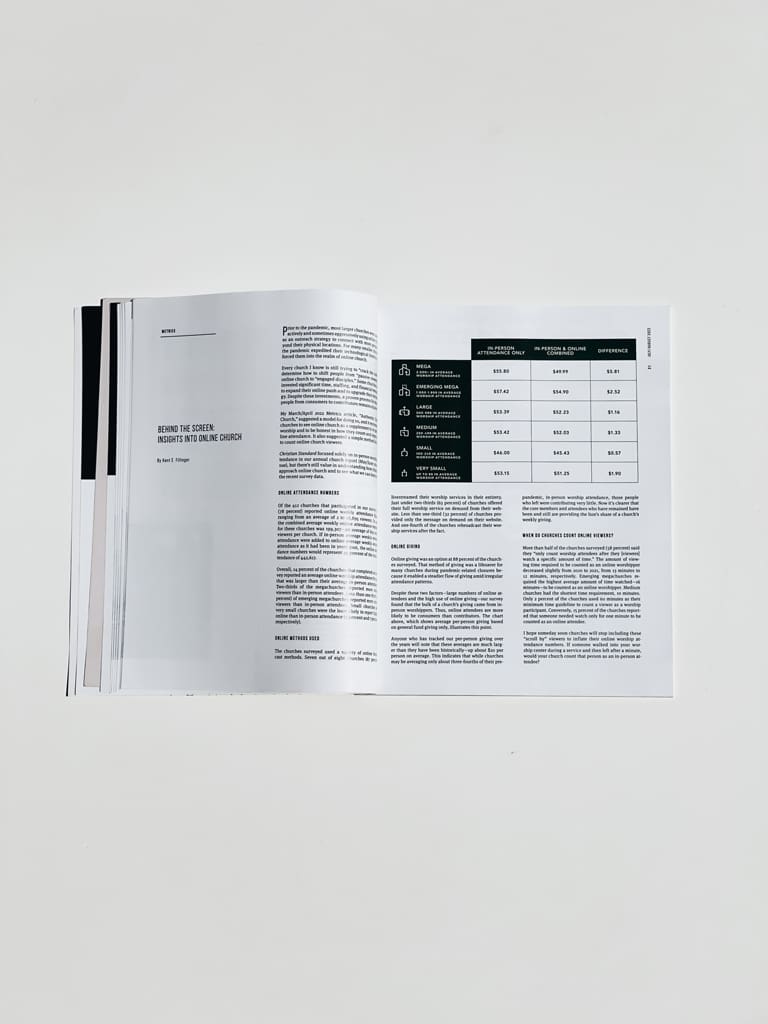
By Kent E. Fillinger Prior to the pandemic, most larger churches were already actively and sometimes aggressively using online church as an outreach strategy to connect with more people beyond their physical locations. For many smaller churches, the pandemic expedited their technological timeline and forced them into the realm of online church. Every church I know is still trying to “crack the code” to determine how to shift people from “passive viewers” of online church to “engaged disciples.” Some churches have invested significant time, staffing, and financial resources to expand their online push and to upgrade their technology. Despite these
May 1, 2022
Let not your heart be troubled as you review our annual church survey report. Your congregation may not be in the church-size category where you expect it. For some churches, it may appear, at first glance, as if your attendance has declined over the last couple years, even if it hasn’t. It may look like some megachurches and emerging megachurches have suddenly vanished or that many of their regular attenders have dropped out. What’s going on? While Christian Standard reported combined in-person and online attendance numbers the previous several years (which was especially significant during the pandemic), our 2021 charts
May 1, 2022
The 2021 Church Report
November 1, 2021
By Kent E. Fillinger Some churches create “holy huddles” that are internally focused and address only the needs of their own members. Their mantra could be, “Us four, no more, close the door!” Other churches are more externally focused and spend time, energy, and resources serving their local communities and meeting practical needs. Church leaders should periodically ask, “If our church were to close today, would our community realize it and miss us?” Answering that question will help a church assess where they fall on the internally focused versus externally focused spectrum. Local Community Involvement Our annual church survey for
May 1, 2021
The year 2020 was, well . . . different! And, because of that, we knew it was super important to capture the stories and statistics from 2020 to gauge the true impact of the COVID-19 pandemic on our churches and establish baselines to measure future growth and changes.
July 22, 2020

(This article is excerpted from a longer feature article written for our October print magazine. We post some of the more time-critical information now for the benefit of our churches. The longer version—available at the end of September—provides a more comprehensive report.) By Kent E. Fillinger During the week of June 7, I conducted a COVID-19 Church Impact Survey to take a “snapshot” of how churches fared during the initial three months of quarantine (March to May) and what they anticipated would be happening over the next three months (June to August) as many have started regathering for in-person worship
July 15, 2020
By Kent Fillinger A lead minister serves as a sort of head coach of the church team and has a major influence on the church’s health and growth. There are many reasons for this influence, but surveys indicate much of it involves the minister’s communication skills and ability to explain Scripture. That said, a 2019 Lifeway survey found that more churchgoers say their minister preaches longer than they prefer (27 percent) than shorter than they prefer (13 percent). This article examines findings from our 2019 survey of 439 churches to explore several factors related to the lead minister’s impact on
May 1, 2020
These “fast facts” are gleaned from survey data collected by Kent Fillinger about churches ranging in average attendance from 10 to 34,444 during 2019. This information is also available in chart form as a download. The download also includes a complete listing of the 439 churches that participated in our survey, and spotlights the 10 fastest-growing churches in each category and those churches with the highest baptism ratios (most baptisms per 100 in average attendance). Go here to ACCESS THE DOWNLOAD. Also, be sure to read Fillinger’s article, “The Difference a Decade Makes.” _ _ _ AVERAGE ATTENDANCE Megachurches: 5,765
May 1, 2020
(See our related post, “2019 Fast Facts from Our Annual Survey of Churches.” Also, we have prepared a download that includes a complete listing of the 439 churches that participated in our survey; the download also spotlights the 10 fastest-growing churches in each category and those churches with the highest baptism ratios. Go here to ACCESS THE DOWNLOAD. _ _ _ By Kent Fillinger Twenty-two years ago marked the first time Christian Standard published a list of churches that averaged more than 1,000 in worship attendance. Sixteen years ago, I started analyzing the data and soon added an annual survey
March 15, 2020
By Kent E. Fillinger The greatest and most important event in the history of the world—Jesus’ resurrection—was announced first to a small group of women who had loved and followed Jesus. These women then communicated the news to the rest of Jesus’ disciples. In subsequent years, as the young church grew, women like Lydia, Phoebe, and Priscilla played notable roles. Fast-forward to today. Where do we find women serving in the church? The short answer is—it depends on the church! Our 2018 annual church survey sought to determine how women are serving in ministry leadership today. Please note: My intent
August 22, 2019
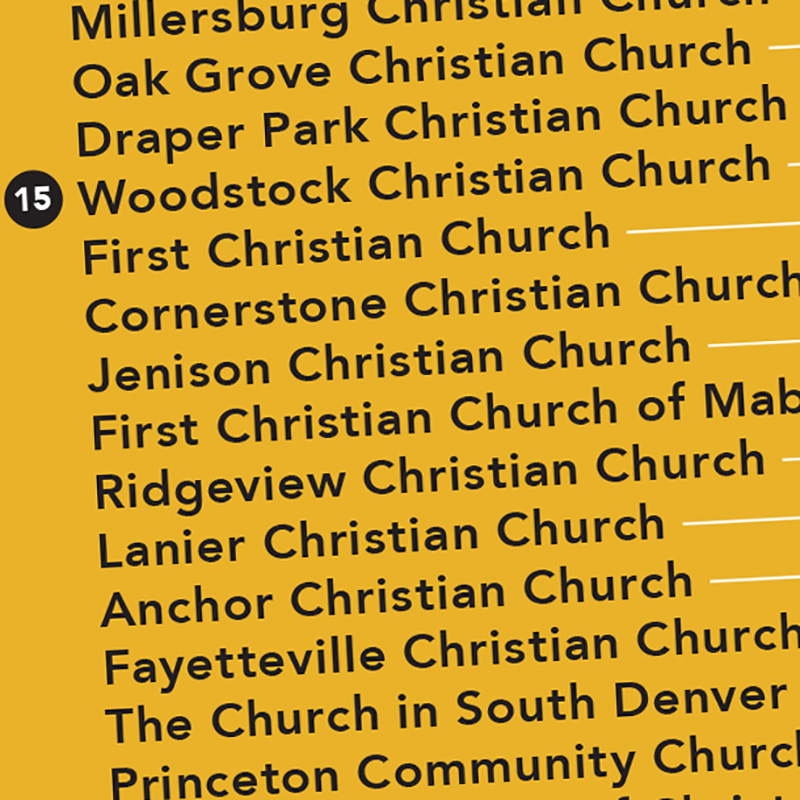
Our annual listing of churches is one of Christian Standard’s most popular features. This year scores of churches participated, including 78 small churches (average weekly worship attendance of 100 to 249 during 2018) and 47 very small churches (attendance of fewer than 100). In May we featured an article and statistics from 55 megachurches (2,000 or more in weekly attendance) and 70 emerging megachurches (1,000 to 1,999). In July we spotlighted 88 large churches (500 to 999 in weekly attendance) and 86 medium churches (250 to 499). Click here to view and download 2018 Charts3, with data from small churches and
June 22, 2019
By Kent Fillinger This is the second installment of a three-part series sharing research findings from our annual church survey. This month, we turn our attention to 88 large churches (average weekly worship attendance of 500 to 999 during 2018) and 86 medium churches (average attendance of 250 to 499). Growth Flip-Flop The medium churches on average grew at almost twice the rate of large churches in 2018 (3.7 percent compared to 1.9 percent, respectively). This was the first-time since 2009 that medium churches we surveyed grew faster than large churches. This flip-flop partially resulted from medium churches having their
June 22, 2019
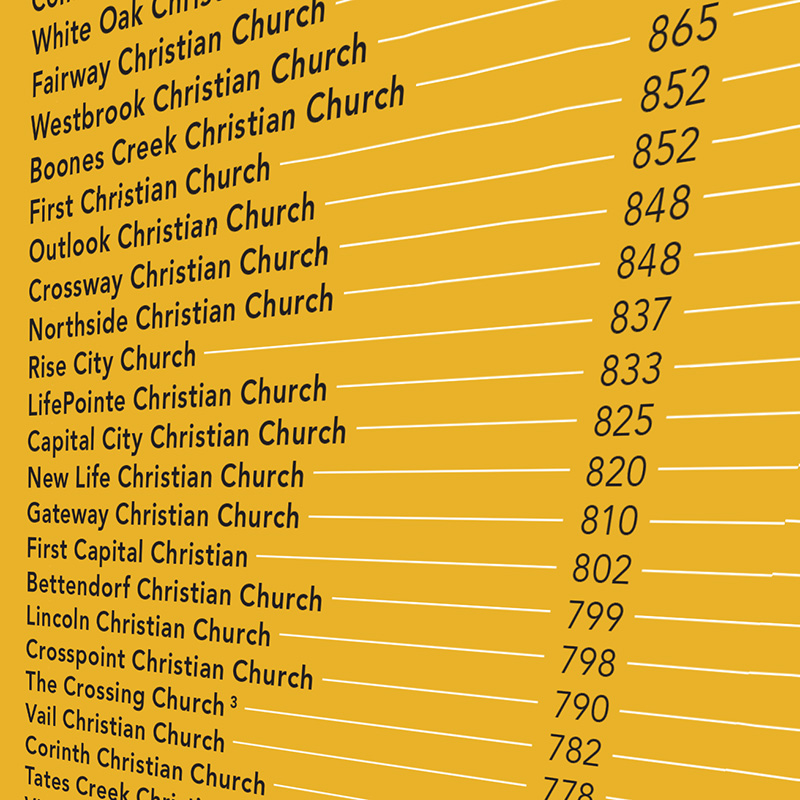
Our annual listing of churches is one of CHRISTIAN STANDARD’s most popular features. This year scores of churches participated, including 88 large churches (those with 500 to 999 in weekly attendance during 2018) and 86 medium churches (250 to 499). In May we featured an article and statistics from 55 megachurches (2,000 or more in weekly attendance) and 70 emerging megachurches (1,000 to 1,999). Come back in October for articles and charts from small (100–249) and very small churches (less than 100). Click here to view and download 2018 Charts2, with data from large churches and medium churches . . .
April 25, 2019
By Kent Fillinger It might seem hard to believe, but the millennial generation is approaching middle age! The oldest millennials will turn 38 this year, which means they were entering adulthood before today’s youngest adults were born. Many researchers and demographers are now shifting their attention from millennials to generation Z to learn more about them. Researchers quibble about when the millennial generation ends and generation Z begins—the years range from 1996 to 2002—but a Pew Research Center article from January indicates people in the two age groupings aren’t all that different. Here’s the article’s headline (so judge for yourself):
April 24, 2019
By Kent E. Fillinger When I started conducting megachurch and emerging megachurch research 15 years ago, there were a total of 255,179 people attending these churches on a given weekend. That number has grown 52 percent to 388,243 in 2018, which is a cause for celebration! For me, this statistical journey has always been about sharing and celebrating how God is at work in churches of all sizes in many different ways. My focus continues to be on helping churches learn from one another and providing context and clear metrics for church leaders to make better decisions based on research

April 7, 2026
John B. Penrose Jr

April 7, 2026
David Faust

March 27, 2026
Rick Cherok