
Hope for the Future
What do Gen Z and Gen Alpha think about faith—and what should churches do next? Luke Proctor explores concerning trends, surprising hope, and three practical choices to help pass the baton to the next generation.
What do Gen Z and Gen Alpha think about faith—and what should churches do next? Luke Proctor explores concerning trends, surprising hope, and three practical choices to help pass the baton to the next generation.
May 2, 2026

Are we seeing a religious “vibe shift” in America? Survey data, Bible-reading trends, and stories from Restoration Movement churches point to new openness—especially among younger adults.
January 1, 2024
HOW A SERMON SERIES ON MENTAL HEALTH BROUGHT HEALING TO A CHURCH A perceived need among church leaders and church members led to a survey on mental health, which led to a dynamic and transformative sermon series. By Clayton Hentzel During the pandemic, I regularly participated in Zoom calls with pastors from across the country. One of those calls was with The Solomon Foundation. Early in the pandemic, Doug Crozier, the CEO of TSF, put counselor Dr. Wes Beavis on retainer. Dr. Beavis briefly shared some mental health tips on each weekly call. He provided everyone with a little help
September 1, 2023
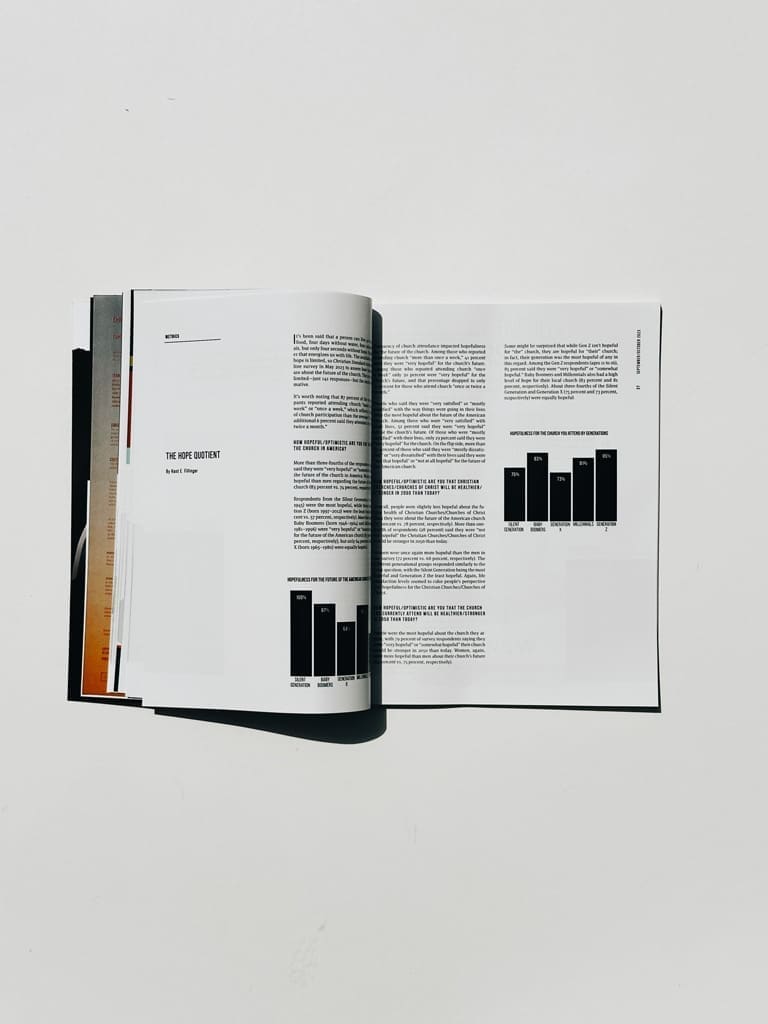
By Kent E. Fillinger It’s been said that a person can live 40 days without food, four days without water, four minutes without air, but only four seconds without hope. Hope is a power that energizes us with life. The available research on hope is limited, so Christian Standard conducted an online survey in May 2023 to assess how hopeful people are about the future of the church. The survey size was limited—just 141 responses—but the results were informative. It’s worth noting that 87 percent of the survey participants reported attending church “more than once a week” or “once a
September 1, 2023
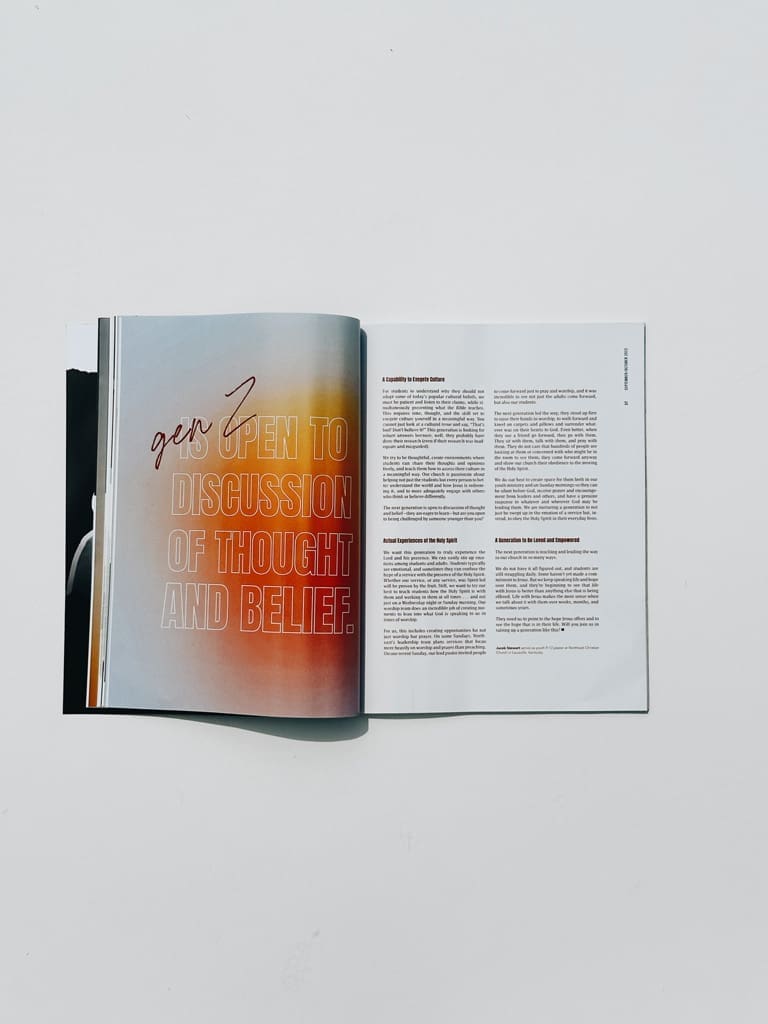
By Jacob Stewart We have seen the data. We have heard the news. We get it. Gen Z is the worst. At least that is what I am accustomed to hearing. Generation Z (comprised of people born from 1997 to 2012) may go down in history as the most analyzed, picked on, studied, and bashed generation in the world . . . right next to Millennials (those born 1981–96). Have you seen the memes? It’s brutal out there. As a youth pastor for 10 years, I have worked closely with Gen Z. I agree with my current high school ministry
February 26, 2023

Hayley Anderson, who grew up at Northeast Christian Church in Louisville and is now a student at Asbury University, was interviewed by Fox News last week and spoke of Generation Z's desperation for God. “I think what’s so special about this [revival],” Hayley said in the interview, “is that it’s a story about how God has met students where they’re at . . ."
November 1, 2022

By Kent E. Fillinger Giving USA 2022: The Annual Report on Philanthropy for 2021 reported charitable giving rose for its fourth consecutive year, reaching its highest level in history, $484.8 billion. Total giving increased 4 percent in current dollars but decreased 0.7 percent in inflation-adjusted dollars. About two-thirds (67 percent) of total giving came from individuals, the fourth straight year individual giving totaled less than 70 percent. The wealthiest 1.4 percent of the country accounted for 86 percent of charitable donations, according to the Philanthropy Roundtable. Giving is highest among those in their 60s and 70s. Charitable giving since World
July 15, 2022

As a young teen, I thought that value would come from being popular among my peers. The popular kids went to beer parties, so I wanted an invitation. . . . The invitation I ultimately received, however, was to join Bible Bowl. It changed my life forever.
July 1, 2022

By Kent E. Fillinger When I was young, whenever a boy and girl played together on the school playground, the other kids typically would tease them by singing “The Kissing Song”: “[Boy’s name] and [girl’s name], sitting in a tree, K-I-S-S-I-N-G! First comes love, then comes marriage, then comes baby in the baby carriage!” The order prescribed in that song is being followed less and less these days. The purpose of this article is to explore recent data on dating, marriage, and parenting to help church leaders better understand current trends to help shape future teaching and ministry possibilities. DATING
July 1, 2022
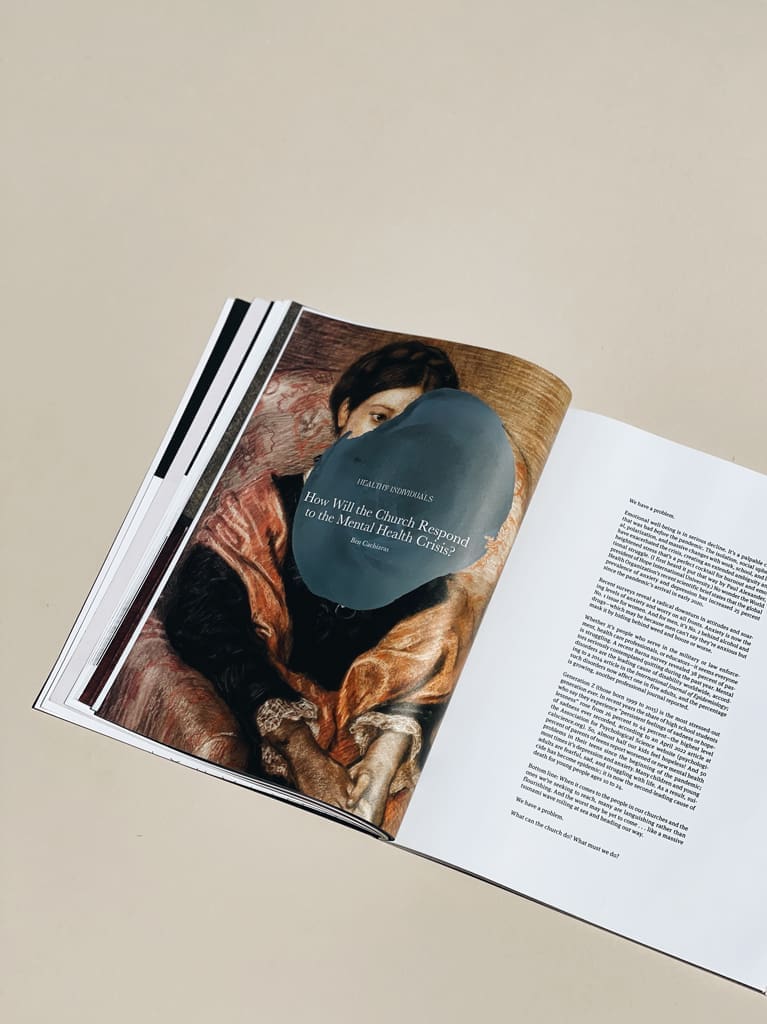
By Ben Cachiaras We have a problem. Emotional well-being is in serious decline. It’s a palpable crisis that was bad before the pandemic. The isolation, social upheaval, polarization, and massive changes with work, school, and life have exacerbated the crisis, creating an extended ambiguity and heightened stress that’s a perfect cocktail for burnout and emotional struggle. (I first heard it put that way by Paul Alexander, president of Hope International University.) No wonder the World Health Organization’s recent scientific brief states that the global prevalence of anxiety and depression has increased 25 percent since the pandemic’s arrival in early 2020.
March 1, 2022

By Megan Rawlings “Tell me about yourself.” There was a long, long pause. “Well,” she finally said, “I’m a 2.” “A 2?” I asked. “Yeah, on the Enneagram. It’s this test that tells you who you are and so much about yourself . . .” This conversation and others like it spurred me on to contemplate the emotional and mental state of young adults in our country. Although I cannot speak for the masses, in my experience, millennials (those born 1981–1998) and Generation Z (born 1999–2015) are longing to find their identity and purpose. There appears to be a chasm
January 1, 2022

What Independent Christian Churches Have to Celebrate . . . and the Challenges Ahead We live in a world of polls describing a hopelessly post-Christian culture in which the church is constantly losing ground. A 2020 Gallup Poll found the number of Americans now affiliated with a church is just 47 percent, a sub-50 percent number for the first time in 80 years. Cary Nieuwhof shared a recent Barna/Stadia Poll that stated 30 percent fewer people in Generation Z (those born 1999 to 2015) attend church than baby boomers (those born 1946 to 1964). Another Barna study informed us that
August 17, 2021

Over the past 30 years, a growing number of Americans are reporting they have fewer friends—and the situation has only gotten worse during the COVID-19 pandemic. What can your church do?

By Tyler McKenzie The Ephesian church was a first-century megachurch that had everything, and then, by all historical accounts, lost everything. Ephesus was the sort of city Paul liked to target: a hub of culture and a place of notoriety. He knew if he could plant the gospel in Ephesian “soil,” it would spread. Ephesus was a major commercial center—three trade highways ran through it—it was a port town, and it was tourist hub. One of the seven wonders of the world, the temple to the goddess Artemis, was located there. Some estimate the city’s population at a quarter-million people—massive
January 29, 2020

By Kent E. Fillinger “OK Boomer” is a new social media catchphrase that is becoming popular with many people younger than 40. In the Washington Post, Holly Scott defined the phrase as “a jab from the young to the old, a collective eye-roll at the out-of-touch judgments baby boomers pass on the tastes, values and lived experiences of millennials and Gen Zers.” Generational divides and derision are nothing new. Ironically, when boomers (those born between 1946 and 1964) were young adults, many said you can’t trust anyone over the age of 30. In my June 2019 Metrics article, I asked,
July 22, 2019

God’s Word, Urbanization, Generational Shifts Compel Us to Plant Urban Churches Now By Nathan “Chivo” Hawkins and Josie Barton People are drawn to cities for many reasons: education, employment, entertainment, economic and social opportunities. People have also been overwhelmed by cities; the exposure to poverty, illness, and other symptoms of brokenness have caused many people to flee urban centers. But whether pulled or repulsed, the Great Commission compels us to minister in cities. Biblical Rationale for Urban Ministry Social justice has become such a buzz phrase that followers of Jesus might dismiss urban ministry as a fad. Yet, we have
June 22, 2019

By TR Robertson David Embree has led Christian Campus House at Missouri State University in Springfield for 41 years. I talked to him about the state of campus ministry, past, present, and future. QUESTION: Why is campus ministry important? ANSWER: As Charles Malik [former president of the United Nations General Assembly] said back in the ’60s, if you want to impact the world, impact campuses. Eighty-five percent of kids from our churches go to non-church-related schools; [it] is going to be one of the most challenging intellectual and spiritual experiences of their lives. We need to be the church on
April 25, 2019
By Kent Fillinger It might seem hard to believe, but the millennial generation is approaching middle age! The oldest millennials will turn 38 this year, which means they were entering adulthood before today’s youngest adults were born. Many researchers and demographers are now shifting their attention from millennials to generation Z to learn more about them. Researchers quibble about when the millennial generation ends and generation Z begins—the years range from 1996 to 2002—but a Pew Research Center article from January indicates people in the two age groupings aren’t all that different. Here’s the article’s headline (so judge for yourself):
March 29, 2017
By Jim Tune I keep coming across articles about millennials. Most of them are written by millennials (those aged 20″“35) about why they”re done with church. A recent article advised churches to start listening to millennials, to ditch vision and mission statements, to stop preaching at people, to disclose on the church”s website how every dollar is spent, and more. “Decide if millennials actually matter to you and let us know,” it concluded. “In the meantime, we”ll be over here in our sweatpants listening to podcasts.” Articles like these make some valid points. Many millennials aren”t part of a church.
Sponsored

Sponsored

Sponsored


Learn how to turn the sermons you’re already preaching into searchable, shareable content that helps people discover and connect with your local church. Access Be Seen, Be Heard on demand with Wes Woodell and Trey Sheneman. A two hour course for preachers, church media and website teams, and anyone who wants to help their church reach more people online.
October 6, 2026
Rick Cherok

October 6, 2026
Landon Shuman

October 6, 2026
Doug Redford